Venice Guide and Boat
Venice Hidden Gems: 25 Places, Experiences and Masterpieces That Most Visitors Never Find
The tourist Venice and the real Venice are the same city separated by about 500 metres. The tourist route runs from the train station to St Mark’s Square via the Strada Nova and the Rialto — a corridor of extraordinary monuments, gift shops and tourist restaurants through which millions of people pass each year without deviating significantly in either direction. The real Venice — the Venice of quiet campi and neighbourhood bacari, of extraordinary art in churches nobody visits, of residential canals where the only sounds are footsteps and water — is immediately adjacent. It requires only a willingness to turn off the main route and see what happens.
This guide is about what happens. It is a curated list of 25 places, experiences and works of art in Venice that most visitors never find — not because they are inaccessible or remote, but because they are not on the standard itinerary, not mentioned in the most widely read guidebooks, and not visible from the main tourist corridor. Some are five minutes from St Mark’s Square. Some require a ten-minute walk from the nearest vaporetto stop. All are worth the minor detour.
The guide is organised by category: hidden churches (which hold some of the finest art in Venice without the crowds), overlooked campi (the squares that function as the real social spaces of the city), secret views (the vantage points that most visitors walk past), forgotten museums, underrated islands and the food and drink experiences that the tourist infrastructure has not yet absorbed.
| The most important thing to know about Venice’s hidden gems is that they are not hidden in any meaningful sense — they are simply not on the route that most visitors follow. Any reasonably curious traveller who is willing to walk for ten minutes in a direction other than St Mark’s will find them. The city rewards deviation with extraordinary consistency. |
Hidden Churches: The Greatest Art Nobody Sees
Venice has approximately a hundred churches open to regular visitors. Most people see three or four. The churches below hold art of the first order — paintings, sculptures and architectural spaces that would be major attractions in any other city — and receive a fraction of the visitors that the Accademia or the Doge’s Palace see in a morning.
| San Zaccaria Castello — 5 min from St Mark’s Church / masterpiece painting Giovanni Bellini’s 1505 altarpiece, hanging above a side chapel in the left nave, is one of the finest paintings in Venice — and one of the most undervisited. The sacra conversazione composition achieves a quality of light and spatial harmony that no reproduction adequately conveys. Free entry. Almost always quiet. | Santa Maria dei Miracoli Cannaregio — near Campo Santi Giovanni e Paolo Architecture / Pietro Lombardo A tiny Renaissance church entirely clad in marble, designed by Pietro Lombardo in the 1480s. One of the most elegant interiors in Venice — small enough that the proportions are immediately legible, richly detailed, and completely free of the art-historical weight that makes larger churches exhausting. Almost never crowded. |
| San Giovanni Elemosinario San Polo — inside the Rialto market Church / Titian altarpiece A church embedded in the Rialto market complex that most visitors walk past without realising it is a church. Contains a Titian altarpiece of considerable quality — the saint distributing alms, painted in the 1540s — and an extraordinary coffered ceiling. Entry with the Chorus pass. | Santa Maria Formosa Castello — between St Mark’s and Santi Giovanni e Paolo Church / campo / Palma Vecchio One of the most important medieval churches in Venice, rebuilt by Mauro Codussi in the late 15th century. Contains Palma il Vecchio’s extraordinary polyptych of St Barbara — a monumental composition of unusual quality. The campo outside is one of the finest in Venice and is used as a market square on weekday mornings. |
| Madonna dell’Orto Cannaregio — northern edge Church / Tintoretto’s parish church Tintoretto’s parish church, where he is buried — and which he decorated with some of his finest and most personal works. The Last Judgement and the Making of the Golden Calf on either side of the chancel arch are among the most powerful large-format paintings he ever made. A 10-minute walk from the ghetto; almost always quiet. | San Sebastiano Dorsoduro — western edge Church / Veronese’s private project Veronese’s own parish church, which he decorated over 20 years with a series of paintings that constitute his most sustained and personal decorative cycle. The church is his workshop made visible — less formal than the Doge’s Palace commissions, more exploratory and more revealing of his actual interests. He is buried beneath the organ loft. |
| San Pietro di Castello Castello — eastern tip of Venice Former cathedral / remote location The former cathedral of Venice — the bishop’s seat was here, not at St Mark’s, until 1807. Located at the far eastern end of the Castello sestiere, in a campo that feels entirely removed from tourist Venice. The building is architecturally important (Palladio designed the facade) and is now almost entirely without visitors. | San Polo church San Polo — Campo San Polo Church / Tiepolo via crucis A 9th-century church on the second-largest campo in Venice, containing Giandomenico Tiepolo’s Via Crucis (Stations of the Cross) — a cycle of 14 paintings of remarkable psychological intensity, made when the artist was in his twenties. The campo outside is worth visiting at any hour. |
| The Chorus Pass (available at participating churches) gives entry to 15 of Venice’s finest churches for approximately €15 — the single best-value arts ticket in the city. If you plan to visit more than three or four churches, the pass pays for itself immediately and opens up the entire church circuit. |
Hidden Campi: Venice’s Real Social Spaces
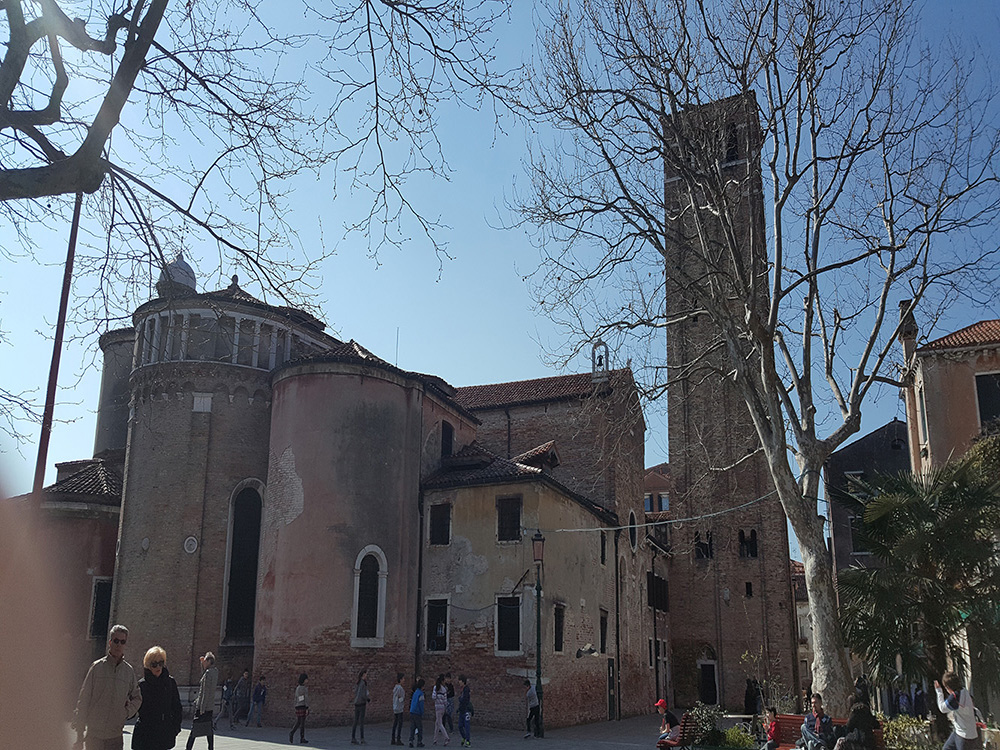
Venice’s campi — the open squares that function as the city’s streets, markets, playgrounds and social spaces — are the truest expression of daily Venetian life. The famous ones (Piazza San Marco, Campo Santa Margherita, Campo Santi Giovanni e Paolo) are remarkable. The less-visited ones, below, are where the city lives.
| Campo San Giacomo dell’Orio Santa Croce — near Piazzale Roma Neighbourhood campo / local life One of the finest campi in Venice and one of the least visited — a large, irregular square with a magnificent Romanesque-Gothic church, old trees, benches and an atmosphere of genuine neighbourhood life. The bacari around the campo are excellent. An ideal base for a quiet afternoon in the Santa Croce sestiere. | Campo dei Mori Cannaregio — near Madonna dell’Orto Unusual campo / historic figures A small, strangely shaped campo with three stone figures of Moorish merchants embedded in the walls of the surrounding buildings — their turbaned heads protruding at street level. Tintoretto’s house is on the corner (a plaque marks it). One of the most visually peculiar and least visited spaces in Venice. |
| Campo San Francesco della Vigna Castello — eastern Large campo / Palladio facade A vast, empty campo fronted by the finest Palladian church facade in Venice — Palladio’s design for the church of San Francesco della Vigna, begun in 1562. The campo is almost always deserted. The church contains important works by Veronese, Giovanni Bellini and Paolo Veneziano. | Campo del Ghetto Nuovo Cannaregio — Jewish Ghetto Historic campo / layers of meaning The central campo of the world’s oldest ghetto — a large, melancholy square surrounded by the tall buildings that were constructed when the Ghetto’s footprint was fixed and the population forced to build upward. The Holocaust memorial on the north wall is one of the most affecting public sculptures in Venice. |
| Campo Santa Maria Nova Cannaregio / Castello border Secret campo / almost no tourists A tiny, irregular campo between the main tourist routes with a wellhead, an old church and an atmosphere of complete quiet even in high season. One of those spaces that makes Venice feel entirely different from the tourist city a hundred metres away. | Rio Terà dei Pensieri Dorsoduro — away from Zattere Canal-turned-street / quiet neighbourhood Not a campo but a filled-in canal (rio terà) in the western Dorsoduro — a long, quiet street with the slightly sunken pavement characteristic of former canals, lined with residential buildings and neighbourhood shops. The most un-touristed part of the Dorsoduro, five minutes from the Accademia. |
Secret Views: Vantage Points That Most Visitors Walk Past
Venice is a city of views — but many of the finest are invisible from the main tourist routes. These are the vantage points that reward a short detour.
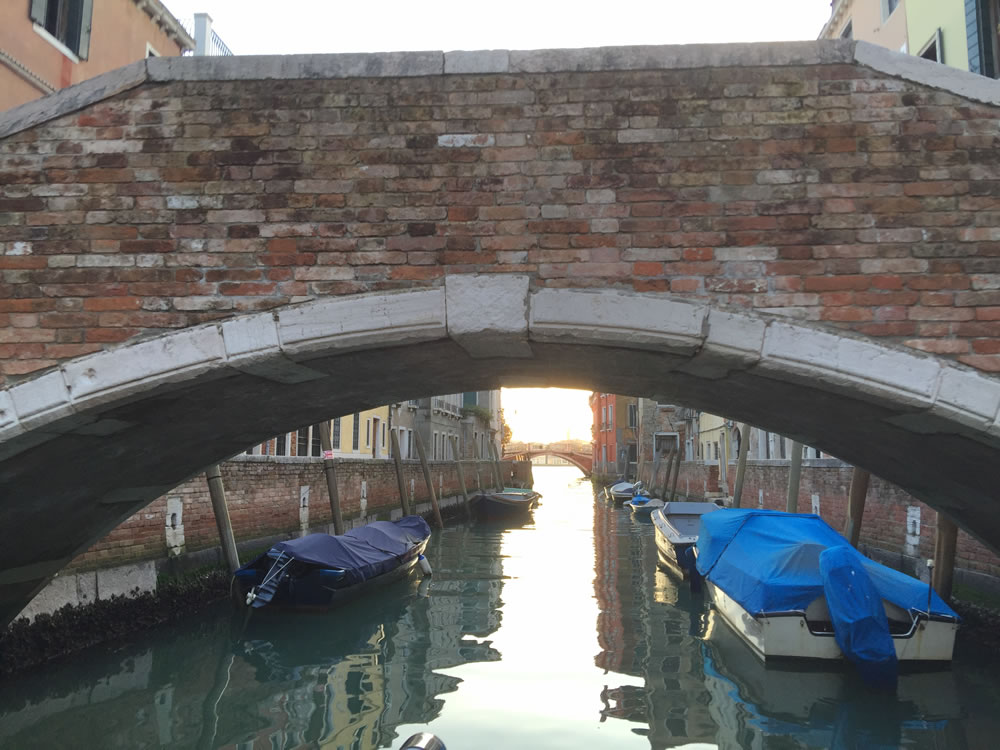
| San Giorgio Maggiore campanile Island of San Giorgio Maggiore Panoramic view / better than the Campanile The campanile of San Giorgio Maggiore, reached by lift, offers what is arguably the finest panoramic view in Venice — looking north across the Bacino di San Marco to the entire historic centre, with the Campanile of St Mark’s in the foreground. The difference from the famous Campanile view: you see the entire Piazza San Marco from across the water, as it was designed to be seen. | Ponte dei Pugni at sunset Dorsoduro — near Campo Santa Margherita Canal view / evening light A bridge over a residential canal in the Dorsoduro, with a view south that catches the evening light in a way that no postcard adequately captures. The water turns gold, the boats are tied up for the evening, and the buildings on either side of the canal are completely unmarked by tourism. |
| Punta della Dogana terrace Dorsoduro — tip of the peninsula Grand Canal / Giudecca panorama The tip of the Dorsoduro peninsula, where the Grand Canal meets the Bacino di San Marco — one of the finest views in Venice. The dome of Santa Maria della Salute directly behind you, the open water ahead, and the island of San Giorgio Maggiore to the left. Best at sunset, when the light comes from the west. | Ponte Longo, Giudecca Island of Giudecca Venice skyline / rarely seen angle The long bridge on the southern side of the Giudecca island, looking north across the Giudecca canal towards the historic centre. The view of Venice from the Giudecca — the entire south-facing skyline — is the perspective from which painters including Canaletto most often depicted the city, and it is almost entirely unvisited. |
| Fondamenta Nuove on a clear day Cannaregio — northern waterfront Lagoon / Dolomites view The long northern waterfront of the Cannaregio sestiere, looking across the open lagoon towards the islands and, on clear days in winter, the snow-covered Dolomites in the distance. The perspective is entirely unlike any other view in Venice — open, flat, with the city behind you and the mountains visible at the horizon. | Rio di San Barnaba from the water Dorsoduro — via private boat or gondola Inner canal / film location One of the most photographed canals in Venice — and yet somehow undervisited on foot. The Rio di San Barnaba, with its floating vegetable barge and its Romanesque bridge, has appeared in numerous films set in Venice. From the water, the perspective is entirely different from the bridge view. |
| The finest views in Venice are rarely the obvious ones. The tourist infrastructure naturally concentrates around the easily accessible and the most famous — the Campanile, the Rialto Bridge, the waterfront along St Mark’s Square. The views that Venice guards more carefully — from San Giorgio, from the Giudecca, from the northern fundamenta — require a five-minute boat ride or a ten-minute walk and deliver something quite different. |
Overlooked Museums: The Collections Nobody Queues For
| Ca’ d’Oro (Franchetti Gallery) Cannaregio — Grand Canal Palace museum / Renaissance collection The most beautiful Gothic palace facade on the Grand Canal houses an intimate museum of Renaissance bronzes, tapestries and paintings — including Mantegna’s Saint Sebastian, one of the most powerful images of martyrdom in Italian art. Almost never crowded. Entry with the Museum Pass. | Museo CorrerSan Marco — south side of Piazza Venetian history / underrated The comprehensive museum of Venetian history, occupying the entire south side of St Mark’s Square. Maps, documents, weapons, portraits, coins and a remarkable collection of historical objects — including the extraordinary platform shoes (pianelle) worn by Venetian noblewomen in the 16th century. Included with the Doge’s Palace ticket. |
| Scuola Grande di San Giovanni Evangelista San Polo — near the Frari Confraternity building / Mauro Codussi staircase One of the great confraternity buildings of Venice, containing Mauro Codussi’s extraordinary double-ramped staircase — one of the finest pieces of early Renaissance architecture in the city. The collection includes important paintings and the building itself is spectacular. Open limited hours; check before visiting. | Museo Fortuny San Marco — Campo San Beneto Artist’s palazzo / Mariano Fortuny The former palazzo and studio of Mariano Fortuny (1871–1949) — the Spanish-born polymath who designed the pleated Delphos gown, invented theatrical lighting systems and created extraordinary printed velvets. The museum is as much about the palazzo itself — untouched since his death — as about the collection. One of the most atmospheric interiors in Venice. |
| Museo del Merletto, Burano Burano island Lace museum / craft heritage The Lace Museum on Burano holds the finest collection of historical Venetian lace in existence — centuries of the most exquisite needlelace ever made, produced for the courts of Europe and now displayed with care and context. The demonstrations by surviving practitioners are among the most moving encounters with a dying craft tradition available anywhere in Italy. | Ca’ Pesaro (International Gallery of Modern Art) Santa Croce — Grand Canal Modern art / undervisited A Grand Canal palazzo holding Venice’s collection of modern and international art — including important works by Klimt, Chagall, Bonnard and Henry Moore. Less well-known than the Guggenheim but holding comparable quality in a magnificent Baroque palazzo. Usually very quiet even when the Guggenheim is crowded. |
The Sestiere Guide: What Most Visitors Miss in Each District
| Sestiere | What Most Visitors Miss |
| San Marco | The Museo Correr (south side of the Piazza, included with Doge’s Palace ticket — almost nobody goes); the church of San Moisè (Baroque facade excess at its most extraordinary); the Bacino Orseolo (the gondola stand just behind St Mark’s — a completely different view of the city at gondola level); the Scala Contarini del Bovolo (a spiral external staircase of astonishing elegance, in a courtyard accessible through an easy-to-miss entrance on a side street) |
| Dorsoduro | The church of San Sebastiano (Veronese’s most personal decorative project, in the far western corner of the sestiere); the Squero di San Trovaso (the last easily visible working gondola boatyard, seen from the Zattere); the Fondamenta Zattere ai Gesuati at dawn (the finest morning walk in Venice, before any other tourists appear); the Rio Terà dei Pensieri (the most un-touristed street in the Dorsoduro) |
| San Polo | The Scuola Grande di San Giovanni Evangelista (the great confraternity building with Codussi’s extraordinary staircase); the church of San Giovanni Elemosinario (the Titian altarpiece inside the Rialto market); Campo San Polo itself (the second-largest campo in Venice, which most tourists pass through without noticing it); the sotoporteghi (covered passageways) of the interior network |
| Santa Croce | Campo San Giacomo dell’Orio (the finest neighbourhood campo in Venice); Ca’ Pesaro (the undervisited Grand Canal palazzo museum); the Fondamenta del Gaffaro (a quiet canal street leading north from Piazzale Roma that is immediately and completely removed from the tourist city); the church of San Stae (a Baroque facade on the Grand Canal with important 18th-century paintings inside) |
| Cannaregio | Madonna dell’Orto (Tintoretto’s parish church, 10 minutes north of the Rialto area); the church of Santa Maria dei Miracoli (Pietro Lombardo’s marble masterpiece); the Fondamenta della Misericordia for aperitivo (the finest bacaro strip in Venice, frequented predominantly by locals and students); the Fondamenta Nuove (the northern waterfront, with its extraordinary view across the open lagoon) |
| Castello | The island of San Pietro di Castello (the former cathedral, in a campo at the far eastern end of the sestiere that feels like a different city); Campo Santa Maria Formosa (a fine campo with morning market and excellent bacari); the Arsenale walls and gateway (the great naval complex of the Republic, with the exterior visible from the quay and the interior occasionally open for events); the Via Garibaldi (the widest street in Venice, and one of the most authentically residential) |
Hidden Food and Drink: Beyond the Tourist Restaurant
The Bacari Nobody Tells You About
Venice’s bacari (traditional wine bars) are the finest food experience in the city — but the most famous ones near the Rialto are well known. The ones below are equally good and significantly less crowded.
- Osteria al Squero (Dorsoduro, near the Squero di San Trovaso) — a tiny bacaro facing the gondola boatyard across the canal. Excellent cicchetti, excellent natural wines, constantly full of locals at aperitivo time.
- Osteria Boccadoro (Cannaregio, near Campo Santi Giovanni e Paolo) — a neighbourhood institution with outstanding cicchetti and a daily-changing menu that reflects the morning’s market produce. Barely known outside the Cannaregio sestiere.
- El Sbarlefo (multiple locations, best in Cannaregio) — a small chain of bacari with exceptional baccalà mantecato and a wine list significantly above average for the price.
- Osteria dalla Vedova (Cannaregio, near Ca’ d’Oro) — one of the oldest osterie in Venice, still operating in much the same way it has for over a century. The polpette (meatballs) are considered by many Venetians to be the finest in the city.
- Cantinone già Schiavi (Dorsoduro, near the Accademia) — a beloved neighbourhood wine bar with one of the most comprehensive selections of Veneto wines by the glass in Venice, and cicchetti of consistent quality.

The Trattoria Hidden Behind the Campo
The finest neighbourhood restaurants in Venice are not near St Mark’s Square or the Rialto. They are in the quieter parts of Cannaregio, in the western Dorsoduro and in the eastern reaches of Castello — places with handwritten menus, no English-language signs outside and a clientele that is predominantly local. Finding them requires either local knowledge or a willingness to walk until you find a restaurant that looks right and go in.
The indicators of a genuinely local Venetian restaurant: the menu changes daily (or at least seasonally); the wine list is predominantly Veneto, with specific producers named; the clientele at lunch includes people in work clothes; the menu has no photographs; the fish is described as ‘fresco dell’Adriatico’ with the specific day’s catch listed; and the prices are lower than the equivalent quality near the major monuments.
The Best Gelato You’re Not Eating
Most gelato near St Mark’s Square is industrial — made from premixed pastes, served from containers kept at a temperature that allows it to be piled into dramatic peaks, and available in every flavour simultaneously regardless of season. The finest gelato in Venice is made in small quantities, from seasonal ingredients, and is usually not available in flavours that have no business existing in northern Italy.
- Gelateria Nico (Dorsoduro, Zattere) — famous among Venetians for the gianduiotto, a brick of chocolate and hazelnut gelato eaten from a small tray. The Zattere terrace is one of the finest places to sit in Venice.
- Gelateria Il Doge (Santa Croce) — consistently rated among the finest artisanal gelaterias in Venice, with a short and seasonal menu.
- Alaska Gelateria (Santa Croce, near the Piazzale Roma) — entirely natural ingredients, wild and seasonal flavours (asparagus, artichoke, wine grape), completely unknown to tourists.
| The rule for gelato in Venice — as everywhere in Italy — is simple: if the gelato is piled high in the display case, it is industrial. Real gelato is served from flat metal containers stored below the counter, in small quantities, in the flavours that are actually seasonal. If you can see it from outside the shop, it is probably not the real thing. |
The Hidden Venice Walk: A Two-Hour Route Off the Tourist Map
This route starts at the Accademia Bridge and moves through the least-visited parts of the Dorsoduro and Cannaregio — covering four hidden churches, two overlooked campi, one secret view and two excellent bacari stops, all within approximately two hours of walking.
| When to Go | Where to Start | The Key Insight |
| Morning (9–11am) | Start: Accademia Bridge | The Dorsoduro is quietest before 10am; the churches open early; the light on the canals is extraordinary in the morning |
| Morning (9–11am) | San Sebastiano church | Veronese’s most personal decorative project is 15 minutes from the Accademia; almost nobody goes this far west |
| Morning (9–11am) | Squero di San Trovaso | The working gondola boatyard is visible from the opposite bank of the Rio di San Trovaso — five minutes from San Sebastiano |
| Late morning | Campo San Giacomo dell’Orio | The finest neighbourhood campo in Venice is a 20-minute walk from the Accademia; the bacari open at 10am |
| Late morning | Santa Maria dei Miracoli | Pietro Lombardo’s marble church is a 15-minute walk east through the Cannaregio; the interior is one of the most perfectly proportioned in Venice |
| Lunch (12–1pm) | Fondamenta della Misericordia | The finest bacaro strip in Venice is five minutes north of the Miracoli; cicchetti and Soave at the bar |
| Afternoon | Madonna dell’Orto | Tintoretto’s parish church is a 10-minute walk north; the Last Judgement and the Golden Calf are among his finest works |
| Afternoon | Campo dei Mori | The campo with the three Moorish figures embedded in the walls is 2 minutes from Madonna dell’Orto; Tintoretto’s house is on the corner |
How Venice Guide and Boat Reveals the Hidden City
The hidden Venice described in this guide is not inaccessible — it simply requires knowledge of where to look and the willingness to depart from the main tourist route. Venice Guide and Boat’s guided experiences are designed precisely around this principle: the conviction that the Venice most worth experiencing is not the Venice of the famous monuments alone, but the Venice that surrounds them — the churches, campi, viewpoints, bacari and human stories that constitute the real character of one of the world’s most extraordinary cities.
Tours that go beyond the standard itinerary
- Another Venice — a tour specifically designed for visitors who have already seen the major monuments and want to explore the quieter, less-visited dimensions of the historic centre. Covers at least three of the hidden churches above, with expert commentary connecting the works to the history of the surrounding neighbourhood.
- Venice Intangible Heritage — an exploration of the living cultural traditions and artisan workshops hidden within the city’s quieter streets, connecting visitors directly with the people who maintain the crafts that define Venetian identity.
- Venice Secret Gardens — access to the walled private gardens of the historic centre that are entirely invisible from the street and that reveal a completely unexpected dimension of the city.
- Business and Faith in Rialto — an early morning exploration of the Rialto Market and the surrounding streets and churches, combining the most authentic food experience in Venice with the hidden architectural and historical layers of the city’s commercial heart.
- Foreigners in Venice — an exploration of the traces left by the foreign communities who shaped Venetian history, visiting the spaces of the Greek, Armenian, Jewish, Turkish and Flemish communities whose presence defined the cosmopolitan character of the Serenissima.
- Safeguarding Venice — a tour that explores the physical, social and ecological challenges facing the city, including the parts of Venice that are changing most rapidly and the initiatives underway to preserve what makes it irreplaceable.
| Venice Guide and Boat’s specialist tours are all private — your group, your guide, your pace. Each one is led by a qualified local guide with deep knowledge of the specific subject, and each one takes you into a Venice that the standard itinerary does not reach. Contact us to discuss which tour best fits your interests and your visit. |
Frequently Asked Questions
What are the most underrated sights in Venice?
The church of San Zaccaria (Bellini’s greatest altarpiece, five minutes from St Mark’s), the church of Santa Maria dei Miracoli (Pietro Lombardo’s marble masterpiece in Cannaregio), the church of Madonna dell’Orto (Tintoretto’s parish church with his finest large-scale paintings), Ca’ Pesaro (the undervisited Grand Canal museum of modern art), and Campo San Giacomo dell’Orio (the finest neighbourhood campo in Venice, almost always without tourists). All are accessible without advance booking, most are free or low cost, and all are within easy walking distance of the main tourist areas.
Where do locals go in Venice?
Campo Santa Margherita in the Dorsoduro is the most genuinely mixed space in the city — students, residents, visitors and local tradespeople all use it throughout the day. The Fondamenta della Misericordia and the Fondamenta degli Ormesini in Cannaregio are where younger Venetians gather for aperitivo. The Rialto Market in the early morning is where chefs and residents buy their food. Via Garibaldi in Castello is the most authentically residential commercial street in Venice. The bacaro at the counter (standing, not seated) in any of the places listed above is where locals eat lunch.
How do I get off the tourist trail in Venice?
The single most effective technique is to turn left or right whenever you are about to follow a sign towards San Marco or the Rialto. The secondary canal network of Venice — away from the main tourist routes — is reached within five minutes of leaving either thoroughfare, and it is entirely different in character. A willingness to get lost (knowing that Venice is small enough that you cannot be lost for long) is the most reliable method for finding the city that most guidebooks describe but most visitors never actually reach.
Are there any truly unknown places in Venice?
The places listed in this guide are not unknown — they are simply undervisited. Venice has been a major tourist destination for three centuries, and genuinely unknown places do not exist in any practical sense. What does exist are places that are off the standard itinerary, require a short walk or a brief boat trip to reach, and reward the visitor with a quality of experience that the famous monuments, despite their extraordinary quality, do not always provide: the sense of being in a living city, not a museum exhibit.
The Venice That Waits for Those Who Look
The hidden Venice is not a secret. It has been there, adjacent to the tourist route, for as long as the tourist route has existed. Every Venetian who has watched the millions of visitors file from the station to the Piazza and back again knows that the city they live in — the city of neighbourhood bacari and quiet campi and extraordinary art in undervisited churches — is a few hundred metres from where the crowds are, and is entirely accessible to anyone who wants it.
The barriers are not physical. They are psychological: the pull of the famous, the reassurance of the route that everyone takes, the sense that if something important existed beyond St Mark’s Square someone would have told you about it. This guide has told you about it. The rest depends on a willingness to turn off the map, walk in a direction that doesn’t lead to a queue, and see what Venice reveals to those who go looking.
It reveals, consistently, something that surprises even experienced travellers: that the city off the tourist route is not a diminished version of the famous one, but an extension of it — and that the experience of moving between the two, in a single afternoon, is one of the most pleasurable things that Venice has to offer.
| Ready to explore the Venice most visitors never find? Venice Guide and Boat’s specialist tours — Another Venice, Venice Intangible Heritage, Venice Secret Gardens, Business and Faith in Rialto, Foreigners in Venice — are designed to take you there. All private, all expert-led, all off the standard itinerary. |

