
Venice Guide and Boat
Venice Walking Tour: Three Routes, Every Kind of Visitor, One Extraordinary City
Venice is, in its most fundamental character, a walking city. There are no cars, no bicycles, no motorbikes, no wheeled transport of any kind in the historic centre. Everything and everyone moves on foot across the 400 bridges that connect the city’s 118 islands, through the network of calli (streets), sotoporteghi (covered passageways), campielli (small squares) and campi (larger squares) that constitutes the urban fabric of one of the most complex and disorienting cities on earth.
Walking Venice is simultaneously the most rewarding and the most challenging way to experience the city. Rewarding because the pedestrian scale of the calli — some barely a metre wide, others opening unexpectedly into large campi — creates an intimacy of encounter that no other form of movement can produce: you are always close to the buildings, always within arm’s reach of a canal, always potentially turning a corner onto something completely unexpected. Challenging because Venice’s street network is genuinely non-Euclidean in its logic: addresses are numbered by sestiere rather than street, the same bridge can be approached from four different directions, and the official yellow directional signs (which point towards San Marco, the Rialto, the Accademia and the train station) can lead you further from your destination before they lead you towards it.
This guide offers three complete walking routes for Venice — one for first-time visitors covering the essential historic centre, one for those who want to explore beyond the tourist route, and one dedicated to the Dorsoduro and Cannaregio, the two most rewarding sestieri for extended walking. Each route is designed to work as a self-guided walk and as the basis for a private guided tour. The guide also explains what a private walking guide adds to each route, and why the combination of expert knowledge and independent exploration produces the finest possible walking experience in Venice.
Understanding Venice’s Street Layout: A Navigation Primer
Before walking Venice, it helps to understand how its streets work — because they work differently from any other city, and knowing the vocabulary prevents a significant amount of disorientation.
| Venetian Term | Translation | What It Means in Practice |
| Calle | Street (from Latin callis, path) | The standard street type — narrow, often winding, sometimes barely shoulder-width. Most calli are unnamed on maps; Venetians navigate by landmark, not address. |
| Rio | Canal | The primary water routes of the city. Rii (plural) are crossed by bridges (ponti); unlike calli, they always have names. |
| Rio Terà | Filled-in canal | A former canal that was filled in to create a street — identifiable by their slightly sunken profile and the characteristic width of a canal. |
| Fondamenta | Canal-side walkway | A street running alongside a canal, offering the characteristic Venetian view of buildings reflected in still water. Among the finest walking surfaces in the city. |
| Salizada | Paved street | Historically, the first calli to be paved (from lastrico, stone paving) — often wider than standard calli, slightly more important in the local hierarchy. |
| Sottoportego / Sotoportego | Covered passageway | An archway or tunnel passing beneath a building that connects two streets or calli. Often the key to navigating through the interior of a block. |
| Campo | Square (literally ‘field’) | The open social spaces of Venice — once used for markets, games and gatherings. Ranging from tiny campielli to the vast Piazza San Marco (the only campo officially called piazza). |
| Corte | Courtyard | A dead-end court, often with a wellhead (vera da pozzo) at the centre — the private social space of a building cluster. Sometimes accessible to the public, sometimes not. |
| Ramo | Branch (of a calle) | A short dead-end spur off a main calle — a frequent source of navigational dead-ends for visitors following a map. |
| Piscina | Former swimming pool / pool | A rare topographical feature — a former moat or depression that has been partially or fully filled in, leaving a depression in the urban fabric. |
| The single most useful navigation insight for Venice: when you encounter a yellow directional sign pointing towards San Marco, the Rialto, the Accademia or the Ferrovia (train station), it is pointing you towards a route that passes through many landmarks — not the shortest or most direct route. For efficient navigation, use a good map or GPS app; for the most interesting navigation, ignore the signs entirely and follow your instincts. |
Route One: The Essential Venice Walk
This route covers the major monuments and the most important public spaces of the historic centre, designed for first-time visitors who want to see the essential Venice in a single half-day walk. Distance: approximately 3.5 kilometres. Duration: 2.5–3 hours walking, 5–6 hours including monument visits. Best time: morning start, departing by 8:30am.
| Start: Santa Lucia Station | The finest arrival in Italian travel — step out of the station and the Grand Canal is immediately in front of you. Take a moment. The Scalzi Bridge (Ponte degli Scalzi) to your right gives you your first Grand Canal view. |
| Stop 1: Strada Nova | Walk east along the main pedestrian route through Cannaregio — not the most interesting street in Venice, but useful for orientation. Turn south when you reach Campo Santi Apostoli. |
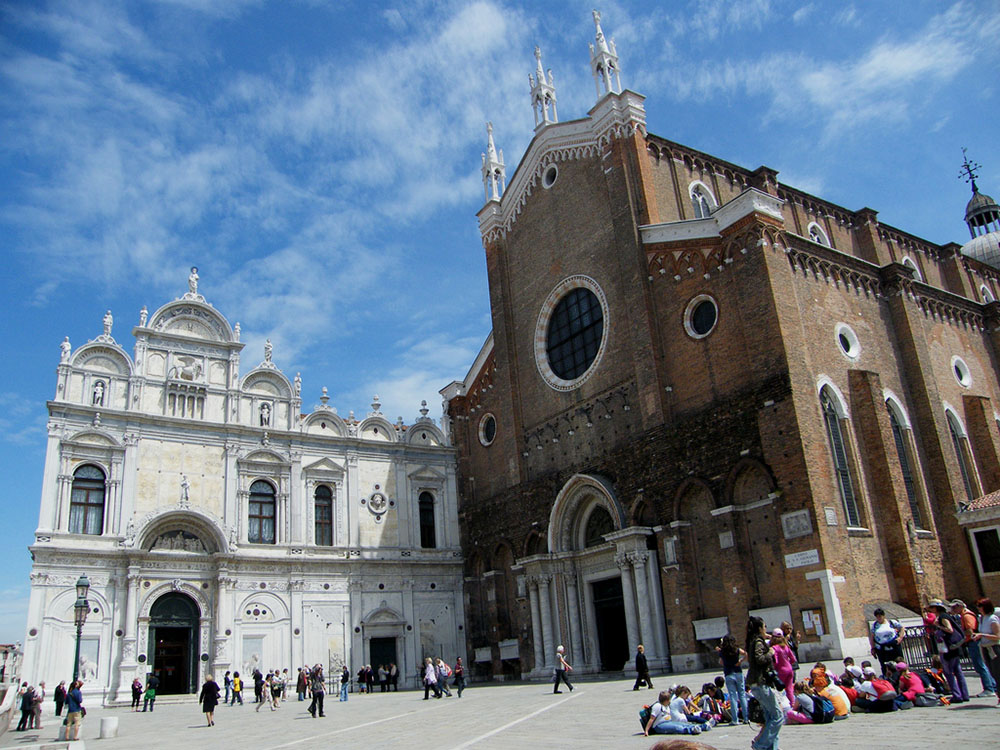
| Stop 2: Campo Santi Giovanni e Paolo | Venice’s greatest Gothic church square — the church of Santi Giovanni e Paolo (San Zanipolo) flanks one side; Verrocchio’s equestrian statue of Bartolomeo Colleoni stands in the campo; the Scuola Grande di San Marco faces the church entrance. Allow 30–40 minutes inside the church. |
| Stop 3: Santa Maria dei Miracoli | Two minutes east — Pietro Lombardo’s marble church, one of the most elegant Renaissance interiors in Venice. Allow 15–20 minutes. |
| Stop 4: Rialto Bridge | Walk west and south along the signs for Rialto. Cross the bridge; pause at the top for the Grand Canal view. Walk into the San Polo side for the market (Tuesday–Saturday, morning only). |
| Stop 5: Frari church | Walk southwest through the San Polo sestiere — allow 20 minutes of walking. The Frari holds Titian’s Assumption and Bellini’s sacra conversazione. Allow 30–40 minutes. |
| Stop 6: Scuola Grande di San Rocco | Immediately adjacent to the Frari. Tintoretto’s lifetime decorative cycle. Allow 30 minutes. |
| Stop 7: St Mark’s Square approach | Walk east towards San Marco via the Calle dei Fabbri — one of the more atmospheric approaches to the Piazza, emerging near the Torre dell’Orologio (Clock Tower). |
| Stop 8: St Mark’s Basilica & Doge’s Palace | The culmination of the route. Both require advance booking in high season. Allow 60–90 minutes for the Basilica and 90 minutes for the Palace; visiting both in the same afternoon is possible with advance tickets. |
| End: Riva degli Schiavoni | Exit the Doge’s Palace onto the waterfront promenade. Walk east as far as the church of San Zaccaria (Bellini altarpiece — free, rarely crowded). Return along the waterfront or via vaporetto. |
| This route works best with a private guided walking tour for the first section (Santi Giovanni e Paolo, Miracoli, Rialto) and skip-the-line guided entry for the Frari, the Basilica and the Doge’s Palace. The walking between monuments is genuinely enjoyable self-guided; the monuments themselves are transformed by expert interpretation. |
Route Two: The Other Venice Walk
This route leaves the tourist corridor and explores the quieter, more residential dimensions of the city — the Dorsoduro away from the Zattere and Accademia, the western Santa Croce, and the Cannaregio northern waterfront. Designed for visitors who have seen the major monuments and want to explore beyond them, or for those on a return visit. Distance: approximately 4 kilometres. Duration: 2.5–3 hours walking. Best time: mid-morning to early afternoon, or afternoon into early evening.
| Start: Ponte dell’Accademia | Begin at the Accademia Bridge — one of the finest views of the Grand Canal in either direction. Cross to the Dorsoduro side. |
| Stop 1: Campo Santa Margherita | Walk northwest from the Accademia to the social heart of the Dorsoduro — a large, bustling campo used by students, residents, market traders and the occasional tourist. The best bacari in the Dorsoduro are immediately adjacent. Allow 20–30 minutes, including a coffee or cicchetto stop. |
| Stop 2: San Sebastiano church | Walk southwest to Veronese’s own parish church — a 15-minute walk from Campo Santa Margherita. The frescoes and paintings inside represent his most personal decorative project. Allow 20–30 minutes. |
| Stop 3: Squero di San Trovaso | Return northeast along the Rio di San Trovaso — the working gondola boatyard is visible from the bank. One of the few places in Venice where gondolas are still built by hand. |
| Stop 4: Campo San Giacomo dell’Orio | Cross the Accademia Bridge and walk northwest through the Santa Croce sestiere — approximately 20 minutes. Campo San Giacomo dell’Orio is one of the finest neighbourhood campi in Venice, with an extraordinary Romanesque church. |
| Stop 5: Fondamenta del Gaffaro | Walk north from Campo San Giacomo dell’Orio along this quiet canal street — it leads towards Piazzale Roma but feels entirely removed from the tourist city. |
| Stop 6: Cross to Cannaregio | Walk north across the Canal Grande via the Scalzi or Guglie bridge into the Cannaregio sestiere. |
| Stop 7: Jewish Ghetto | The world’s oldest ghetto, established 1516. Campo del Ghetto Nuovo; the tall buildings; the Holocaust memorial. Allow 20–30 minutes. |
| Stop 8: Fondamenta della Misericordia | Walk east along this canal — the best bacaro strip in Venice. Aperitivo between 6–8pm is the finest possible way to end this walk. |
| End: Fondamenta Nuove | Walk north to the Cannaregio waterfront — the open lagoon, the outer islands visible in the distance, and, on clear days, the Dolomites on the horizon. Vaporetto back from Fondamenta Nuove stop. |
| Route Two is entirely self-guided for most of its length — the pleasure is in the walking, not in entering monuments. The exception is San Sebastiano church (Veronese), which genuinely benefits from expert commentary about the iconographic programme of the frescoes. Venice Guide and Boat’s Another Venice tour covers much of this ground with a specialist guide. |
Route Three: The Castello and Eastern Venice Walk
The eastern Castello sestiere is the most residential and least touristed part of the historic centre — the sestiere where Venetians actually live in the highest concentration, where the streets feel like streets rather than tourist corridors, and where some of the most interesting architecture and the finest campo life in Venice is found. Distance: approximately 3 kilometres. Duration: 2–2.5 hours. Best time: morning or late afternoon.
| Start: Santi Giovanni e Paolo | Begin at the great Gothic church square — the most impressive campo in the Castello sestiere and a natural starting point for exploration eastward. |
| Stop 1: Campo Santa Maria Formosa | Walk southeast — a fine campo with a morning market, excellent bacari and the church of Santa Maria Formosa (Palma Vecchio’s polyptych of St Barbara). Allow 20 minutes. |
| Stop 2: San Zaccaria | Continue south — Giovanni Bellini‘s extraordinary 1505 altarpiece, in a side chapel, five minutes from the Doge’s Palace and almost always quiet. One of the finest paintings in Venice, frequently overlooked. Allow 15–20 minutes. |
| Stop 3: Riva degli Schiavoni | Walk to the waterfront promenade and east along it — past the Ponte della Paglia (the most photographed bridge in Venice, with the Bridge of Sighs visible through the arch), past the naval museum entrance, past the beginning of the Via Garibaldi. |
| Stop 4: Via Garibaldi | The widest street in Venice — a canal filled in under Napoleon, now the main commercial street of the eastern Castello. Shops, bars and residents that are genuinely local. The street leads to the Giardini (the public gardens, with the permanent Biennale pavilions). |
| Stop 5: Giardini and Biennale pavilions | The public gardens of Venice — the only significant green space in the historic centre. The Biennale pavilions are scattered through the gardens, open when the Biennale is running (spring–autumn, odd years for Art, even years for Architecture). |
| Stop 6: San Francesco della Vigna | Walk northwest from the Giardini — Palladio’s finest church facade in Venice, in a vast empty campo that most tourists never reach. The church interior contains works by Giovanni Bellini, Veronese and Paolo Veneziano. Allow 20 minutes. |
| Stop 7: Arsenale walls | Walk west along the Arsenale walls — the great naval complex of the Venetian Republic, where the ships that kept Venice powerful were built. The entrance gate is one of the finest pieces of Renaissance civic architecture in the city. |
| End: Campo Santi Giovanni e Paolo | Complete the circuit, or take the vaporetto from Arsenale stop back towards the centre. |
| Route Three is the walk that makes most visitors feel they have discovered Venice rather than visited it. The eastern Castello is the part of the city where the tourist infrastructure thins most completely — where you can walk for twenty minutes and encounter no other foreign visitors, no souvenir shops, no tourist restaurants. The experience of this transition — from the crowded areas near the Riva degli Schiavoni to the quiet streets around San Francesco della Vigna — is one of the more pleasurable surprises Venice has to offer. |
Self-Guided vs Private Guided Walking Tour: What’s the Difference
| Self-Guided Walking | Private Guided Walking Tour | |
| Navigation | GPS-dependent; risk of significant dead-ends | Guide knows every shortcut and quiet route |
| Context | Guidebook or audio guide interpretation | Expert live interpretation of buildings, history, art |
| Pace | Fully independent | Adapts to your interests and energy level |
| Hidden places | Significant prior research required | Guide knows the unlisted, unofficial spaces |
| Monument entry | Independent booking required | Skip-the-line entry included where applicable |
| Flexibility | Complete — stop anywhere, anytime | High within private tour framework |
| Spontaneity | Maximum | Good — private format allows detours |
| Cost | Low (guidebook/app) to moderate (audio guide) | Higher; per-person cost reduces with group size |
| Best for | Experienced travellers; return visits; explorers | First-timers; limited time; art/history focus |
| The ideal approach for most visitors: a private guided walking tour for the major monuments (where interpretation makes the biggest difference and skip-the-line entry saves significant time), followed by self-guided exploration of the residential sestieri and the neighbourhood-level discoveries that are best made independently. |
Venice Guide and Boat Walking Tours
Venice Guide and Boat offers a comprehensive range of private walking tours — each designed around a specific dimension of the city’s history, art and character, each led by a qualified local guide with specialist knowledge of the area and subject, and each structured to provide the depth and context that transforms walking through Venice into genuinely understanding it.
See Venice in One Day — the essential walking tours
- Essential Venice — the major highlights (St Mark’s Basilica, Doge’s Palace, Rialto, Grand Canal) with skip-the-line entry and expert guide; the core Route One experience with professional guidance
- Venice Must-see & Must-do — a fuller version of the highlights walk with additional neighbourhood time
- Relaxing Venice Tour — a paced, unhurried version of the essential walk for visitors who prefer a calmer approach
- Another Venice — specifically designed for visitors who want to go beyond the major monuments and explore the quieter sestieri and hidden churches; the guided version of Route Two
Art and History walking tours
- Venetian Painting Tour — a focused walk to the Accademia Galleries and key church paintings, exploring the development of the Venetian school
- A Venetian Palace — combines walking through the Dorsoduro with a guided visit to Ca’ Rezzonico
- Business and Faith in Rialto — an early-morning walk through the Rialto Market followed by a guided exploration of the surrounding churches and a cicchetti tasting
- Venice Masterpieces — a walking tour focused on the greatest paintings in the city’s churches and museums
Specialist walking tours
- Venice Intangible Heritage — a walk through the artisan workshops and cultural institutions that define the living Venice
- Foreigners in Venice — a walking exploration of the traces left by Venice’s historic foreign communities
- Venice Secret Gardens — access to the private walled gardens of the historic centre, invisible from the street
- Safeguarding Venice — a walking tour exploring the physical and social challenges facing the city
Practical Guide to Walking in Venice
| Shoes | The single most important preparation. Venice involves walking on stone, over bridges (steps, not ramps) and sometimes on uneven, slippery surfaces. Comfortable, flat-soled, well-supported shoes are essential. High heels are a serious mistake. |
| Distances | The historic centre is compact — approximately 4km from west to east, 2km north to south. Most major sights are within 15–20 minutes’ walk of each other. The distances are manageable; the navigation is what requires time. |
| Bridge crossings | Every route in Venice involves bridges — there are approximately 400. All bridges have steps; there are very few ramps. For visitors with limited mobility, specific low-bridge routes exist. |
| Crowds | The main tourist route (station → Rialto → St Mark’s) is extremely crowded in peak season from 10am–4pm. Start early and/or navigate parallel routes one block from the main arteries. |
| Getting lost | Accept it as part of the experience. The historic centre is small; you cannot be seriously lost for long. Following any of the yellow directional signs (Ferrovia, Rialto, San Marco, Accademia) will eventually orient you. |
| Water | Tap water in Venice is excellent and free. The city’s historic wellheads (vera da pozzo) in most campi are no longer active drinking fountains, but there are public drinking fountains (nasoni) in many larger campi. Carry a reusable bottle. |
| Rest | The campi are Venice’s parks — use them for rest, observation and recovery. The best campi for sitting and watching the city pass: Campo Santa Margherita (Dorsoduro), Campo San Giacomo dell’Orio (Santa Croce), Campo Santi Giovanni e Paolo (Castello). |
| Navigation apps | Google Maps works reasonably well in Venice for basic pedestrian navigation. Citymapper also has Venice coverage. The specialist Venice in a Pocket app is particularly good for detailed calle-level navigation. |
| Flooding (acqua alta) | From October to March, low-lying areas (particularly St Mark’s Square) may flood. Waterproof boots or overboots (available for purchase at shops throughout the city) are useful. The city deploys raised walkways (passerelle) during flood events. |
| Photography | Walking provides the finest photography in Venice — the perspective from the calli and fondamente is lower and more intimate than any other vantage point. Early morning (7–9am) produces the finest light and the fewest crowds. |
The Art of Getting Lost: Walking Venice Without a Map
The most experienced Venice walkers — those who have visited the city many times and know its general layout — often recommend a period of deliberate non-navigation: putting away the map, switching off the GPS, and simply walking in whichever direction seems interesting, with no fixed destination and no concern about arriving anywhere specific.
This approach works in Venice in a way that it does not work in most other cities because the consequences of disorientation are mild. The historic centre is small enough that any sustained walking will eventually produce a recognisable landmark — a canal, a vaporetto stop, a yellow directional sign, or simply the sound of traffic from the Piazzale Roma area in the west. Getting seriously lost, in the sense of being unable to find your way back, is essentially impossible for anyone in reasonable physical condition.
What this non-navigated walking produces is often the finest experiences of a Venice visit: the sotoportego that opens onto a canal you didn’t know existed; the courtyard with an ancient well at its centre; the tiny campo with a single bar, three pigeons and a quality of silence that seems to come from another century; the view along a canal that arrives without announcement and then disappears as quickly as it came. These are the accidental discoveries that no itinerary can plan for, and they constitute a significant part of what makes walking Venice one of the great travel pleasures available anywhere in the world.
The five rules of Venice walking
- Turn left when the map says to turn right — at least once per walk
- Follow any sotoportego you encounter, regardless of where it appears to lead
- Stop in every campo, however briefly — sit on the edge of the wellhead, listen
- Walk the fondamente alongside the minor canals, not the main calli — the views are better and the walking is quieter
- Do not rush. Venice has been here for a thousand years. It will wait.
| The finest walks in Venice are the ones you have not planned. The routes above are frameworks, not constraints. Deviate whenever something looks interesting. The city rewards deviation with extraordinary consistency — and the accidental discoveries are often what people remember longest. |
Frequently Asked Questions
How long does it take to walk across Venice?
The historic centre is approximately 4 kilometres from west (Piazzale Roma) to east (the far end of Castello) and 2 kilometres north to south at its widest point. Walking from the train station to St Mark’s Square on the direct route takes approximately 30–35 minutes at a normal pace. In practice, most walks in Venice are longer than expected because the indirect routing around canals adds distance; building in 50% more time than a straight-line estimate suggests is a reasonable rule.
Is Venice easy to walk?
Venice is easy to walk physically — the distances are not large, and the terrain is flat except for the bridges. It is challenging to navigate — the street network is genuinely complex, addresses are counterintuitive, and the lack of visual landmarks (most streets look similar to each other) makes orientation difficult. A good map or GPS app is essential for any specific destination; for general wandering, the lack of orientation is part of the pleasure.
Can I do a self-guided walking tour of Venice?
Yes, entirely. The three routes in this guide are designed to work as self-guided walks, and many visitors find that independent walking is the most rewarding way to experience the quieter parts of the city. The major monuments — the Doge’s Palace, the Accademia, the Frari — benefit from a guide’s interpretation, but the walking between them is enjoyable without one. Combining a guided tour of the major monuments with independent exploration of the residential sestieri is often the ideal balance.
What shoes should I wear for walking in Venice?
Flat, comfortable, well-supported shoes with good soles — the cobblestone and Istrian stone surfaces of Venice’s streets are hard and can be slippery when wet. Avoid high heels, thin-soled sandals and brand-new shoes that have not been broken in. Waterproof boots or ankle boots are useful from October to March when acqua alta is possible.
What is the best time of day to walk in Venice?
Early morning (7–9am) is by far the finest time to walk the main tourist routes — the light is extraordinary, the streets are quiet and you see the city without the crowds that arrive from 10am onwards. Late afternoon (4–6pm) is the second-best window, when the day-trippers begin to leave and the city transitions from its tourist mode to its residential evening. Walking the quieter sestieri (Dorsoduro, Cannaregio, eastern Castello) is rewarding at any hour, since they are less crowded throughout the day.
A City Built for Walking
Venice was designed to be walked. Its calli are scaled for pedestrians — some barely wide enough for two people to pass each other, most too narrow for any wheeled vehicle larger than a child’s bicycle. The bridges are sized for footfall, not traffic. The campi were designed as outdoor rooms — places to stop, gather, transact and be present in the city’s social life. Every architectural decision in Venice’s history has been made around the assumption that the primary mode of movement is the human body on foot.
This makes Venice, paradoxically, one of the most physically demanding cities to visit (the bridges add up, the stone is hard, the heat in summer is real) and one of the most physically intimate. You cannot move through Venice without the city pressing close: the buildings almost touch above the narrow calli, the canals are a step away from the fondamente, the history is literally underfoot and at eye level and overhead simultaneously.
Walking Venice well — slowly, attentively, with occasional guidance on what you are looking at and without the anxiety of needing to arrive anywhere specific — is one of the genuinely great pleasures available to a traveller in Europe. The routes above are a starting point. The rest depends on nothing more than comfortable shoes, a willingness to turn left instead of right, and the time to let the city work on you at the pace it was built for.
| Book a private walking tour with Venice Guide and Boat — from the essential highlights with skip-the-line entry to the hidden neighbourhood walks of Route Two and Route Three. All private, all led by qualified local guides, all designed around the specific character of the walk and the interests of your group. |

