Venice Guide and Boat
The History of Venice: a tour through the past centuries
A brief History of Venice to understand the formation, fortunes and fate of La Serenissima, the Republic of Venice. An interesting approach to this amazing city to better appreciate all of the Art treasuries and monuments that we inherited from old Venetians, in memory of the past splendour of the Most Serene Republic.
The History of Venice
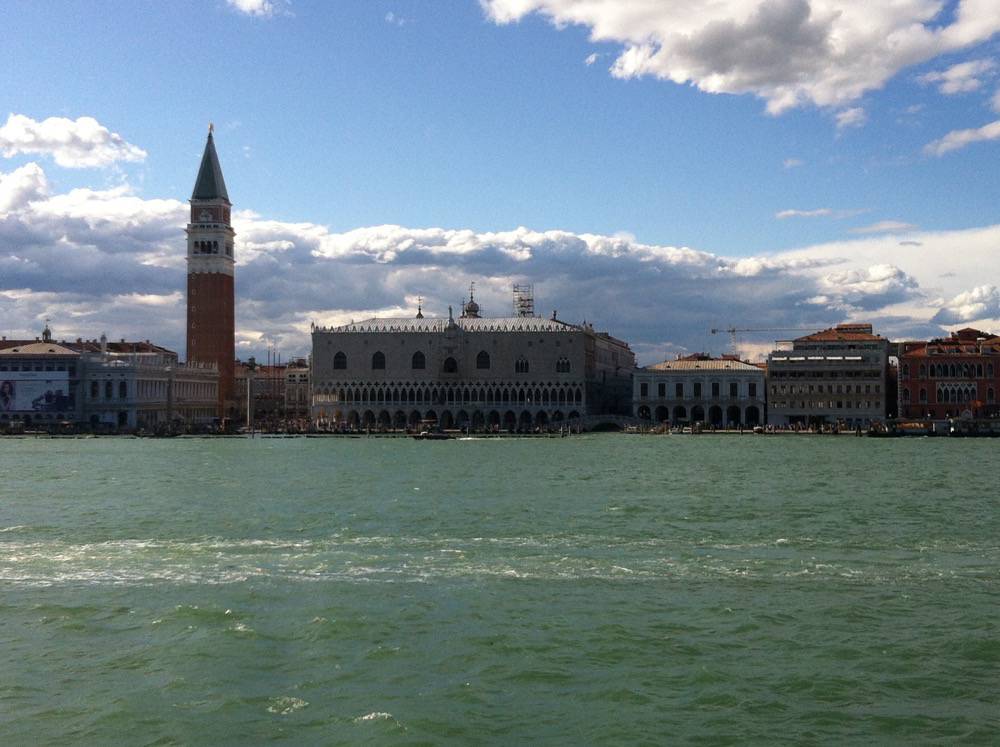
The thousand year existence of the Venetian Republic can be roughly divided into three main periods: the very beginning, when a population of bargemen became a seagoing nation sailing, trading and fighting in many parts of the Mediterranean; a second period of extraordinary prosperity which saw the consolidation of their power and government followed by the expansion towards the Italian mainland; a third and final one at the turn of the 16th C when we see the beginning of a decline and decadence which eventually culminated with the fall of the Republic by Napoleon in 1797.
The Venetian Lagoon
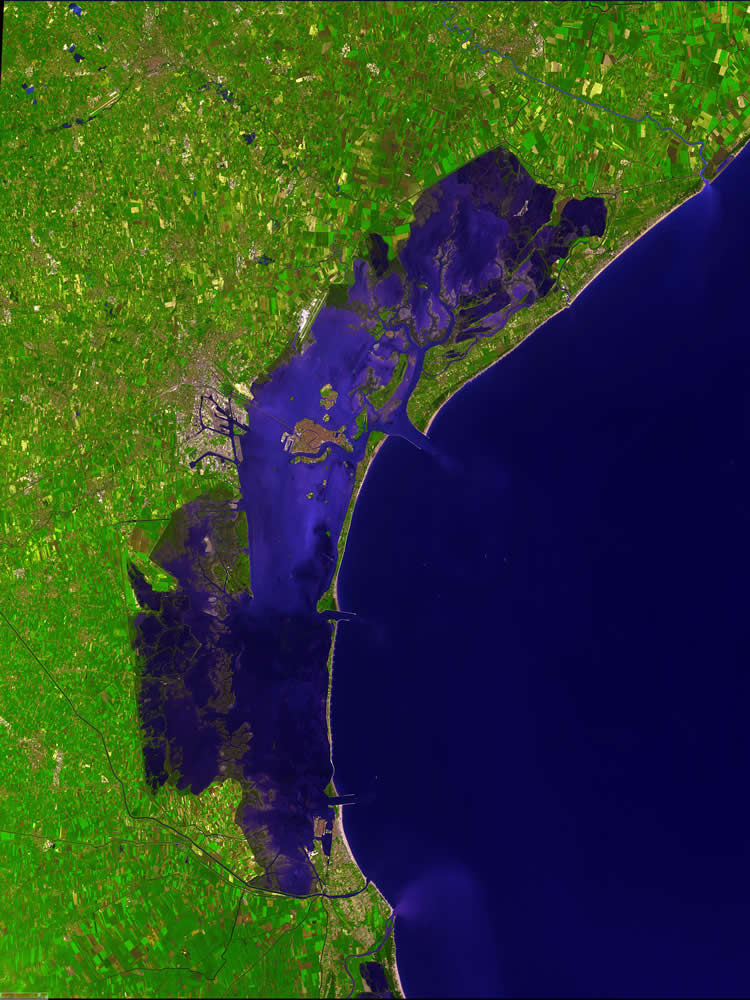 The Venetian Lagoon stretches for 30 miles from north to south, and Venice is in its strategic centre. According to a recent theory the area occupied at present by the waters of the lagoon was once a landmass. Then a combination of natural phenomena operated a dramatic change: the rising of the sea-level and the gradual sinking of landforms – subsidence – caused a rather rapid advance of the sea through disastrous floods.
Between the 2nd and 12th C the increase of the sea level has been estimated around 1,80 mt (approx. 6 feet) while landforms had sunk approx. 1,20 mt (approx. 4 feet).
Sand carried down by the rivers and shaped by marine currents eventually formed bands along the coastline, which in due course practically locked the Lagoon in on itself, with the exception of 3 port of mouths. The presence of the caranto as a sedimentary rock, deep into the subsoil of the lagoon, is significant evidence that at one stage there was no water in this area.

A section of the Venetian Lagoon subsoil
Information on the lagoon goes back to the 3rd Century: Erodiano, a Roman chronicler reports this lagoon as part of the Seven Seas, a navigable network of waterways along the coastline which connected the city of Ravenna to Aquileia.
Then, more information in 537, in a letter written by Cassiodorus, officer at the Goth’s court. The lagoon area is described, the natives’ homes dispersed across the surface of the water, boats tied up at the doors. Fish and salt their basic economic resources. Salt being very important, for it was needed to preserve food… So, these boatmen claim our attention as the first people who found a way of making a living in this mixture of mud and water. Yet, we cannot actually refer to these settlements as VENICE.
Before Venice
The birth of Venice is a consequence of the fall of the Western Roman Empire. From the 4th C the Roman Empire was to be divided into two parts, each part governed by its Emperor. Rome was the capital of the Western Empire and Constantinople that of the Eastern. Constantinople had been founded in 330 by the Emperor Constantine I on the site of an old Greek town, Byzantium, which he renamed after himself.
The fall of the Western Roman Empire was ultimately caused by invaders from the North and East. This is the time of massive invasions of barbaric people: the Visigoth, the Huns – led by Attila, ” the scourge of God” – the Goths, and others. The last of the Western Roman Emperors was deposed in 476.
During this violent incursions Roman citizens fled from the mainland and sought shelter on the tidal islands of the lagoons. Tradition wants to identify the birth of Venice with these migrations, but this is not correct. Many of these earlier refugees in fact returned to their devastated homes once the immediate danger was over.
Moreover, in 555 the Emperor Justinian the Great completed the re-conquest of Italy and these lagoons were re-placed under Byzantine jurisdiction.
It’s actually in the 6th and 7th cs (568 e 639) that things were to change. At that time another Germanic people, the Lombards, thundered down from the North and occupied a large part of the Italian territory. That of the Lombards was not a simple raid. They were actually determined to settle down in those territories and in fact they will gain their end and remain for about two centuries. As a result, the temporary character of those early migrations changed to become permanent, their intrusion causing the alteration of the social structure described by Cassiodorus.
Early Byzantine Domination
 At this stage the lagoon area was unquestionably considered part of the Byzantine Empire, governed by military officials representing Byzantine suzerainty. And the dating of Venetian independence to those early days is just legend, a legend created by the old Venetians to glorify the Myth of their State.
Evidence of this comes from what can be considered the very first written document regarding the history of the lagoon: an inscription contained in the Cathedral of Torcello.
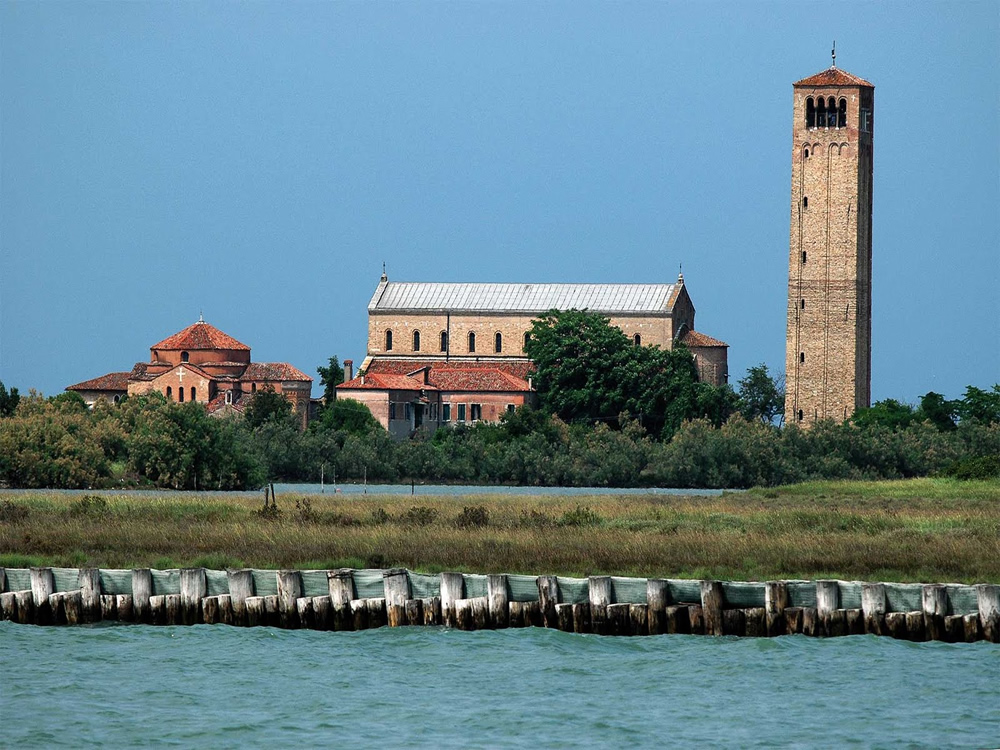
Torcello is a small island at an hour boat ride north from Venice and the visit to Torcello is strongly recommended. The journey offers you the unique opportunity to see and envisage what the lagoon must have looked like in those early days, with its shoals and reed-covered mudflats (wet-lands).
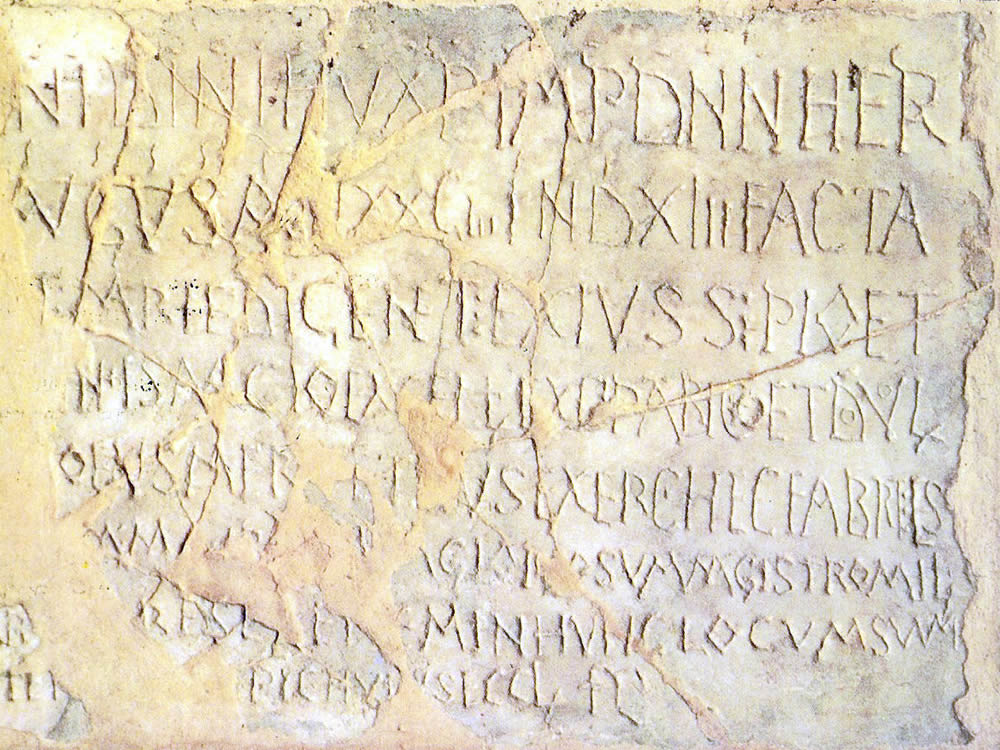 Torcello became important in 638, when the bishop of Altinum moved there his mainland congregation and founded the Cathedral of S. Maria Assunta. The cathedral you can see today, though, is the 11th C reconstruction of the original one. The only two things that have remained from the 7th C are the remains of the Baptistry and the plaque we referred to as the oldest known Venetian document (discovered in 1895), stating that the church was built in 639 “by the Honourable Magister Militum Maurìce who resides in this site which belongs to him“. The Magister Militum Maurice was a Byzantine official, so the inscription confirms that the islands of the Lagoon were originally under Byzantine rule.
Torcello was a thriving island up to the 14th C, rich in beautiful palaces and monasteries and counting approximately 10,000 inhabitants. But what you can see on the picture above is almost all that is left. Torcello is a kind of open air-museum. Its population reduced to 12 souls.
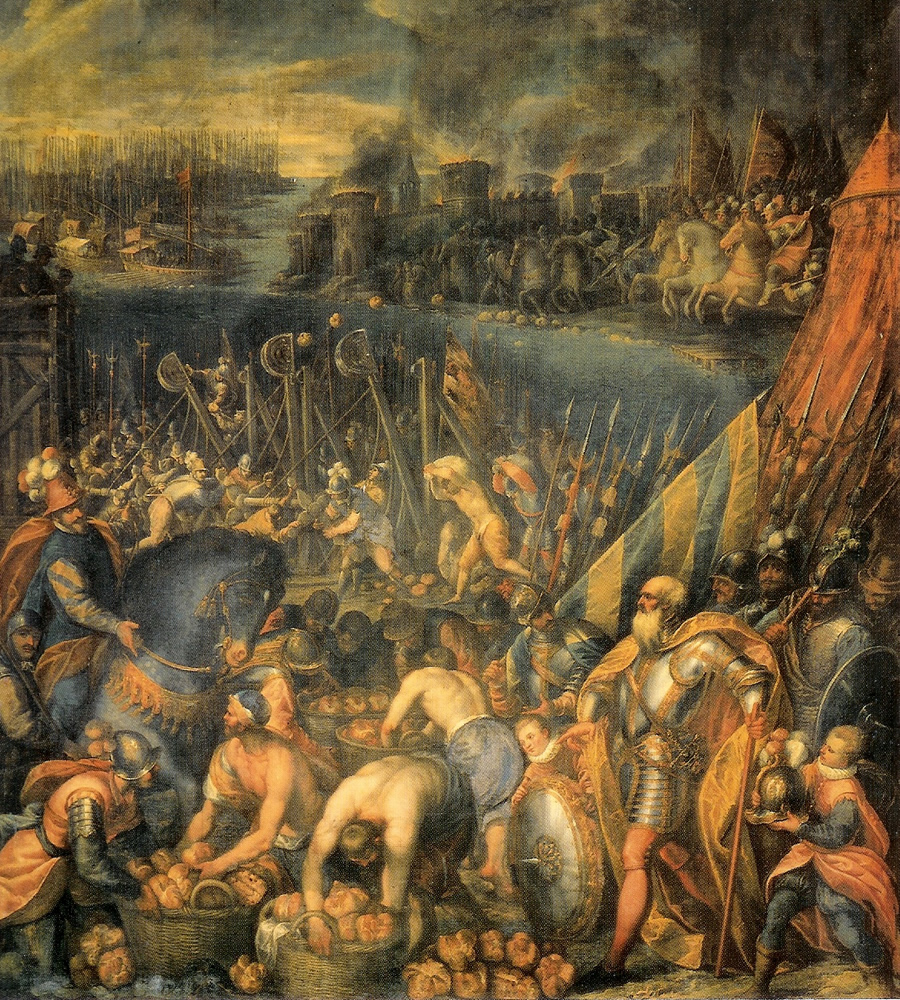 Allegiance to Byzantium and detachment from the mainland were reaffirmed when the Lombard kingdom was absorbed by the Frankish Empire. In those days the seat of the local governor in the lagoon area was Malamocco, on the Lido island. In 809 Pepin, the son of Charlemagne, attacked the lagoons. The Byzantines responded promptly to the Frankish attack and sent their fleet to counterattack Pepin. The Franks were pushed back and the Byzantines reaffirmed their sovereignty over the Lagoons.
Yet, what I have just said is the result of years of deep studies. The truth in fact was disguised by the old Venetians keen to establish the Myth of their original independence. Their version goes in fact that the defeat of the Franks was the result of their military ability.
The account of the chronicler Giovanni Diacono (10th-11th C) reads in fact: “Pepin’s fleet ran aground in the shallow waters of the lagoon and there a multitude of Venetians launched their attack and won “with the help of the Divine Providence”. This “divine providence” was actually the Byzantine fleet…Anyway, legends and myths aside, the outcome of this struggle marked the turning point for the history of Venice.
Venice and it’s political center: The Square of St. Mark
First of all, the territory of the Venetian lagoon was included once and for all under Byzantine jurisdiction. Yet, being Constantinople so far away, the Byzantines soon relaxed their control, their suzerainty gradually faded away and the Venetians became in fact independent.
Secondly, the seat of the government was transferred in 811 to a more protected area corresponding to present St. Mark’s Square, since Malamocco had proved vulnerable to attacks from the sea. And this event marked the beginning of one of the most remarkable and daring engineering enterprises.
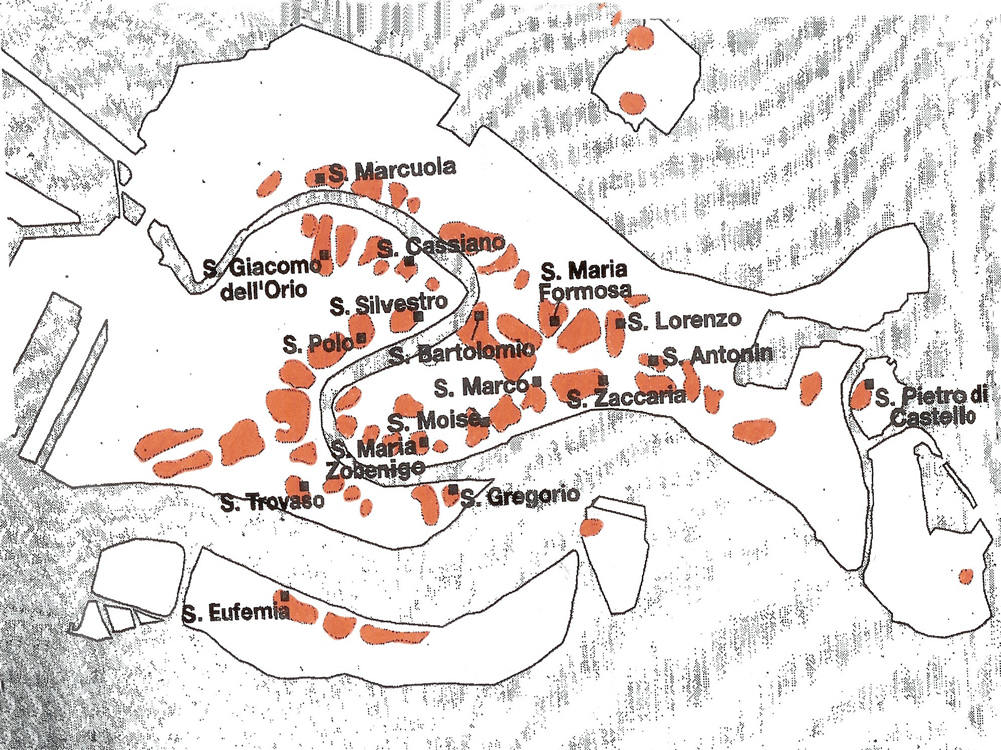 The aspect of the lagoon was very different in those early days, the area being mostly occupied by water. As you can see in the map, the black contour marks the boundaries of present Venice, whereas the red splotches are in fact the islands that already existed in the 8th and 9th Cs. Few centuries later the section of solid land had expanded. Canals were dug, land was drained and reclaimed by erecting basketwork dikes around the sites. And yet this was not enough to withstand the heavy weight of the buildings.
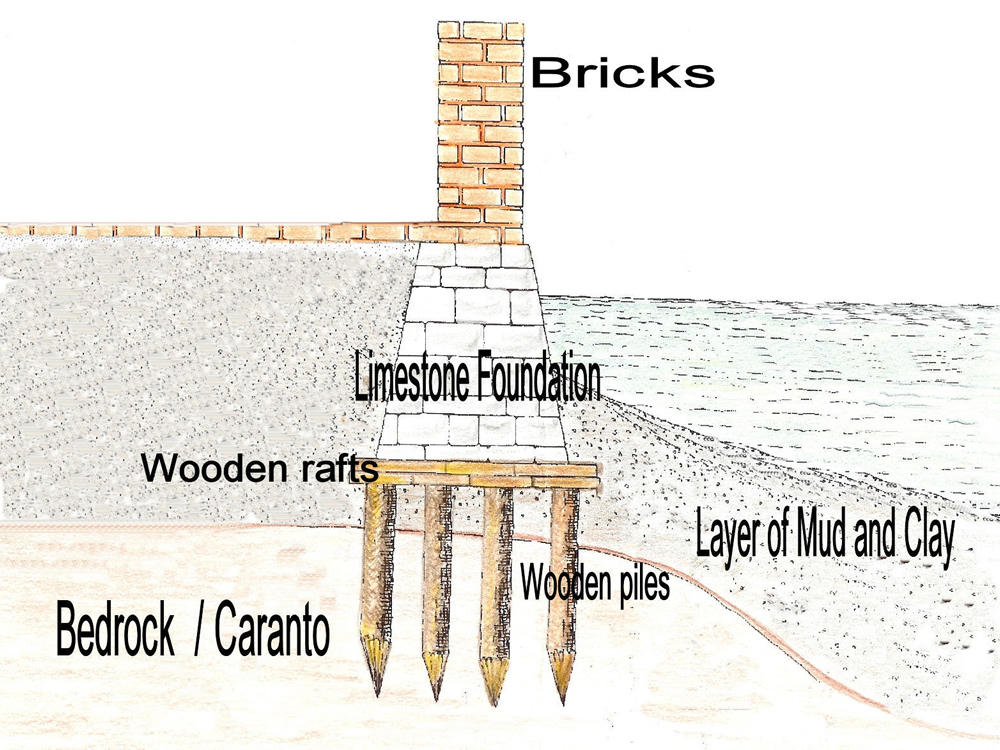
Piles were driven into the ground to reach the bedrock
So thousands and thousands of thick wooden piles were driven into the heavy clay beneath the mud and there, not being exposed to the action of water or air, timber didn’t rot. On top of those piles, wooden rafts were laid to provide elasticity while the piles settle and shifted. Finally, stone slabs.
So this is were Venetian buildings stand on, still now: on some sort of a petrified forest.
The Ducal Palace and the Church of St. Mark
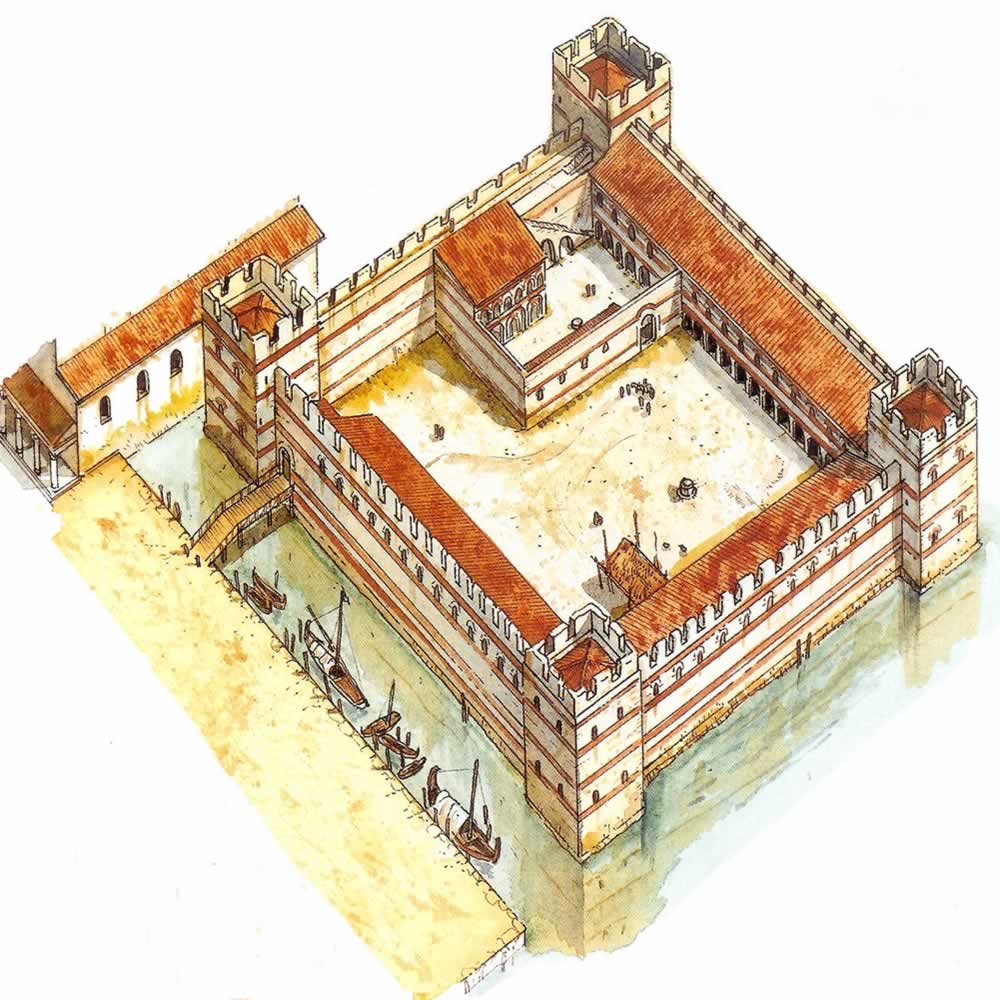 A significant step in the evolution of the Venetian state is the construction of the Doge’s Palace, in those days probably more a castle than a palace: the erection of the government building is in fact more than anything a statement that a durable political system is established.
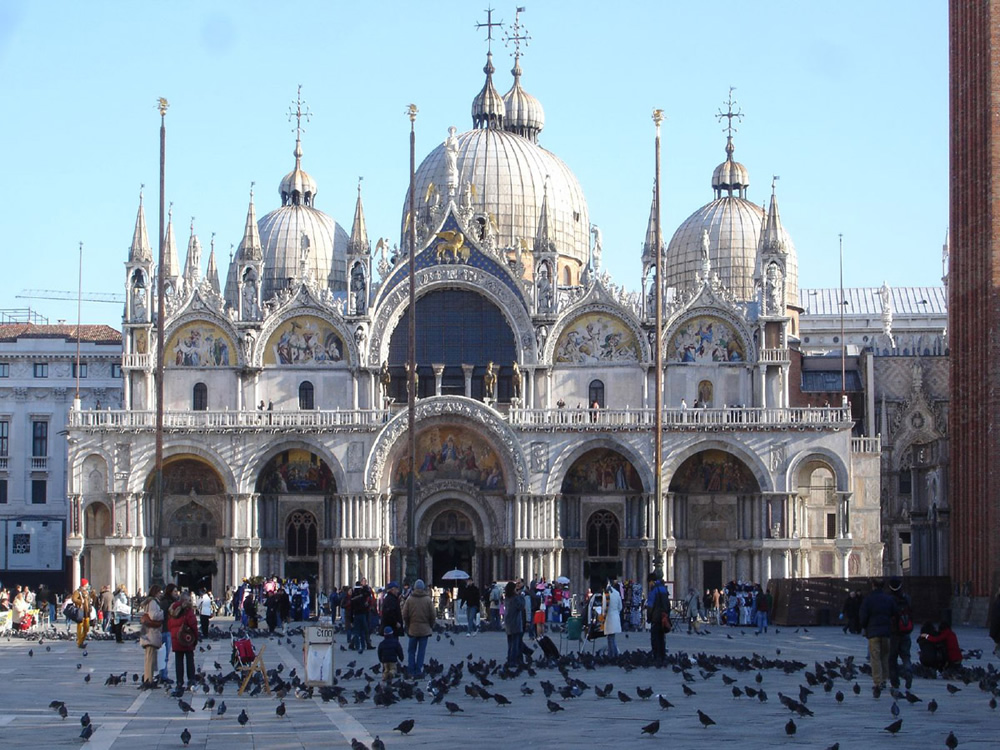 Near the Palace, the Church of St. Mark was soon to be erected and the church was dedicated to the Evangelist who was appointed as the patron saint of the city. Today we might find it difficult to appreciate the importance attached to saints and relics in the Middle Ages. In addition to their mystical properties, they were symbols of the wealth and power of the State… Politics and religion were arm in arm.
So the most desirable for the Venetians were the relics of S. Mark the Evangelist. The saint, in fact, had been officially recognized as the preacher who converted the people of the lagoons to Christianity and founded the patriarchate of Aquileia (the most important religious authority in Italy after the Pope). 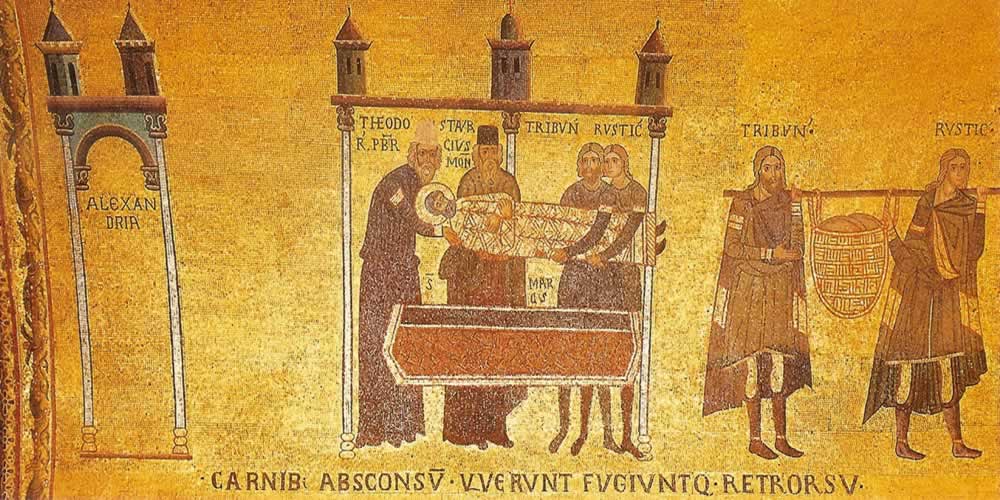 So St. Mark was the most suitable patron…the snag was now to strip Aquileia of the right to the saint’s patronage. The only way to solve this… holy mess was to acquire the relics of the saint which were stolen from Alexandria in Egypt by two Venetians who covered their prize with quantities of pork to avoid possible inspections by the Moslem guards.
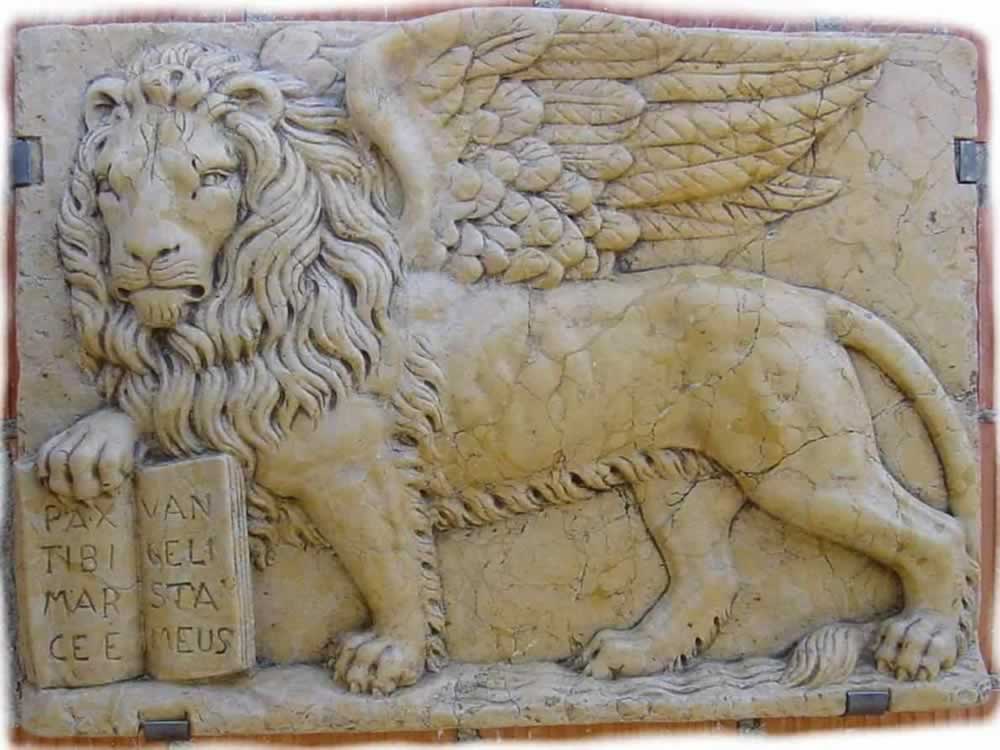 The Venetians then – in order to justify their move – made up the story that St. Mark, on his way to Alexandria, had been caught in a violent storm and had been forced to land on one of the islands of the Venetian lagoon. And while he was marooned, an angel had appeared to him and said “Pax Tibi Marce, Evangelista Meus”: Peace be unto thee, Mark, my Evangelist”. So this was sold as a prophecy that the saint mortal remains would find final repose in Venice despite the fact that he had returned to Alexandria, had died there and his remains were there for over 8 centuries!
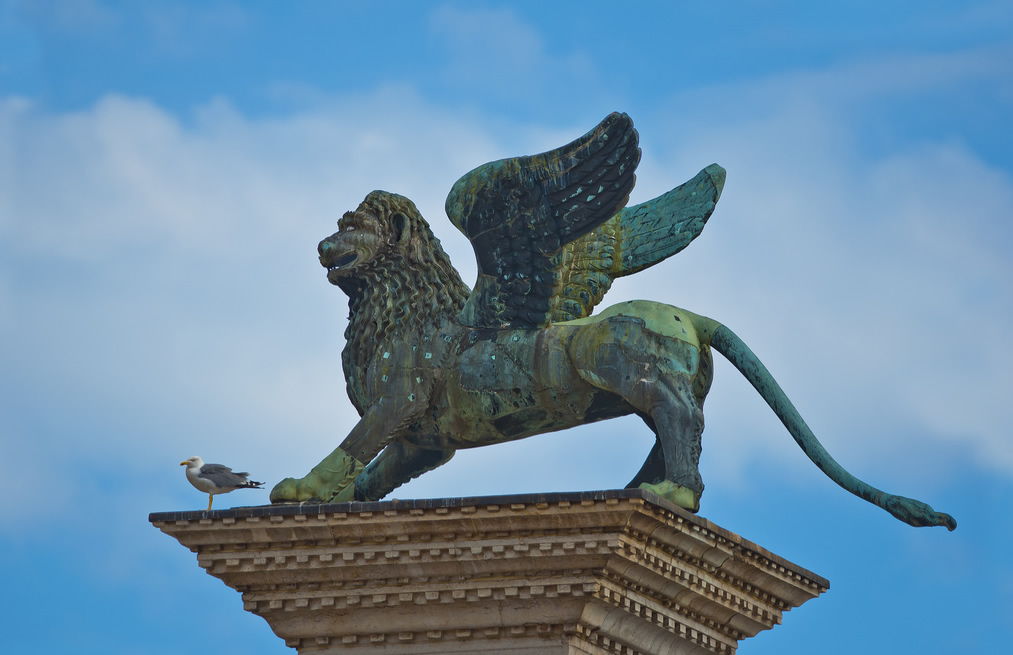 The acquisition of the body of St. Mark – or “pious theft” to borrow Venetian words – was above all a political maneuver, in fact the relics were not placed in S. Pietro di Castello, which was the seat of the bishop, but rather in the church which was going to become the doge’s chapel: in other words, entrusted to the head of state. The State of the Venetians was to become henceforward the State of St. Mark. The cult of St. Mark thus offered a strong political and religious belief to the people, who felt safe and protected by the Evangelist. The winged lion, which according to the vision of St. John in the Book of Revelation is the symbol of St. Mark, became the emblem of the city and is to be found everywhere to look after the Venetians.
Venice becomes a Sea Power
The Venetian economy was initially based on fish and salt… of course, it was to evolve. The lagoon territory fitted into the Byzantine commercial system as the perfect outlet for eastern merchandise. The Venetians’ role was to transport and sell eastern goods up the rivers of northern Italy.
Yet, after 1000 AD they became more active and gradually turned into proper merchantmen, trading with towns along the Adriatic coast down till Constantinople. They eventually set up a fleet and transferred their interest seawards. The Supreme Architect of this evolution was the doge Pietro Orseolo II. In 1000 AD he smashed the Narentan pirates – who were threatening Venetian trade-routes – and established Venetian control over Zara, thus marking the beginning of the expansion over the Adriatic.
The decline of the Byzantine Empire was to provide the Venetians with more opportunities to expand their traffics. When threatened by enemies, the Byzantines turned to Venice for help offering commercial advantages.
This is what happened in 1081 when the Venetians contributed to check the Normans, and in return the Byzantines conferred them trading privileges, exemption from tolls, and even a colony in Constantinople. At that stage conditions became more favorable for Venetian rather than Byzantine merchants.
Western Europe
If we want to understand the evolution of the Venetian State, we’ll now have to look at the Western context. We’ll find that at the beginning of the 12C – after centuries of stagnation due to the barbaric invasions – economy and trade were revived. In this new context, towns, seats of trading fairs, grew in importance and wealth, and gradually turned independent from feudal lords.
Economic independence then turned into political autonomy: this is the rise of the Communes or City-States.
However, in 1152 the most famous of German Emperors next to Charlemagne came to the throne. This was Frederick I, the “Red-bearded”. Frederick’s ambition was to restore its Empire’s former glory and influence on the Italian territory. Venice initially remained aloof from the struggle, but when she realized the danger of the emperor’s presence in Mainland Italy, she enacted her diplomatic machinery and sent ambassadors to the pope and to Frederick. These expeditions contributed to the reconciliation of the two and the site of the meeting between the pope and the emperor was Venice!
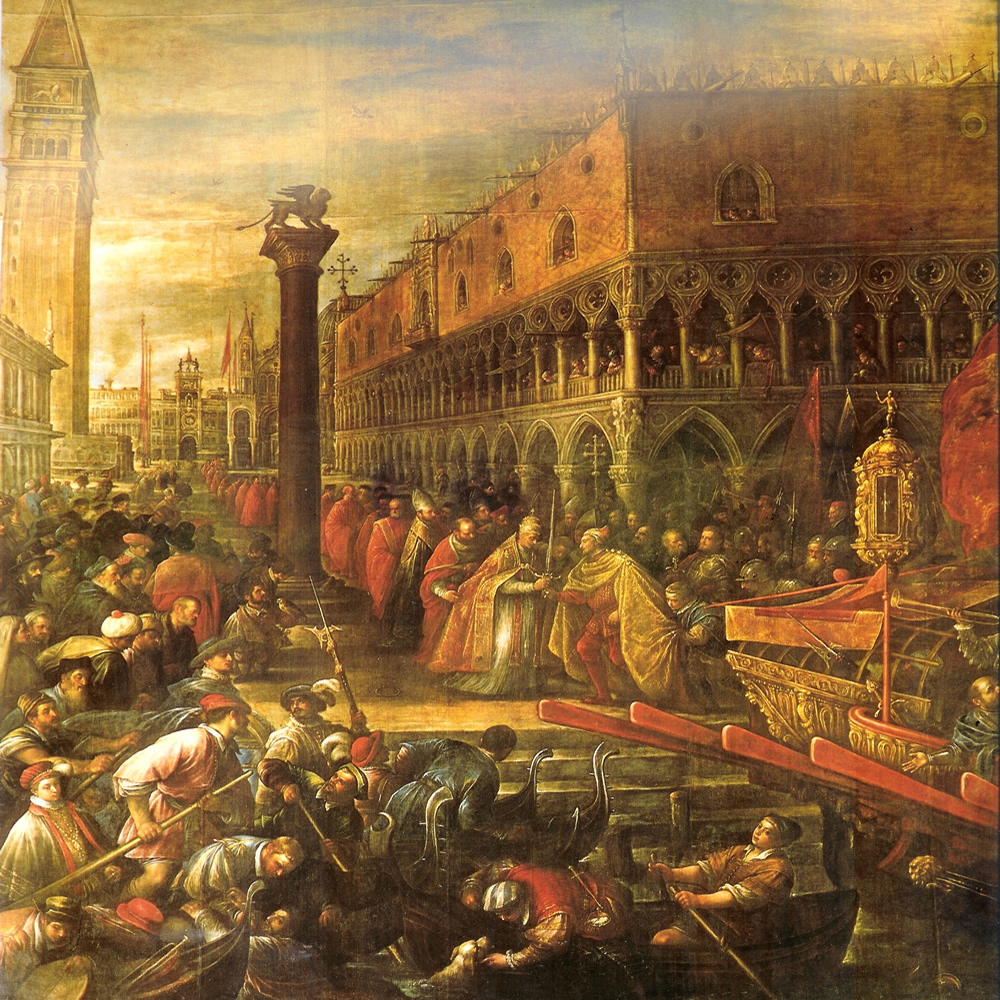 The Pope offers a sword to the Doge as recognition of Venice’s dominium on the Adriatic The event was considered a source of immense pride for the Venetians. The pay-off in terms of prestige was immense. They exploited the event to manipulate history and made up the story that the pope had expressed his gratitude by giving to them a sword and a golden ring s a symbolic token of Venetian authority on the Adriatic Sea.
Venice emphasized the event with the institution of an annual festival, the Marriage of Venice to the Sea. 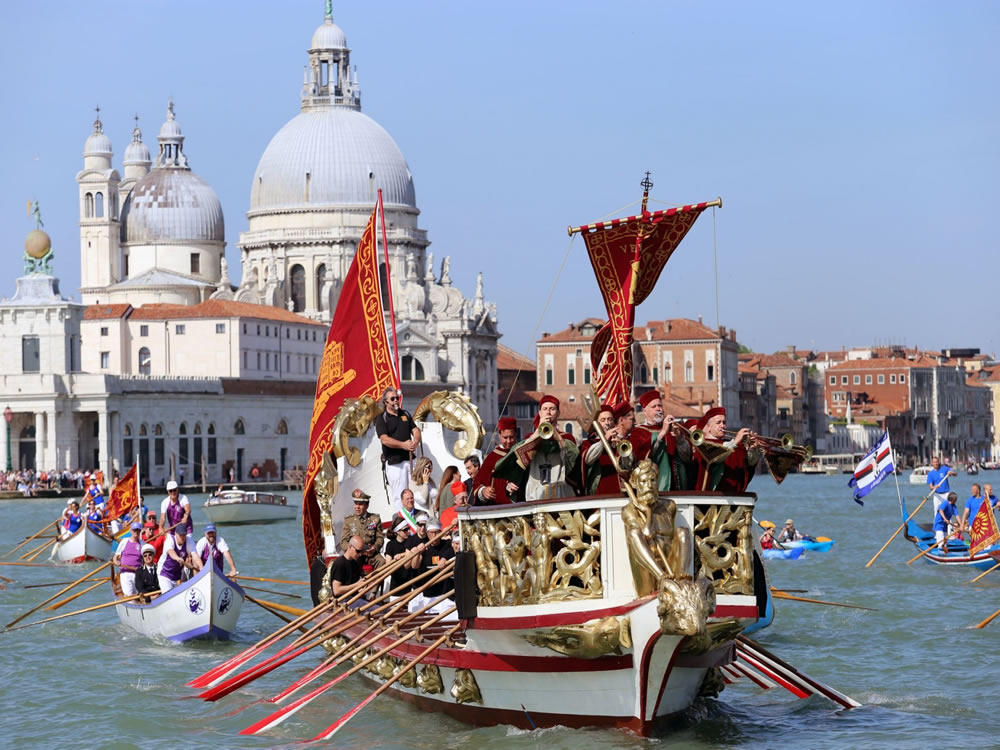 Every year the doge aboard the Bucintoro – the sumptuous state barge – along with the noble, the clergy the foreign ambassadors sailed for the port of St. Nicolò followed by a procession of boats and gondolas and having arrived at the mouth, the Doge cast the ring into the sea and pronounced the words “We wed thee, sea, in token of our perpetual rule”. With this symbolic official ceremony a series of festivities began on the Lido and went on for 15 days.
And this is a festival we still celebrate the very same way, with the mayor instead of the doge and without the Bucintoro – for the last one was destroyed by Napoleon.
The Fourth Crusade
It wasn’t just the West that had troubled the Venetians in this period. The concessions they had been granted by Byzantine emperors became a source of friction. In 1171 the Byzantine Emperor felt ready for a drastic move and suddenly arrested all the Venetians in his empire and seized their properties.
Venetian’s retaliation came in 1204. This is the date of the Fourth Crusade, what proved to be the most profitable transaction in Venetian history. The Venetians had played a fairly passive role in the previous expeditions to reclaim the Holy Land from the Infidels for their situation in fact was already extremely favourable in the Mediterranean.
Yet, in 1204 the Venetians became protagonists.
The crusaders asked the Venetians to provide them with transportation to the Holy Land and in return they agreed to repay them with an exorbitant sum of money. The time came for the crusaders to depart, but not all the money had yet been paid. Doge Enrico Dandolo therefore struck another bargain: if the crusaders would help him recapture Zara, he would allow them to defer payment. The new terms were accepted, Zara recaptured, but the itinerary of the Crusade was to undergo a further diversion and in fact this is the only crusade which will never reach Jerusalem.
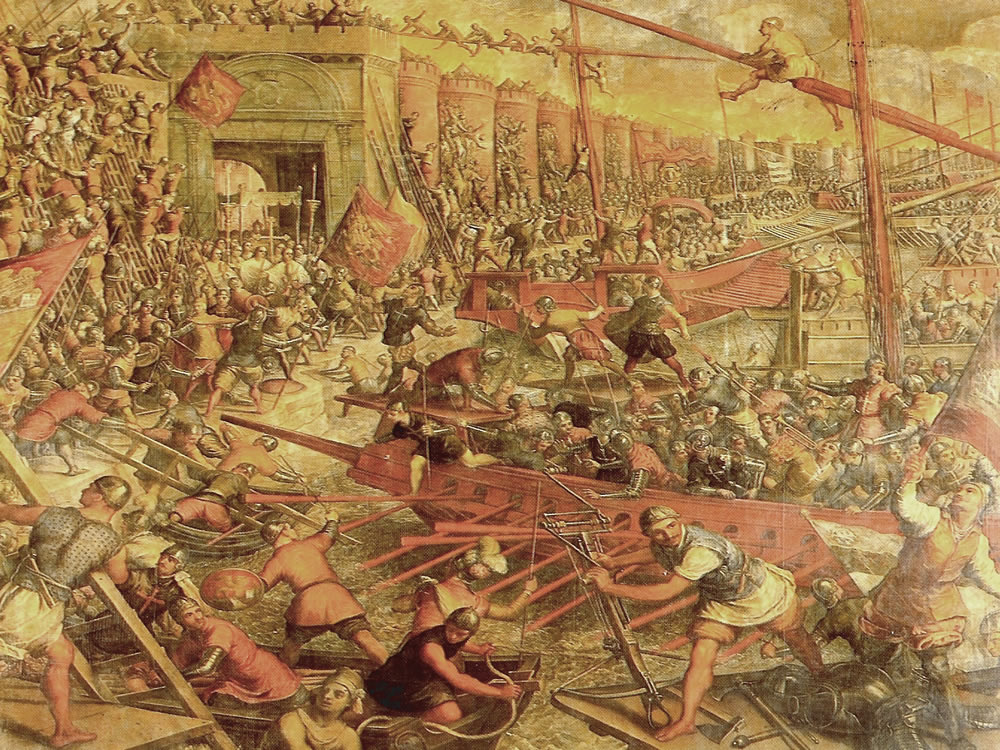 Instead of making for the Holy Land, they set sail for Constantinople… This is an obscure page of history, full of intrigues… To be brief, in the end Costantinople was captured and sacked for three days.
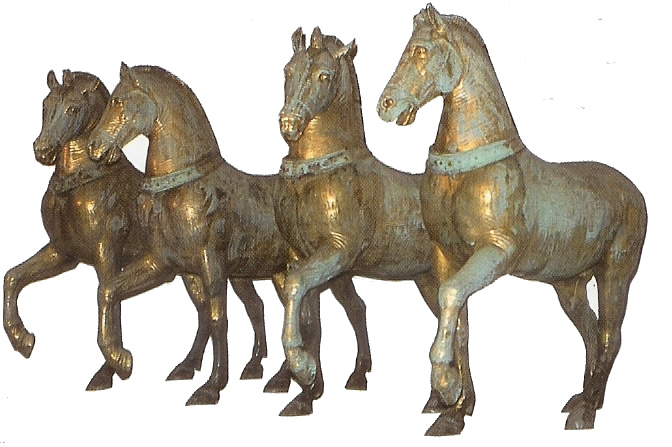
The Venetians demonstrated their appreciation of art by seizing sculptures and treasures which were to decorate the outside of their Basilica… like the 4 horses placed over the central arch of St. Mark’s basilica.
 The Byzantine Emperor was deposed and the territory of the Empire was divided among the crusaders.
In the partition, Venice obtained what she wanted: 3/8 of the territories of the former Byzantine Empire: mainly islands or naval bases along the route to the eastern markets, so as to form an almost uninterrupted chain from the Lagoon to the Black Sea, thus establishing conditions of near-monopoly on the trade with the East. The Venetian “Stato da Mar”, or Sea-state was formed yet destined to continuous alterations…
Behind these achievements there was a solid and steadfast direction by the Venetian government, ready to adapt itself to the circumstances.
The Venetian Political System
In the 9th, 10th and 11th Cs the head of state was a monarch called doge, from dux-duke.
The Venetians then evolved the first system of constitutional monarchy and they spared no pains to make sure that the head of state was kept strictly within his constitutional limits.
Councillors to control and limit the power of the doge appeared as early as 1032. The oath the doge took at his coronation bound him to execute the orders of the Major Council. There were numerous restrictions on his activities: all his letters were read by censors, he couldn’t receive foreign delegations alone, he was not permitted to trade. At his death his record in office was examined and, had he accepted any gift or act of homage that were not clearly intended for the State as a whole, his heirs were prosecuted and forced to pay compensation.
Towards the end of the 13th C the Venetian constitutional framework becomes more and more complex following the creation of several organs with different responsibilities. The most important of all was the Major Council, elected by the General Assembly, whose function was to elect all members of the Venetian government and was therefore very powerful.
Distrust of individual power made the Venetians depend on committees and councils which crosschecked one another. Even their election system which was re-elaborated in 1268 reflects their obsession to eliminate/to check political plots and intrigues.
How the doge was elected This is how the doge was elected after the reform:
 From the Major Council there was chosen by lot 30
The 30 were reduced by lot to 9
The 9 named 40
The 40 were reduced by lot to 12
The 12 named 25
The 25 were reduced by lot to 9
The 9 named 45
The 45 were reduced by lot to 11
The 11 named 41
The 41 nominated the Doge, for approval by the Assembly
At the turn of the 13th C the Venetian constitution reached a form that will endure until the end of the Republic, in 1797.
 Changes were prompted by a certain number of influential families which had continued to reassert their office within the Major Council. They felt the need of a law which would never displace them, and could as well prevent the concentration of political power in the hands of one single family. This is in fact what is happening in the rest of Italy, where the Communes are turning into Signorie, dominated by single families or Signori.
The process of transactions which was to lead to the reform took years and culminated in 1323 with the Serrata del Maggior Consiglio, literally the “closure of the Major Council”: membership to the Major Council was restricted to those who had already been part of it or who could prove that a paternal ancestor had sat in it and the list which recorded the names of eligible families was closed henceforth.
These families were self-proclaimed the Venetian Aristocracy and their names registered in the Golden Book. The Serrata can be thus considered similar to a coupe-d’état, performed – though -through bills rather than weapons.
Venice VS Genoa
In the second half of the 14th C when we see the climax of the conflict between Venice and Genoa which had engaged them in a 150-year struggle and 4 wars for the control of the Mediterranean trading routes.
In 1379 the city of Venice came near to being taken by assault.
Blockaded on all sides, Venice began to run out of food and supplies. The Genoese allied with the Paduans and took Chioggia (a fishermen village in the Southern Lagoon) by storm.
The Venetian backlash was remarkable and its success was possible thanks to the peculiar configuration of the lagoon environment. The lagoon waters are very shallow and navigable channels were known only to the natives…. even today they have to be marked by bricole. So, entrances to the lagoon were barricaded with large vessels chained together and enemies’ lines of communication were cut by sinking stone-laden barges in the canals…
In June 1380 the Genoese surrendered.
The Turning Westward
After the War of Chioggia and with Genoa out of the way, Venice felt restored in power and prosperity. Yet, the Lord of Padua had not given up his ambition to humble Venice. His aggressive policy became a real menace when he threatened to cut Venice off from the Alpine passes leading to Germany.
The Republic could no longer remain aloof from all that was taking place behind her back.
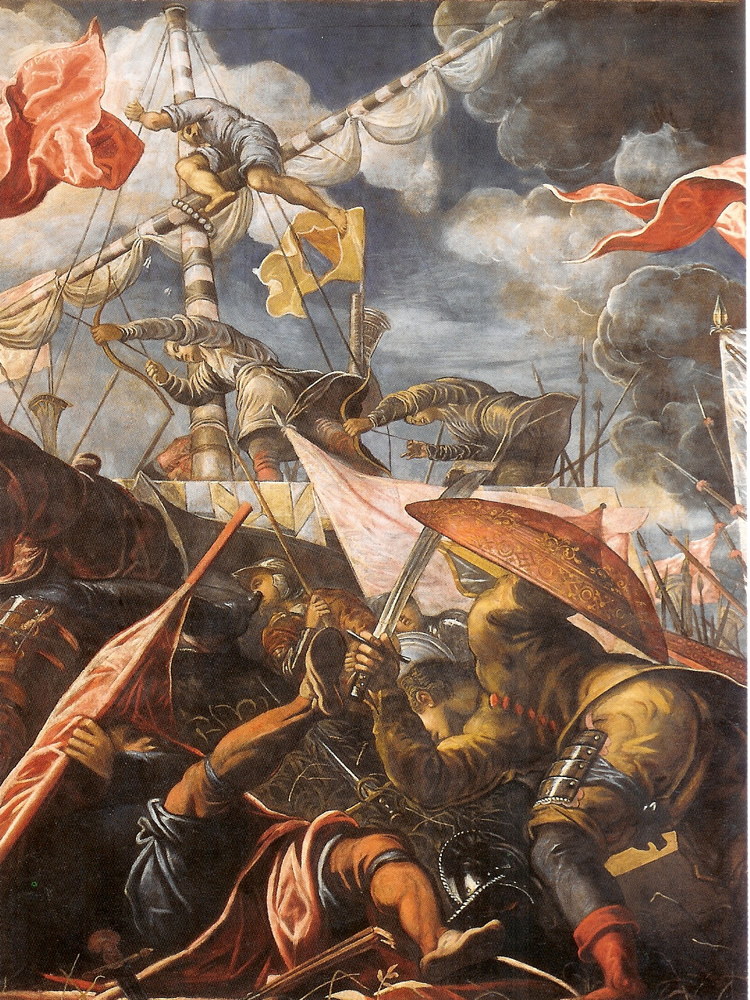 At the turn of the 14th C in fact we shall see a shift in the Venetian strategy: the turning westwards and Venice’s expansionism on mainland Italy
If sea lanes of the eastern Mediterranean were the foundation of Venice’s wealth, its dominance as a trading centre depended on the possibility of reaching other markets, relying on free access to the rivers and mountain passes of northern Italy. Thus, although Venetian foreign policy was predominantly eastward-looking, a degree of intervention on the mainland was inevitable, especially with the rise in the 14 C of ambitious dynasties such as the Scaligeri in Verona, the Carrara in Padua and the Visconti in Milan.
The political and military intrigues of northern Italy in this period are extremely complicated: alliances were regularly made and betrayed, and cities were changing hands with bewildering frequency. Venice formed an alliance with Florence to counter the expansionistic campaign of the Scaligeri of Verona (gaining control on Treviso and the surrounding areas).
At the close of the 14th C the Doge and Senate were watching with increasing alarm the Carraras of Padua eager to expand their territory. The Senate checked them for a while by supporting their opponents and finally took the extreme step of allying with the ruler of Milan, the dangerous Gian Galeazzo Visconti. Together they overthrew the Carraras and shared their lands. Yet the Venetians realized that the Visconti could now become the real threat… luckily their concern didn’t last long for Gian Galeazzo was carried off by a plague and Venice could take advantage of the vacancy in the Milanese state and gain control on vast portions of territories.
Having once turned to the mainland, Venice was to end by coveting greater imperialistic ambitions which will later come down on her head.
You Venetians – had warned the Duke of Milan – are wrong to disturb the peace of Italy, and not rest content with the fine state that is yours. If you only knew how everyone hates you, your hair would stand on end!
And a similar warning had come from the 80-year old doge Tommaso Mocenigo in his “Farewell Address” made just before his death. His speech was directed against those who thought Venice could gain wealth from wars in Lombardy, and extolled on the other hand the high prosperity brought by peace.
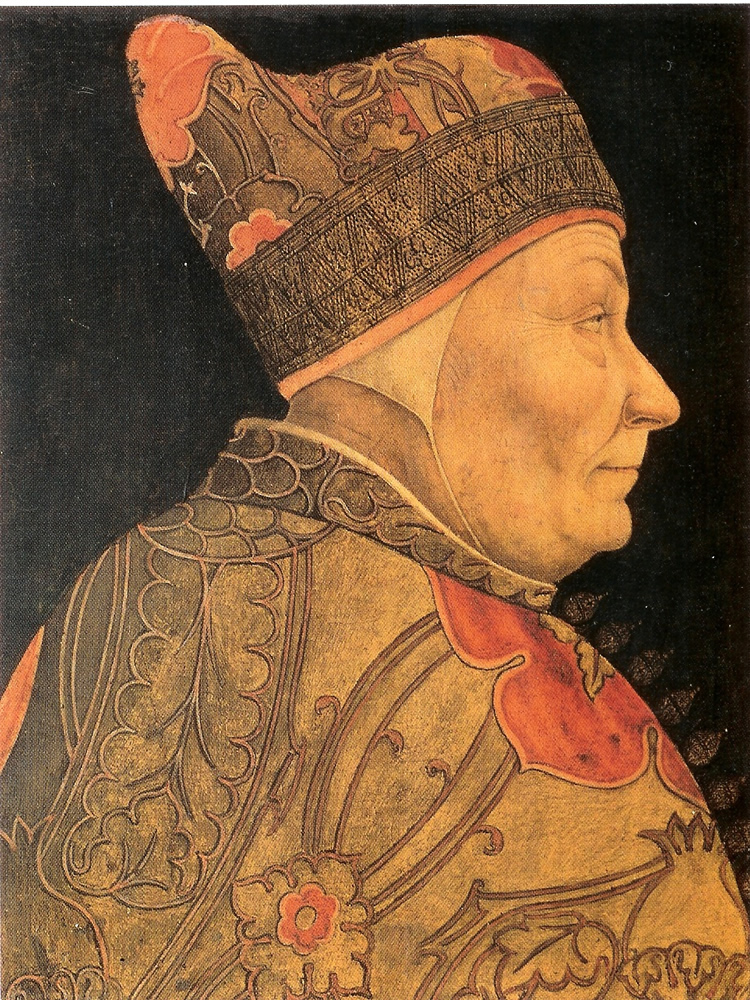 The leading advocate of the policy criticized by the old Mocenigo was a man known primarily as an aggressive politician: Francesco Foscari.
“Beware of Messer Francesco Foscari” came the warning of the doge Mocenigo “He is a vainglorious braggart… If he becomes doge” – read his speech – “you will find yourselves constantly at war; you’ll fail even to keep your long-johns and will become the slaves of your men at arms and their captains”.
Yet Francesco Foscari was elected, and his election marked the beginning of thirty years of almost constant warfare in Lombardy.
These Lombard wars were in part naval wars! The battle to control the city of Brescia fought on Lake Garda is quite remarkable: Venetian galleys were rowed through the rivers and then with 120 oxen to a galley, pulled over hills to reach the lake.
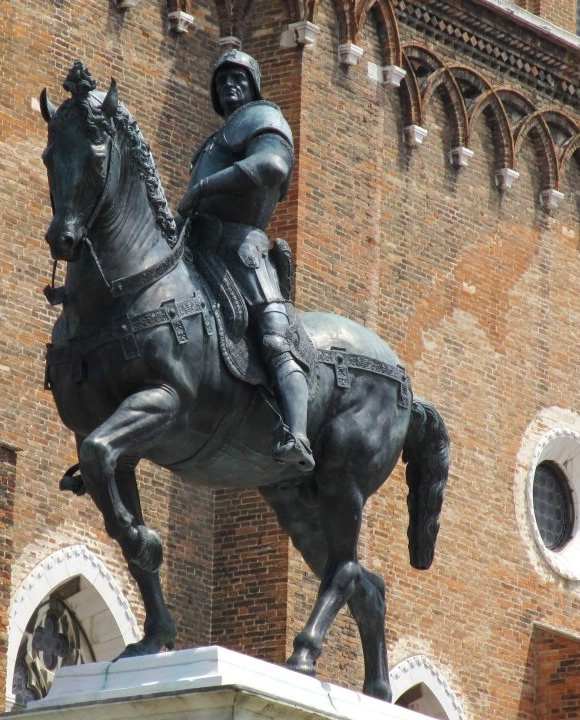 Statue of Bartolomeo Colleoni by Verrocchio in Campo San Giovanni e Paolo For warfare of that kind, Venice relied on mercenary captains. They were called condottieri because they operated according to a contract, a condotta which stated the amount of money they received for their services. Bartolomeo Colleoni was one of the most celebrated of all condottieri. At his death he even left 100,000 ducats to Venice on condition that an equestrian monument should be erected to his memory in St. Mark’s square… The money was surely needed by the State Treasury whose coffers had been exhausted by the long wars; on the other hand a monument in St. Mark’s Square would have been contrary to the traditions of Venice, which had never consented to excessive glorification of single individuals. So they resorted to a cunning diplomatic compromise and erected the monument in front of St. Mark’s … confraternity – in Campo San Giovanni Paolo.
By mid-15th C Venice’s so called land-state was formed a territory which reached Bergamo and Brescia on the west and extended eastwards onto Istria and Dalmatia, a state of affairs officially sanctioned in 1454 by the Treaty of Lodi.
The Ottoman Turks
Another reason for the turning westward is to be found in the expansion of the Ottoman Turks in the Levant. In 1453, in fact, Constantinople fell in the hands of the Turks. The Venetians concentrated their efforts to avoid any offense to the Ottoman sultan so as not to confront the full power of the Turkish army. Yet, in 1470, Mehmet attacked Negroponte, Venice’s main base in the North Aegean, and also snatched bits of territories here and there.
However, the Venetians were soon to compensate their losses with the acquisition of Cyprus.
 The acquisition of this important island was the result of a combination of shrewd diplomacy and shameless opportunism. The Republic arranged in fact the marriage of the beautiful 14 year-old Caterina Corner to King James of Cyprus. Caterina was formally adopted as daughter of the Republic and then shipped to Cyprus.
 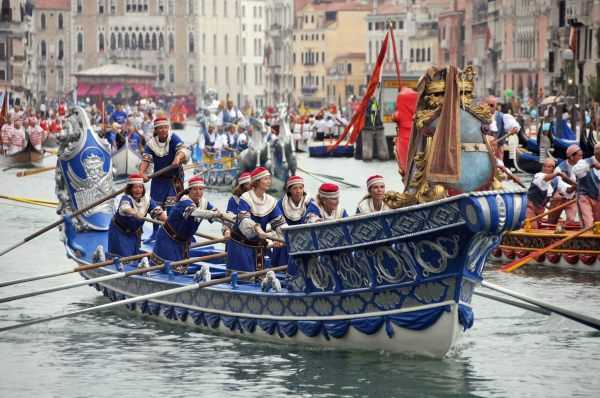 When James died about a year later, the Republic decided that this beloved daughter had better abdicate in favour of her adopted mother, the Republic. In October 1488 in fact Cyprus was formally incorporated in the Venetian Sea-State and its Queen sent back to Venice. The Doge even sailed out in his state barge to greet her.
The historical regattta on the Grand Canal A stately procession up the Grand Canal then followed. The event is one of the grandest ceremonies we still celebrate every year on the first Sunday of September: the Historical Regatta, a memento of all the pomp and pageantry the Venetians loved so much.
A turning point
In 1494 Italy was invaded by Charles VIII of France, an intervention which Venice lost no time in exploiting. By playing the various territorial contenders off against each other, Venice succeeded in adding bits and pieces to the her “land-state”. by the end of the 15th C Venice held a vast portion of territory, coveting greater imperialistic ambitions which will eventually come down on her head. By now, the Italian powers were in fact suspicious that Venice may upset the balance of power and dominate the whole peninsula.
The last straw fell in 1503, when the Venetians found the temptation to strike at the Papal State. Enough was enough.
The pope, France, Germany and other Italian city-states formed an alliance against Venice – the League of Cambrai – and smashed her army at Agnadello in 1509. The fall of the Venetian state seemed inevitable. Yet, shrewd diplomacy and a shift of the alliances made it possible for Venice to recover practically all her possession on the mainland
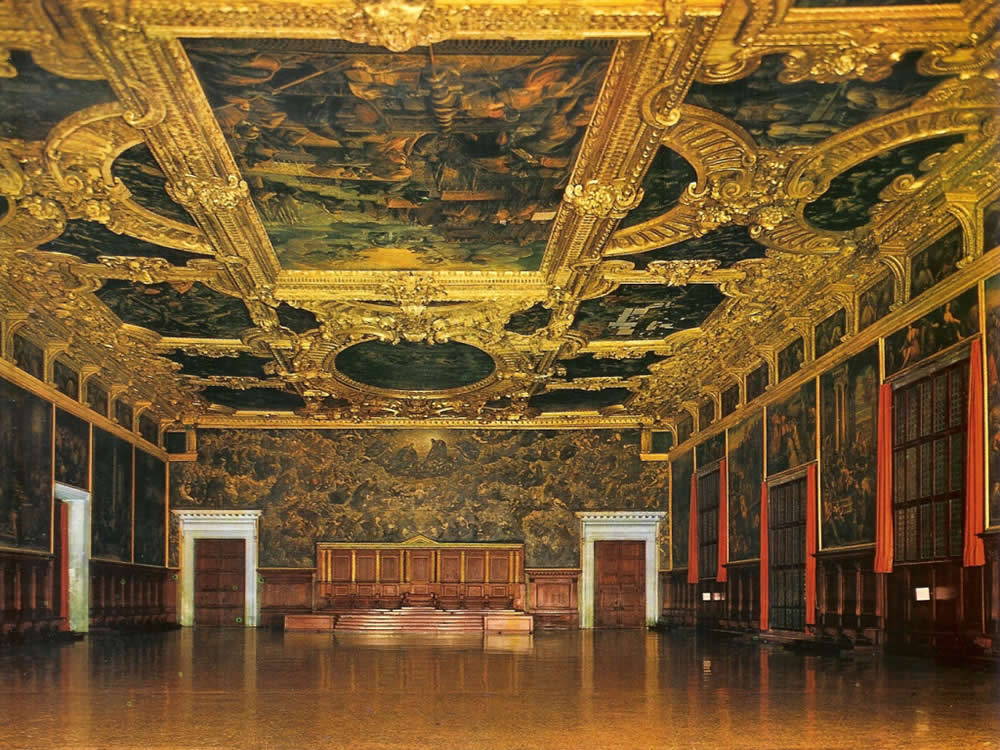
The Grand Council Chamber of the Doge’s Palace in Venice contains paintings by the best Renaissance painters of Venice
The Venetian government, however, realized that the City could no longer match wits with the great European powers. They decided to drop further expansionistic ambitions and go for a policy of neutrality. Their frailty and impotence could never be admitted and were in fact masked as a decision of its wise administration. Venice began to address herself as the Serenissima, the Most Serene Republic, claiming to be a model to regard with no less admiration than those of the Greeks’ and the Romans’ in ancient times.
The Hall of the Grand Council in the Doges Palace Her government has decided to devote all energies to the strengthening of institutions and the reorganising of her relationships with the subject territories and with European and Italian states. Basically, a policy of public relations to promote the Myth of a glorious state whose force was still to be reckoned with.
The new course transpires in the works of art produced throughout the century. The paintings in the Ducal Palace – the Government building – reflect the glory of Venice and illustrate land battles, sea fights, diplomatic victories… The allegorical and mythological scenes are added with propagandist significance and conscripted into Venetian service.
Decline and Pride
Despite military setbacks, the expansion of the Turks and the discovery of new worlds and alternative sea routes, Venice remains a powerful state throughout the 16th C. Then, at the turn of the century, the Republic will start loosing predominance. During the decade after 1602, the volume of trade moving through Venice fell forty percent
Compared to great European monarchies, such as France or Spain, Venice is now a small state and has no more say in international matters. She relies on a policy of neutrality and the ability of her ambassadors to keep afloat. Yet, although the Venetian state was on its last legs, it held its head high. And in fact at the time of the Counter-reformation Venice kept a stiff upper lip and had the nerve to take a stand against the Pope.
This happened when Venice restricted the amount of the tithe, the tax that monasteries paid to the Church of Rome – and then imprisoned two priests charged with secular crimes – rape and child molesting. The Pope’s demand for the return of the priests and the repeal of the monastic legislation was firmly rebuffed, and the upshot was a papal interdict in April 1606, forbidding all religious services in the Venetian territory.
Excommunication for the entire city followed. In retaliation, Venice booted out the Jesuits and threatened with exile or death any priest who wouldn’t ignore the interdict. And when priest in Padua insisted that the Holy Spirit had moved him to obey the pope, he was informed by the Council of Ten that the Holy Spirit had already moved them to hang all dissenters. Venice obtained the support of the King of England, James I and eventually French mediation brought about a resolution which required no compromise from the Venetians.
The Last Century
Despite her declining political weight, Venice in the 17th and 18th Cs was the centre of European culture offering numerous attractions. In the 17th and 18th Cs Venice had the reputation of being the gayest and most inconsequential of European capitals.
Among the many features that drew visitors to the city were her theatres and her music. Venice was the opera centre of the world in the 17th C..
In 1637 the S. Canciano Theater performed Europe’s first opera before a paying public. Elsewhere operas were performed at that date only in the closed world of princely courts.
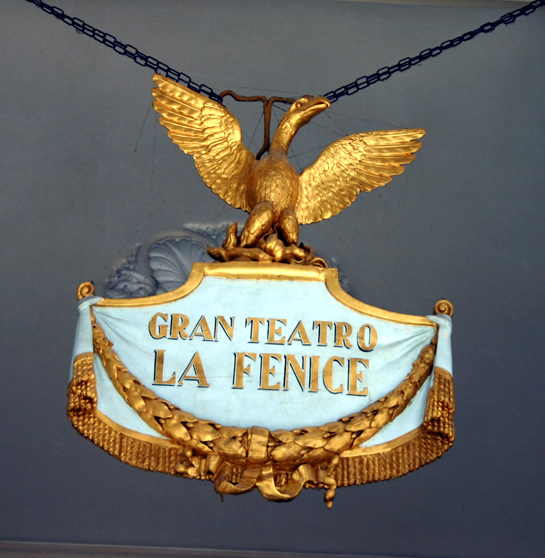 Venice’s Opera House was opened in 1792. Its name, La Fenice, couldn’t be more appropriate. The Phoenix, in fact, was a mythological bird reputed to rise from its own ashes. In the case of this theatre, this already happened once, when it was rebuilt following a terrible fire in 1836. And as you probably know, the Fenice was again gutted by a fire in January 1996 and was recently rebuilt.
The taste for music in Venice grew apace until 18C. In addition to the accademies and private concerts which took place every night in one palace or another, the “Ospedali” (orphanages) began to organize paying concerts where vocal and instrumental music were given by the young girls of these institutions. They were standing in a n upper gallery hidden behind a grill. The success of these concerts were so immense that great masters such as Galuppi and Vivaldi welcomed the opportunity of directing them.
 From 1703 Antonio Vivaldi taught at the musical seminary of La Pietà, where he was the violin master and occasionally also the choirmaster. Vivaldi was an incomparable virtuoso and composed approximately 250 violin concerts.
In 1700 the city counted 17 theatres. Her theatres began to give more time to spoken drama. Both tragedies and comedies attracted audiences which expressed their reactions vociferously. “Claques” organized to boo or cheer were recruited particularly among the gondoliers who were rewarded with free admission.
Among the hundreds of productions, it is the comedies that are of most interest, especially those of Carlo Goldoni who contributed to provide Italy with a tradition of written comedies. Before Goldoni, in fact, the Commedia dell’Arte depended largely on pantomime that was almost acrobatic and improvised by the actors.
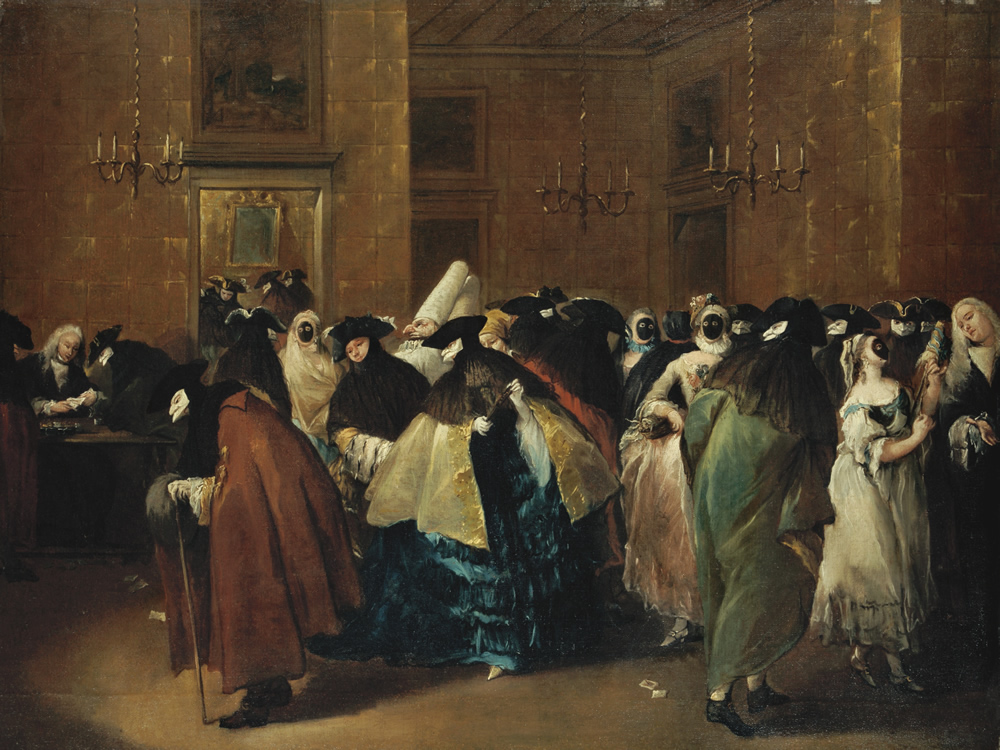
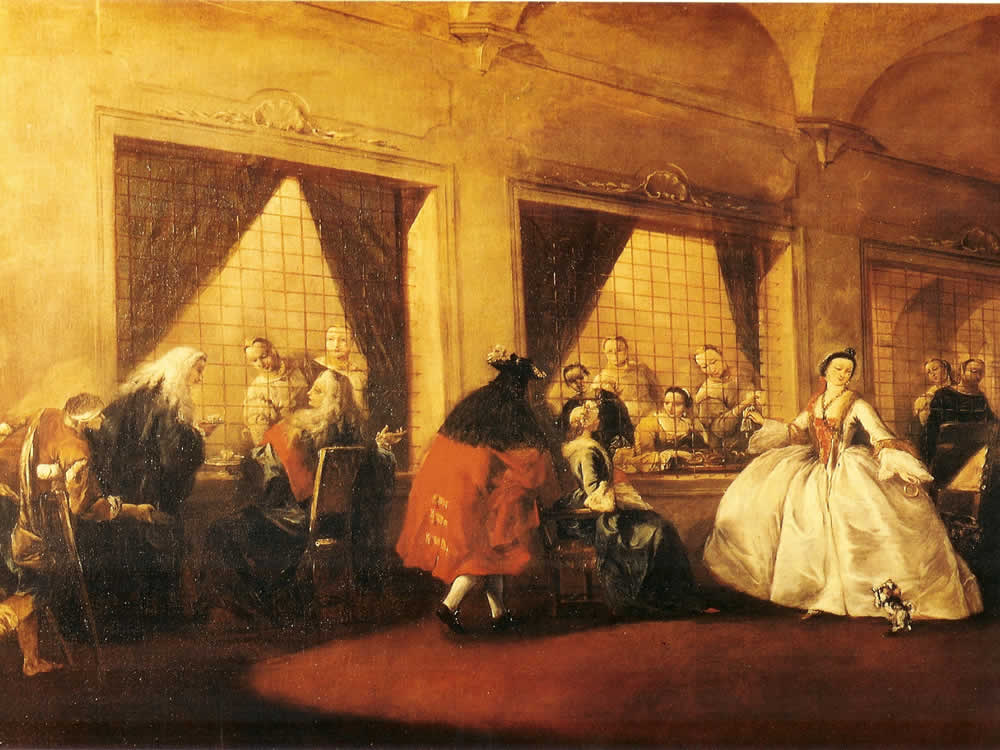 Tourists in the 18th C Venice found her public gambing rooms even more popular than the theatres.The Ridotto was among the most popular ones, opened in 1638 by Marco Dandolo in his palace. It was later described by the Major Council as a place of ” solemn, continuous, universal and violent gambling”. In fact in 1774 the Council ordered the closure of the premises, because several families had been completely bankrupted there.
And nunneries on the other hand simply continued to be popular. They had a long-lived tradition to defend: notorious is the episode that in 1509 saw the nuns of the Celestia admitting a bunch of young noblemen into their convent and dancing all night with them to the sound of pipes and trumpets. And what about the banquets celebrated in some convents, with the nuns at the grill sipping drinks with the aid of straws passed through the bars?
Venetian Carnival
Carnival was a pagan ritual marking the end of the old year on winter solstice, the shortest day of the year. With Christianity it became the time when confessions were made in preparation for Lent. And Carnival probably derives from old Italian “Carne levare”, a farewell to meat – and flesh! – before the rigours of Lenten fast. Eventually, it evolved in a relatively short period of merrymaking which reached its climax the day before Ash Wednesday.
Well, in Venice Carnival began on Boxing-day, the day after Xmas, and ended with Mardi Gras…The ceremonies accompanying the event were just extraordinary:
 The flight of the angel was an acrobatic stunt where an equilibrist had to jump from the bell tower, slide on a rope and end in the arms of the doge assisting on the balcony to give him a bunch of flowers. Bullfights instead took place in the campi (the squares of Venice).
Consider that in February 1789 the doge Paolo Renier died and the announcement of his death was postponed, so as not to spoil the Carnival!
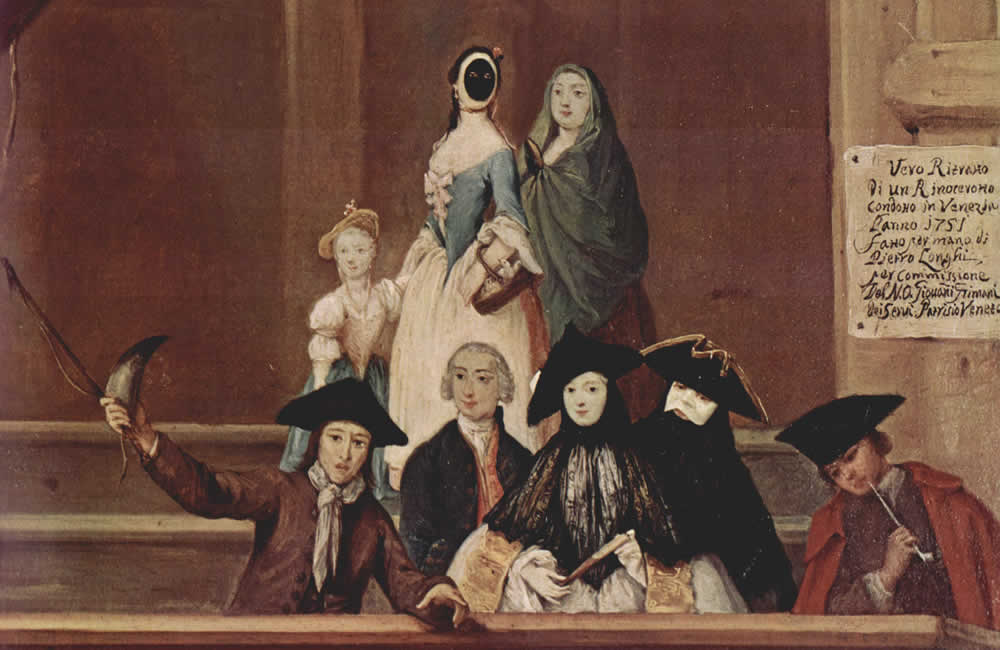 Venetian Masks But masks and the same gay spirit lasted almost all year round. The mask was used as a disguise to go to parties, brothels, gambling houses, nunneries.
From early date, tourists reporting on Venice included enthusiastic or disgusted comments on her courtesans. The most notorious picture of Venetian licentiousness is to be found in the memoirs of Giacomo Casanova.
Coffee houses multiplied. There were dozen around the Piazza, including Florian which opened in 1720 and Quadri in 1775.
So, 18th C Venice was pervaded by a spirit of festivity, and light-heartedness which derived from the absence of any serious purpose arising from political involvement.
The End
In 1797 in fact Napoleon’s troops entered the city which had never before been occupied.
Napoleon demanded that the government dissolve itself and turn power over to a democratic municipal council to be protected by French soldiers. The doge Ludovico Manin summoned the members of the Maggior Consiglio and proposed to accept Napoleon’s demands for this seemed the only way to “preserve unharmed the Religion, Life and Property of all these most beloved inhabitants”: he was asking for some sort of a political suicide for the interest of the state a principle which prevailed in the decisions of the ruling class until the very end.
The debate was opened when from outside the Palace a burst of musket shots was heard: a contingent of mercenaries was preparing to leave and that was their salute to the Republic. Those shots were enough to scare the members of the Great Council who hurriedly voted the old constitution out of existence.
Napoleon plundered Venice systematically. Then, to buy time for his imperial schemes, he turned it over to Austria by the Treaty of Campoformio (October 17th).
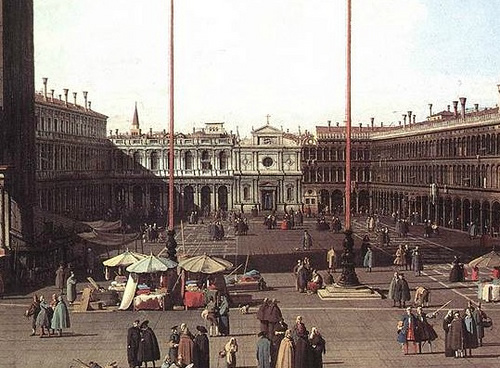 Eight years later Napoleon took Venice back, having meanwhile defeated Austria. In 1805 he added it to his Kingdom of Italy. A decade of French rule brought changes typical of Napoleonic administration. A good number of monasteries and churches were suppressed notorious is the demolition of Sansovino’s Church of St. Giminiano opposite St. Mark in 1807 to make way for a Ballroom in what had become Napoleon’s Royal Palace.
Public gardens were opened (again, with no mercy for pre-existing architecture).
Last but not least, we are told that Napoleon cherished the plan to dredge part of the lagoon to the south-east and connect Venice with the mainland. Luckily he never had the time to accomplish it.
Smashed at Waterloo, Napoleon was exiled in the Island of St. Helena where he died. The Congress of Vienna in 1815 reassigned Venice to Austria.
The Foreign Domination
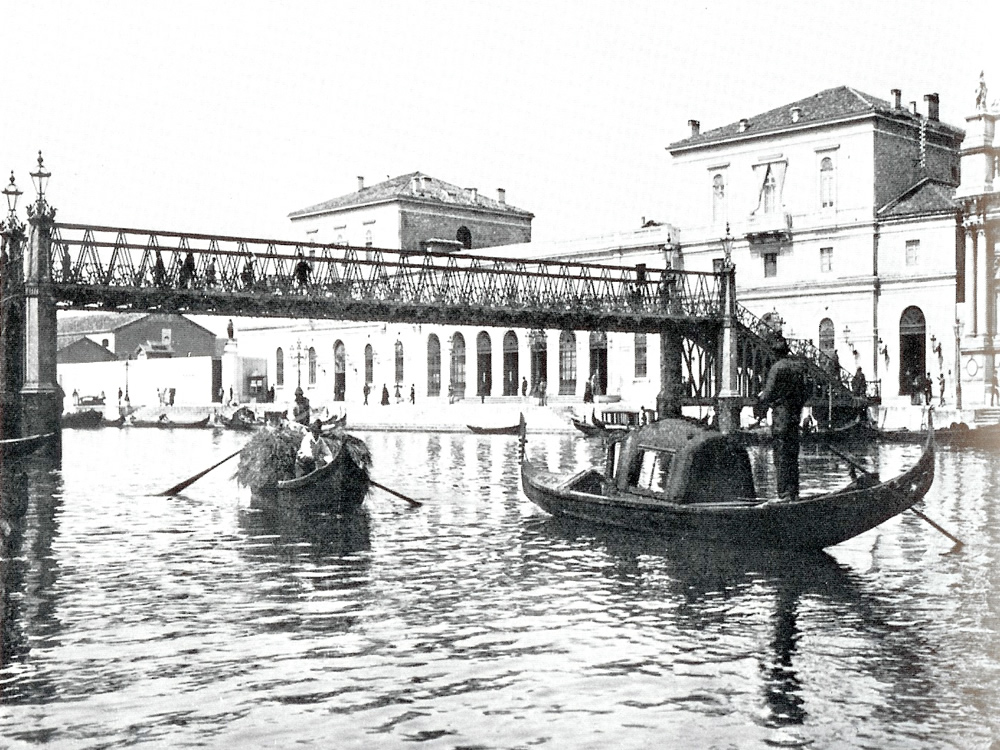 Under Austrian occupation, Napoleonic policies for improving the city’s network of streets and canals were continued. Streets were widened, bridges restored or rebuilt, canals dredged.
The simplest, cheapest method of creating new streets was the filling in of canals. The Rialto Bridge ceased to be the only bridge spanning the Grand Canal when the Accademia bridge was built in 1854. Four years later it was the turn of the Scalzi’s near the station. The first structures were in iron, later replaced by the present bridges.
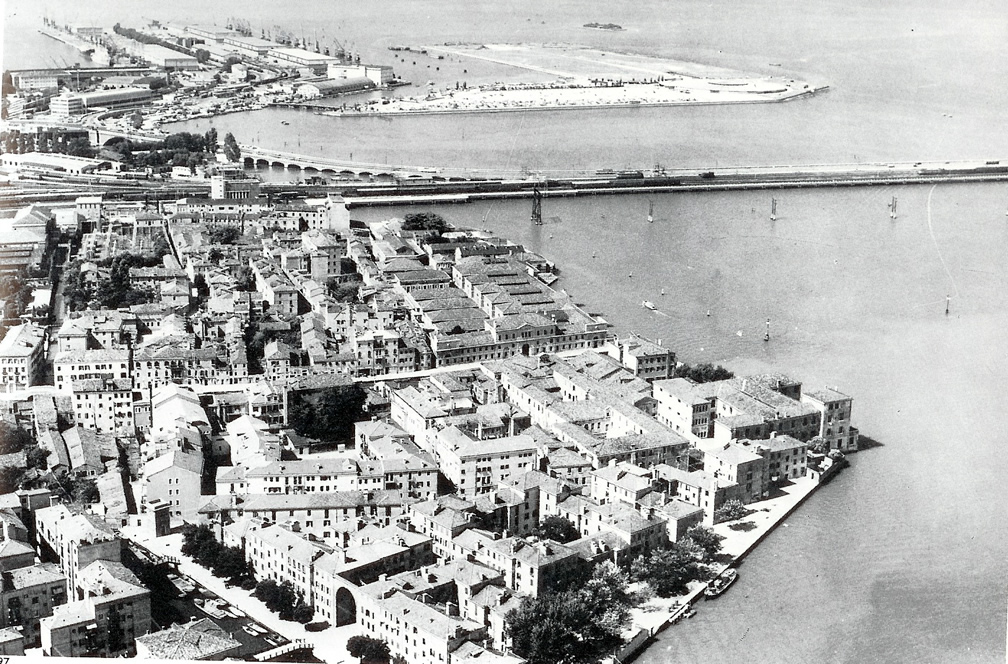 The Liberty Bridge connecting Venice to the Mainland Now, as we go through this list of improvements, we must say that such efforts at modernisation also involved taxes on the citizens at a time when economy was totally neglected, the port of Trieste having gained much of Venice’s trade.
In 1846 the city effectively lost her insular status, when the first railway bridge across the lagoon was opened. 14 yrs later a stretch of historic buildings on the Grand Canal, including the church of St. Lucia from which the station derives its name, were ruthlessly demolished to make way for new terminal buildings.
Italy
After the annexation to the newly-formed Italian nation in 1866, the policies for modernising the city were given new life by the greater commitment of the new Italian administration. Impetus was given to the development of Venetian industry.
 Among the new economic ventures was the Mulino Stucky, a flour-milling complex on the Giudecca which is now being converted into a conference center.
After the first World War, the most significant manifestation of the rise of the borgeois was the development of the Venetian Lido. When Goethe had visited the Lido in 1786 the long sandy island had been inhabited only by a few fishermen and the Benedectine monks of St. Nicolò.
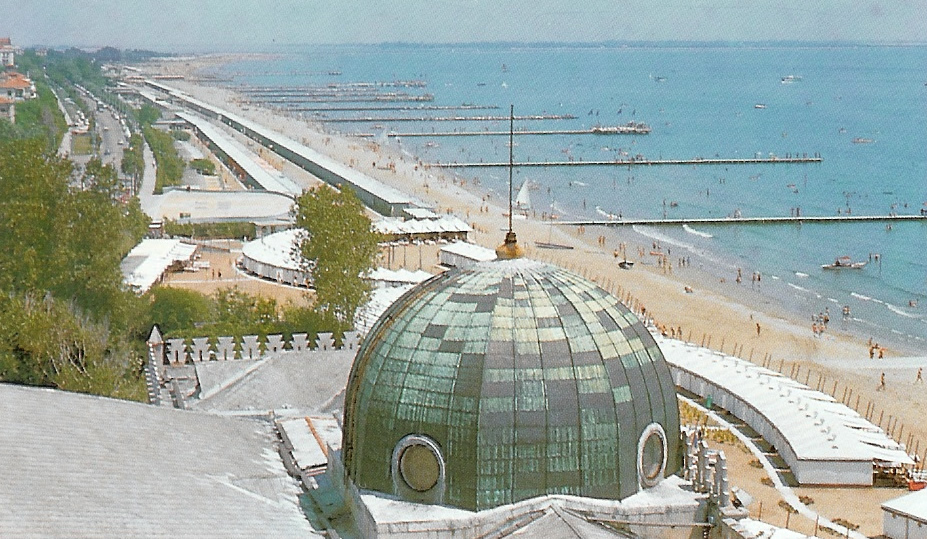 Then, progress! The first bathing establishment on the Lido was opened in 1857.
By the time that Thomas Mann published his novel “Death in Venice” in 1912, the Lido had become one of the bourgeois playground of Europe.
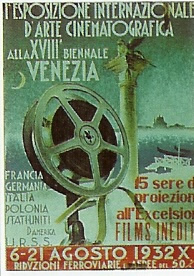 The consecration of the Lido as a very exclusive sea-side resort came with the first Biennale Exhibition of Cinematographic Art in 1932, the first movie festival ever conceived . The aim of the event was to raise cinema to the same level of the other arts”. On that occasion “Dr. Jeckyll and Mr. Hide” (Rouben Mamoulian) represented he Us and “Faithful Heart” (Victor Saville) the Uk.
And Venice was also invested by this wave of urban restructuring schemes.
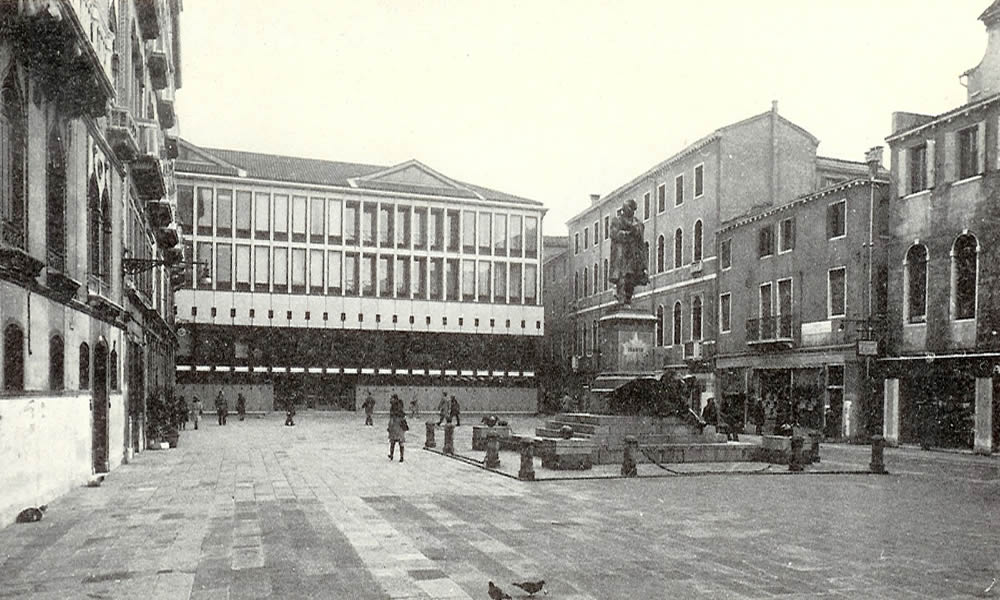 The modern Bank in Campo Manin The building of the Cassa di Risparmio in Campo Manin is an example of modern architecture in the city clashing with the context in which it is inserted. The erection of the building in 1964 proved disastrous for the massive structure dragged down the piling structure of the surrounding buildings.
Luckily, today rigid planning restrictions control the erection of new buildings as well as visible alterations to historic buildings.
After the First World War, the stage was set for the deterioration and depopulation of Venice. In 1917 the Ministry for Work approved the project for an industrial port to be located on the immediate coastline of the terra-firma. The industrial port attracted its workforce from the hinterland rather than providing employment for the Venetians. And those Venetians who found employment there, left Venice to live in nearby Mestre, thus beginning a wave of migration towards cheaper and more comfortable housing which reduced the population of Venice to 70,000 souls, one third of what it used to be.
The creation of the industrial park and its enlargement in the 60’s upset not only the city’s balance but the equilibrium of the lagoon as well. And it is not just a matter of pollution…
The industries in fact have contributed to the aggravation of a phenomenon which we familiarly call acqua alta, high tide.
Problems of the present days
 The acqua alta has always been a natural feature in Venetian life. We have records of disastrous floods as early as in 1240, like this one, reporting that ” Today the water was the height of a man above the streets”.
The acqua alta is in fact a combination of seasonal tides and particular weather conditions. The lagoon is connected with the Adriatic sea, and therefore the lagoon basin experiences two high tides and two low tides every day.
During high tide the sea flows in through the three port-mouths that provide access to the lagoon; then, during ebb tide it flows back out into the Adriatic, carring refuse with it. The motion of water within the basin is circular, and because of this scouring action Venice didn’t need sewers. Twice-daily tidal movements were enough until fairly recently to keep the water relatively fresh.
Now, it is a southern, warm wind which alters the natural flowing of water. First it forces the water of the Adriatic sea through the three port-mouths and then its constant blowing prevents the water from flowing back out again.
The presence of the industrial area – however – has aggravated this phenomenon. Firstly, as you can see on this slide the industries were accommodated on a portion of land which had to be reclaimed, quite vast as you can see, so that space to contain the mass of water flowing in the lagoon has been reduced (the effect is similar to throwing a stone in a basin).
Furthermore, the three channels that provide access to the lagoon have been deepened to allow big tankers through the lagoon.
Consider that in the old days submerged sandbanks protected access to the lagoon, water spilled slowly across it and the violence of the tides was thus cushioned. Ships-of-the-line were brought from and to the Arsenal by attaching to them some kind of pontoons called “camels” to reduce their draught. (It was a protection from enemies..)
Finally, subsidence. Industries (1930) drew millions of gallons of water from artesian wells and that caused a dramatic fall in the water table (18 cm ca.), the sinking which had been going on slowly, about half inch in ten years, became relatively rapid, about two inches in ten years, until the danger of this operation was detected and the practice stopped.
As Venetians, we have grown used to acqua alta. In our own way, we are organized. We have our rubber boots, an alarm which sets off and can be heard in the whole lagoon. And then all the gang-planks where people can walk on. Yet, in the last fifty years, because of the reasons I have just listed, the phenomenon has presented itself more and more frequently, flooding being more and more disastrous.
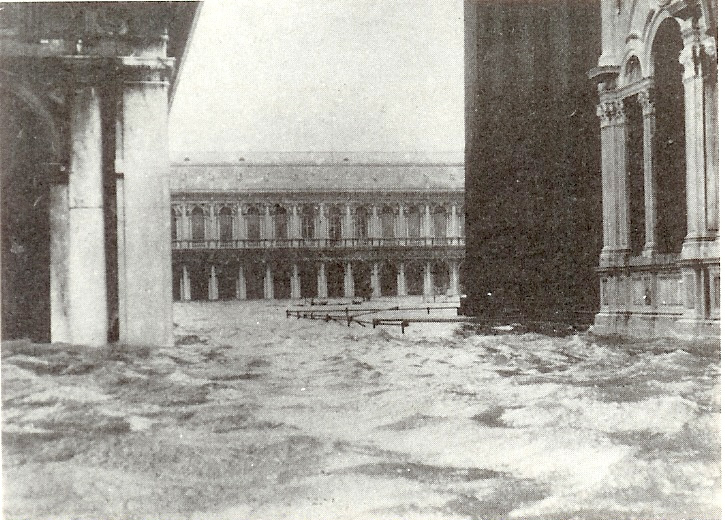 The most disastrous of all floods is that recorded in November 1966, year when the Arno overflowed in Florence. The water in St. Mark’s – which is one of the lowest areas in the city – had risen six and a half feet above normal. Water was lashing in, huge waves were breaking against the columns of St. Mark. All telephone lines were out of order, electricity had failed, most of the gas lines were disrupted, all ground-floor stores and dwellings were flooded. It was impossible to move about the city except by boat. Ebb tide was expected around 6:00 PM. Six o’clock had arrived and to everyone’s dismay and terror the water had not receded, it had risen.
 By 8:00 PM the Venetians, marooned in their unlighted, unheated homes, realized that it wasn’t just another acqua alta, that was a major disaster. Then suddenly, shortly after 9:00 PM the water began receding. By midnight Venice was above water and the Venetians were out in their boots to inspect the havoc by candlelight.
The Flood in November 1966 To some the scene looked like a gigantic funeral: skeletons of boats and gondolas, mattresses, garbage, dead pigeons and rats were scattered everywhere, floating in the canals. Damage estimates ranged as high as $ 64,000,000. Injury to the monuments was all but incalculable.
(On December 2nd of that very same year the then Director of Unesco called upon for contributions to the safeguard of Venice and Florence.
In 1973, when the Italian government enacted its first Special Law for Venice, Unesco transferred its emergency office in Rome to Venice.)
The disastrous floods have also resulted in urging a solution to the problem.
The Mose
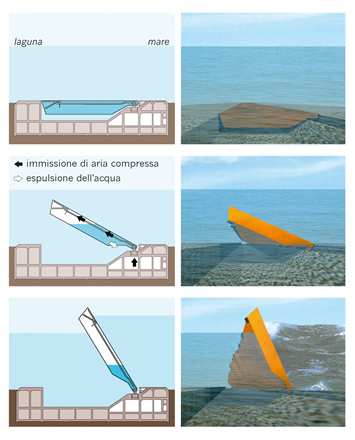 The solution to the problem should to be some sort of a submerged barrage system called Mose, after the great manipulator of waters.
The costly project was to involve laying 80 steel flaps on the floor of the 3 canals that provide access to the lagoon; in case of emergency the ballast is released from the flaps and the barrier rises to protect the city. Yet Mose remains a very controversial issue and many experts and politicians are still criticizing it. It has been the object of extensive studies and testing, but experts claim the problems are the deeper effect of a series of neglect and rushed-in decisions that never showed any consideration for one fact: that the existence of Venice has always depended on the equilibrium of its lagoon, something the old Venetians were very much aware of.
In the 13C the government had established a body in charge of all public and private waters. A proper Magistracy wascreated in 1501.
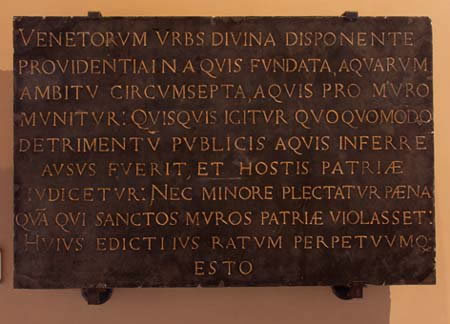
A plaque dating from the 16th C reads:
“The city of the Venetians, with the help of the Divine Providence, was founded on water, it is encircled by water, it is defended by water instead of walls: thus, any-one who attempts in whatever way to harm the public waters should be declared enemy of the city and judged as he who violates the sacred walls of his home country. The validity of this edict is perpetual“.
So we finish with this: the testimony of the great love the old Venetians had showed for their city, a city which is the triumph of a people who turned barren mudflats into a supreme work of beauty. A city which deserves and demands respect from all of us.
Written by C. Trevisan and L. Sabbadin
Venice Guide and Boat © 2005-2018 All rights reserved
VGB Blog
The Venice Film Festival: A Complete Visitor’s Guide to the World’s Oldest Film Festival
Every year in late August and early September, Venice — which for the preceding weeks has been managing the logistical and human pressures of peak tourist season — undergoes a transformation. The focus of the city shifts southward to the Lido, the long barrier island that separates the lagoon from the Adriatic. The Palazzo del […]
Venice Ghost Stories and Legends: The Dark, Mysterious and Supernatural Side of the Serenissima
Every city of sufficient age accumulates its shadows — the stories that explain the things that cannot quite be explained, the legends that attach themselves to old buildings like moss to stone, the rumours that persist long after anyone can verify their origins. Venice, which has been accumulating history since the 5th century and which […]
Venice Solo Travel: Why Going Alone Is the Best Way to Experience One of the World’s Greatest Cities
Venice and solo travel are made for each other. This is not the conventional wisdom — the conventional wisdom says Venice is a city for couples, for romantic weekends, for the honeymoon gondola ride at sunset. And Venice is absolutely all of those things. But it is also, and perhaps more profoundly, a city for […]
Venice with Limited Mobility: A Complete, Honest Guide to Accessible Travel in One of the World’s Most Extraordinary Cities
The first thing to say about Venice and accessibility is this: Venice is significantly more accessible than most visitors with limited mobility expect, and significantly less accessible than an ideal city would be. Both of these facts are important, and this guide addresses both honestly.

