Venice Guide and Boat
The Venice Gondola Ride: A Complete, Honest Guide to Everything You Need to Know
There is no vessel more associated with Venice than the gondola. It appears on every postcard, in every film set in the city, in the imagination of every visitor before they arrive. It is simultaneously the most iconic image in Venetian tourism and, for many visitors, the experience about which they have the most uncertainty: Is it worth it? How much does it cost? Which route should I take? Can I negotiate the price? Will I feel ridiculous?
This guide answers all of those questions — honestly, practically, and with the historical and craft context that transforms the gondola from a tourist cliché into what it actually is: one of the most extraordinary pieces of naval engineering in human history, still built by hand in Venice by a handful of craftsmen using techniques unchanged for five centuries, and still navigated through the city’s canals by gondoliers who have undergone years of training and examination before they are permitted to take passengers.
By the end of this guide, you will know exactly what to expect from a gondola ride, how to get the best value from the experience, which routes and timings offer the finest vantage point, and when a gondola is — and is not — the right choice for what you want.
What Is a Gondola? The Engineering Behind the Icon
The gondola is not simply a black boat. It is one of the most technically refined watercraft ever designed — a vessel so precisely calibrated to its environment that every dimension, every curve and every asymmetry serves a specific engineering function.
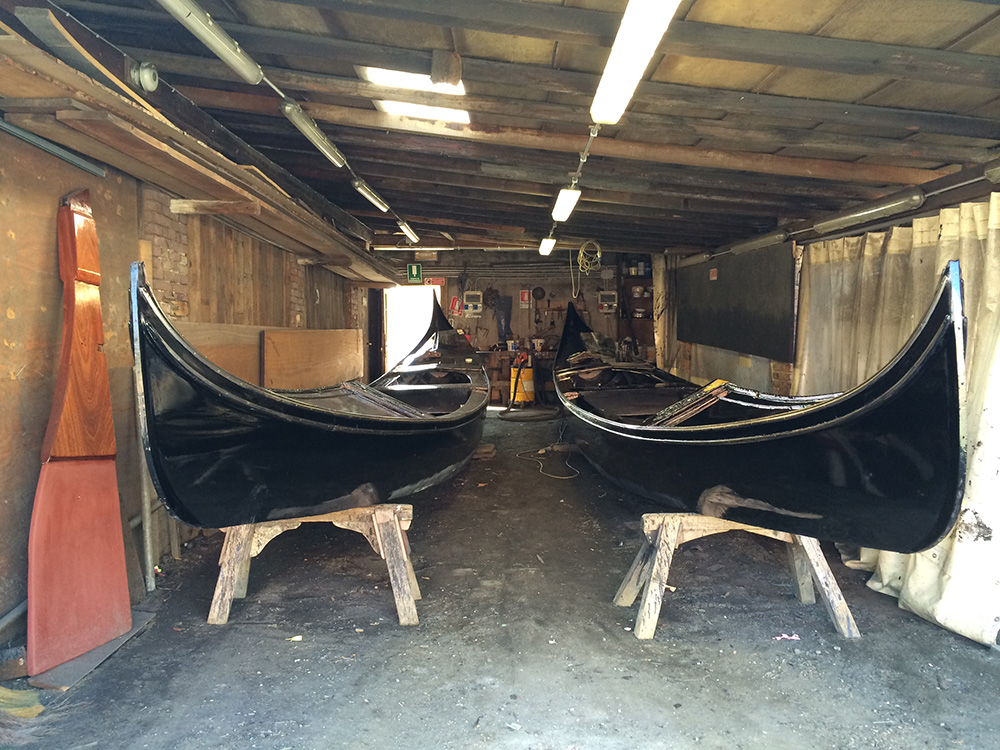
The gondola as it exists today is approximately 11 metres long and 1.4 metres wide, weighing around 350 kilograms before passengers. It has a flat bottom, which allows it to navigate the shallow canals of the historic centre, and a distinctive asymmetric hull: the left side is slightly longer than the right, which counteracts the rotational force of the gondolier’s single oar and keeps the boat moving in a straight line without a rudder. This asymmetry — worked out through centuries of empirical refinement and now precisely specified to within millimetres — is the single most technically sophisticated element of the design and the thing that most distinguishes the gondola from any other type of boat.
The gondola is built from eight different types of wood — fir, oak, cherry, walnut, elm, mahogany, lime and larch — each chosen for a specific structural or aesthetic purpose, assembled in a process that takes approximately two months and requires the combined skills of multiple specialist craftsmen. It is painted black — a custom that dates to a 1562 sumptuary law of the Venetian Republic, which forbade the display of wealth through the decoration of gondolas (previously elaborately gilded and painted in family colours).
The anatomy of a gondola
| Part | What It Is and Why It Matters |
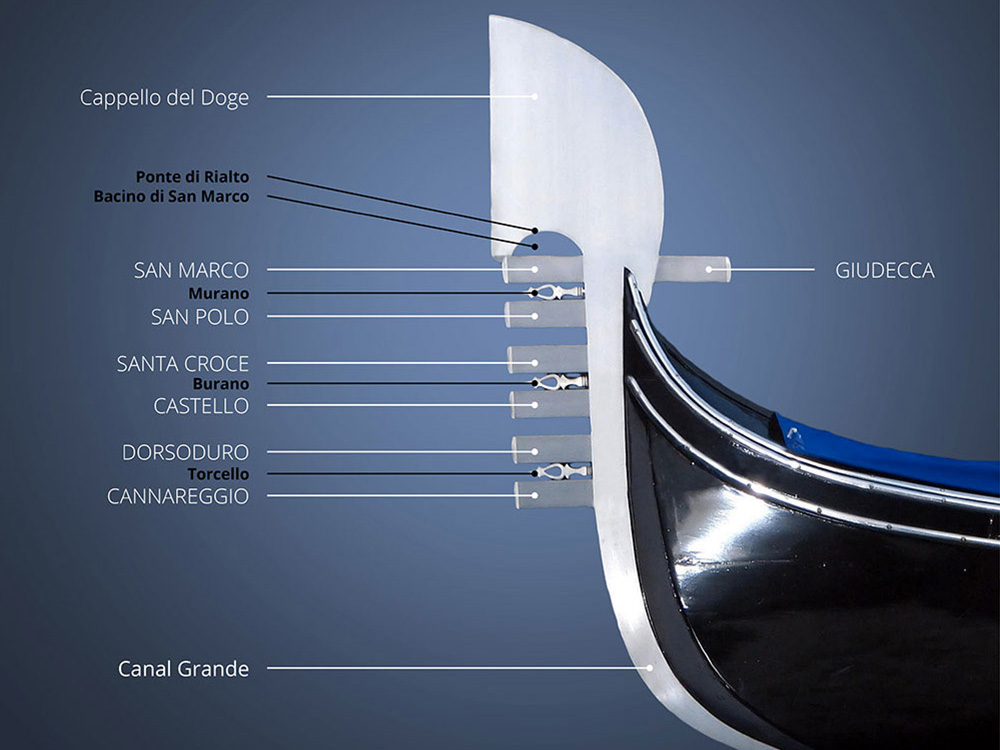
| Ferro (prow ornament) | The distinctive iron prow ornament — one of the most recognisable silhouettes in Venice. The six horizontal prongs traditionally represent the six sestieri of Venice; the single upper prong represents the Giudecca island; the curved top represents the Doge’s cap. The ferro also functions as a counterweight to the gondolier standing at the stern. |
| Forcola (oarlock) | The carved wooden oarlock — arguably the most complex oarlock in the history of boatbuilding. A single forcola has eight working positions for the oar, allowing the gondolier to apply force in any direction and to vary the stroke for speed, turning, stopping and reverse. Each forcola is individually carved for a specific gondolier’s physique and rowing style. |
| Remo (oar) | The gondola oar is approximately 4.2 metres long, made from beech wood. The gondolier rows standing, from the stern, with a single oar — a technique that requires years to master and produces the gondola’s characteristic silent, gliding motion. |
| Felze | The small cabin that once enclosed the passenger compartment of the gondola — visible in many historical paintings and photographs. Most gondolas today have removed the felze in favour of open seating; a few specialist operators retain a version for private excursions. The felze gave the gondola its reputation, in the 18th century, as the private space par excellence — the place for assignations that the Venetian Carnival culture celebrated. |
| Risso (cushions/fittings) | The traditional black upholstery of the passenger seats, with the distinctive brass fittings of the armrests and footrests. The quality of the upholstery is one of the indicators of the quality of the individual gondola and its operator. |
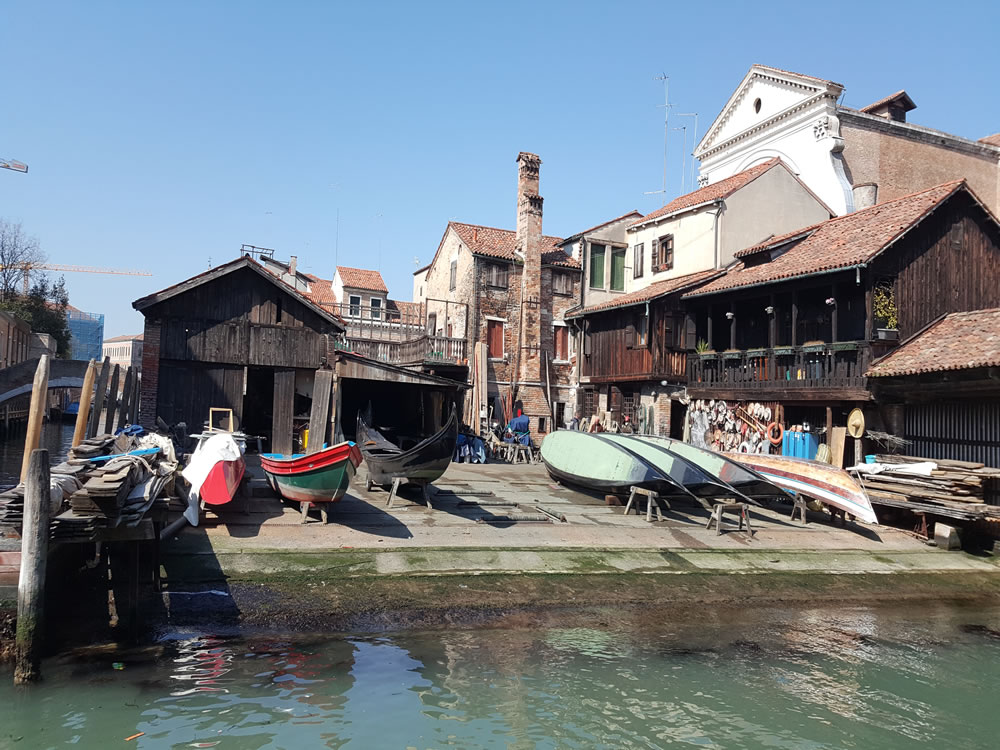
| Squero | Not part of the gondola itself, but the boatyard where gondolas are built and repaired. Venice has only a handful of working squeri remaining — the most visited and photographed is the Squero di San Trovaso in the Dorsoduro, visible from the Zattere. A gondola requires regular maintenance and typically lasts 20–25 years. |
| The gondola is the product of a craft tradition as old as Venice itself — evolved over more than a thousand years through continuous refinement in response to the specific demands of the Venetian canal system. It is not a decorative object; it is a precision instrument, and the skill required to build and row one is comparable to any other major artisanal tradition in the city. |
The Gondolier: Training, Tradition and the Licence
Becoming a gondolier is significantly more difficult and more regulated than most visitors assume. The gondola licence (patente da gondoliere) is issued by the Comune di Venezia and is one of the most strictly controlled professional licences in Italy. The examination process includes a written test on Venetian history, geography and regulations; a practical rowing test in which the candidate must demonstrate mastery of the gondola in a range of conditions; and a language test — gondoliers are required to demonstrate communicative competence in at least one foreign language.
The number of licences is strictly limited. When a licence becomes available — through retirement or death of an existing gondolier — it is made available through a public examination. The total number of active gondoliers in Venice is approximately 400, serving a city that welcomes millions of tourists per year.
Gondoliers do not simply row tourists around the canals. They are, in the fullest sense, professional operatives of a transport system that has existed in Venice for more than a thousand years. Many are the sons, grandsons and great-grandsons of gondoliers; the profession has traditionally passed within families, though the examination process is now entirely open. The physical demands of the job — rowing standing, with a single oar, for hours at a time — require a level of fitness and technique that is genuinely impressive and that becomes visible when you watch an experienced gondolier navigate a tight corner in a narrow canal.
In 2010, after centuries of exclusively male gondoliers, the first female gondolier received her licence: Giorgia Boscolo, whose father was also a gondolier. The profession remains predominantly male, but the licensing examination is now open to all.
| The gondolier is not a tour guide. They are not required to provide commentary on the buildings you pass, and many do not — particularly those who are navigating difficult sections of the canal network or whose English is limited. If narrated commentary is important to you, discuss this before boarding, or book a private gondola ride through an operator who can ensure a gondolier with good English and a willingness to explain what you are seeing. |
How Much Does a Gondola Ride Cost? A Clear Guide to Prices
The price of a gondola ride in Venice is set by a tariff agreement between the gondoliers’ cooperative (the Istituzione per la Conservazione della Gondola e Tutela del Gondoliere) and the Comune di Venezia. This tariff is publicly available and applies to all licensed gondoliers. Understanding the tariff prevents the most common source of visitor frustration: paying more than the official rate.
| Option | Duration | Price (approx.) | Best For |
| Standard shared gondola (up to 6 people) | 30 min | €90 | Groups of 3–6 splitting the cost; daytime sightseeing |
| Standard shared gondola (up to 6 people) | 40 min | €120 | Groups wanting a slightly longer route |
| Evening gondola (after 7pm) | 35 min | €110 | Romantic atmosphere; quieter canals; better light |
| Evening gondola (after 7pm) | 40 min | €150 | Evening groups wanting more time |
| Serenade gondola (with musician) | 30 min | €150–200+ | Special occasions; romantic; the classic Venice experience |
| Private gondola (1–2 people) | 30 min | €90+ | Couples; anniversary; exclusive experience |
| Traghetto (Grand Canal crossing) | 2 min | €2 | Quick canal crossing; the gondola Venetians use |
A few important clarifications about the pricing:
- The official tariff is per gondola, not per person. A group of six sharing a gondola pays €90 total (€15 per person) for the standard 30-minute ride — which is excellent value. A couple sharing a gondola pays €90 for two — significantly more per person but still a fixed, predictable cost.
- The 30-minute duration is strict — gondoliers will end the ride at the agreed time unless an extension is negotiated and agreed in advance. Extensions are charged in additional 20-minute increments at the same proportional rate.
- The evening premium (after 7pm) is official and applies to all gondoliers equally. The canals are quieter and more atmospheric in the evening, and many visitors consider the evening rate worth paying.
- The serenade option — a musician (typically an accordion player or a singer) accompanying the ride — is available at a supplement and is arranged through the gondolier or through the gondola stand. The singing gondolier of popular imagination does not generally exist; singing on gondolas is specifically provided by hired musicians.
- Haggling is ineffective and unnecessary. The tariff is fixed and publicly known. A gondolier who quotes significantly less than the official tariff is either offering a very short ride or creating conditions for a dispute at the end.
| The most important practical tip about gondola pricing: agree the duration, the price and the route explicitly before you board. Point to what you are agreeing to on the official tariff card (which gondoliers are required to display). This eliminates the possibility of misunderstanding at the end of the ride. |
The Traghetto: Venice’s Secret Gondola
There is a version of the gondola ride that almost no tourist knows about and that every Venetian uses: the traghetto. Traghetti are the public gondola ferries that cross the Grand Canal at seven points where there is no bridge — allowing pedestrians and cyclists to cross the canal for a fixed fare of €2.
The traghetto is rowed by two gondoliers, carries up to 15 passengers, and crosses the Grand Canal in approximately two minutes. Venetians traditionally ride the traghetto standing (though sitting is now permitted on most lines for those who prefer it). The ride is brief, the view is extraordinary — you are at water level, in the middle of the Grand Canal, surrounded by palazzo facades in both directions — and the price-to-experience ratio is among the highest in Venice.
The traghetto stands in Venice are at: Santa Sofia (near the Ca’ d’Oro), Riva del Vin (near the Rialto market), San Tomà (near the Frari church), Santa Maria del Giglio, San Barnaba, Rezzonico and Santa Chiara. Hours vary by line and season; many operate primarily in the morning and early afternoon.
| The traghetto is the gondola that Venetians actually use — the functional, daily-life version of the iconic tourist ride. Standing in a traghetto, crossing the Grand Canal among shoppers and students and restaurant workers, surrounded by the facades of the great palaces, for the price of a bus fare: this is the most authentic water experience available in Venice, and almost nobody knows it exists. |
The Best Routes and Timings for a Gondola Ride
Not all gondola routes are equal. The canals of Venice vary enormously in character — from the wide, busy Canale della Giudecca to the narrow, silent calli d’acqua of the interior network — and the experience of a gondola ride depends significantly on which canals you traverse and at what time of day.
| The Interior Canal Network San Marco / San Polo / Santa Croce The narrow inner canals of the historic centre — the experience most people imagine. Silent, shaded, the buildings pressing close on both sides, occasional glimpses of private gardens and Gothic windows. The finest gondola experience for atmosphere. | Rio di San Trovaso and Dorsoduro Dorsoduro sestiere Some of the most beautiful canal perspectives in Venice, passing the church of San Trovaso and the Squero di San Trovaso (the most visible working gondola boatyard). Quieter than the San Marco routes, with a more residential character. |
| Around San Marco and the Bacino St Mark’s waterfront A route that includes a section of the Bacino di San Marco — the open water in front of the Doge’s Palace, with views of San Giorgio Maggiore across the water. More exposed than the inner canals but with the most dramatic views of the principal monuments. | Rio di Cannaregio Cannaregio sestiere The wide canal that runs through the heart of Cannaregio towards the lagoon. Less touristy than the central routes, with a more working-class residential character. The approach to the Jewish Ghetto from the water is particularly atmospheric. |
| Evening on the Inner Canals Any central route, after 7pm The canals at dusk and after dark have a completely different quality from the daytime — quieter, the lights of the buildings reflected in the water, the sounds of the city softened. The evening gondola ride is the most romantic experience Venice offers. | Sunrise / Early Morning Any route, before 8am A private gondola before the city wakes — almost entirely without other tourists, the early light extraordinary on the stone and water. Requires advance arrangement and an early departure, but produces the finest photography and the most intimate experience. |
| The best gondola route is one that includes as many narrow interior canals as possible and avoids the main tourist thoroughfares. Ask your gondolier specifically to take you through the quieter calli d’acqua — the inner residential canals that most tourist routes skip in favour of the more dramatic but more crowded central waterways. A good gondolier will understand the request and will know which canals offer the finest views at the current time of day. |
Gondola vs Other Water Transport in Venice
| Gondola | Water Taxi | Vaporetto | Traghetto | |
| Purpose | Sightseeing / experience | Practical transport | Public transport | Canal crossing |
| Price | €90–200 per gondola | €15–50 per trip | €9.50 (day pass) | €2 per crossing |
| Speed | Very slow — deliberate | Fast | Moderate | 2 minutes |
| Capacity | Up to 6 passengers | Up to 10 passengers | Up to 200 passengers | Up to 15 passengers |
| Privacy | Your group only | Your group only | Public — shared | Public — shared |
| Canal access | Narrow inner canals | Wider canals only | Main routes only | Grand Canal crossing |
| Best for | Experience; atmosphere; occasions | Fast transfers; luggage | Getting around cheaply | Quick crossing; local life |
| Booking | Stand or advance booking | Phone/app or stand | Ticket at stop | No booking — just arrive |
Is a Gondola Ride Worth It? An Honest Assessment
This is the question most Venice visitors ask before they arrive — and the honest answer is: it depends entirely on what you are looking for and how you approach it.
A gondola ride is worth it if you understand what it is. It is not a tour. It is not a sightseeing experience in the sense of moving efficiently from one landmark to another. It is a 30-minute encounter with Venice from a particular vantage point — at water level, in a historic vessel, moving at a pace that allows you to look carefully at buildings that were designed to be seen from exactly this angle. The perspective from a gondola is genuinely different from the pedestrian perspective, and genuinely different from the vaporetto perspective — it is lower, slower and quieter than either, and it opens up views of the interior canal network that no other means of transport provides.
A gondola ride is not worth it if you approach it expecting entertainment. The gondolier will not sing (unless you have specifically arranged a serenade). The route will not include a verbal tour of Venetian history. The 30 minutes will pass quickly, and if you spend them looking at your phone or worrying about the price, you will feel that it was not worth the money.
The visitors who consistently report that a gondola ride was one of the highlights of their Venice trip are those who approached it with the right expectations: as a brief, beautiful, meditative experience of being on the water in a very old city, in a very old boat, moving at the pace the city was designed for. Those who approach it as a theme-park attraction are often disappointed.
Our recommendation: book a gondola ride for the evening (after 7pm), on a night with good weather, for the quieter inner canals. Agree the route and duration in advance. Leave your phone in your pocket. Look at the buildings. Look at the water. Let the 30 minutes be what they are.
Practical Tips: How to Book, Board and Make the Most of It
Where to find a gondola
Gondola stands (stazi) are located throughout the historic centre at well-marked locations. The most convenient are: Piazza San Marco (two stands — one near the Doge’s Palace, one at the Bacino Orseolo), the Rialto Bridge (both sides of the Grand Canal), the Accademia Bridge (Dorsoduro side), the Ferrovia stand near the train station, and several locations along the Riva degli Schiavoni. Each stand has a sign displaying the official tariff.
Booking in advance
Walk-up gondola rides are available at any stand throughout the day and evening. In peak season, stands near the major tourist sites can have a short wait; those in the quieter sestieri (Cannaregio, Castello, eastern Dorsoduro) typically have gondolas available immediately. Advance booking through a licensed operator is an option for evening rides and serenades, and is recommended for special occasions to ensure availability at a specific time.
What to ask before boarding
- Confirm the duration and price before you step in. Point to the official tariff if there is any uncertainty.
- Ask whether the gondolier speaks English, if commentary is important to you.
- Specify which type of canal you prefer — interior (narrow, quiet) or main waterways (more open, more views of monuments).
- For evening rides, confirm the exact departure time so that the light conditions are what you are hoping for.
- For serenades, confirm whether the musician is included in the quoted price or charged separately.
Boarding and safety
Gondolas are stable but require attention when boarding. Step into the centre of the boat, not onto the side, and sit down immediately. The gondolier will instruct you. Do not stand in the gondola during the ride — this is a safety issue and will be firmly discouraged. Children should be seated and supervised; life jackets are not standard but can be requested for young children.
Photography
The gondola provides exceptional photographic perspectives — particularly in the narrow inner canals, where the viewpoint is unique. The canal reflections, the building facades at water level, the stern of the gondola with the gondolier silhouetted against the sky: these are images that cannot be obtained from land. The low position of the gondola also catches the light on the water in ways that are genuinely surprising for visitors accustomed to seeing Venice from bridges and quaysides.
Tipping
Tipping is not obligatory and is not included in the official tariff. A tip of €5–10 per gondola for a ride that has been particularly good — a gondolier who provided excellent commentary, who found a particularly beautiful route, or who handled a special occasion with care — is appreciated but not expected. Do not feel pressured to tip beyond what the experience merited.
The Gondola and Venice’s Wider Water Culture
The Regata Storica
The most spectacular event in the Venetian gondola calendar is the Regata Storica — the Historical Regatta, held on the first Sunday of September each year. The Regata begins with a procession of historical boats along the Grand Canal, with rowers in Renaissance costume representing the ceremonial vessels of the Venetian Republic. This is followed by a series of competitive races in different categories of traditional Venetian boats, culminating in the gondolini race — a race of two-oared racing gondolas that is the most prestigious event in the Venetian rowing calendar.
Watching the Regata Storica from a private boat positioned on the Grand Canal is one of the finest experiences available in Venice, and Venice Guide and Boat can arrange viewing from the water for this event.
The Vogalonga
The Vogalonga — literally the long row — is a non-competitive rowing event held on the Venice Lagoon in May, on the first Sunday after Ascension. Open to any kind of traditional rowing boat, it attracts several thousand rowers from across the world and involves a course of approximately 30 kilometres around the outer lagoon. The spectacle of thousands of boats rowing through the lagoon, passing the outer islands and returning through the Grand Canal, is one of the most joyful and genuinely Venetian events of the year.
Voga alla veneta
The traditional Venetian rowing style — voga alla veneta — is entirely different from any other rowing tradition. It is practised standing, facing forward, using the oar in a sculling motion rather than a pulling one. This technique allows the rower to see where they are going, to navigate the narrow canals with precision, and to communicate with other boatmen — all advantages that the blind-rowed technique of other traditions does not provide. The forcola’s multiple working positions make it possible to apply force in any direction without changing stance, giving voga alla veneta a flexibility and control unmatched by any other rowing technique.
Venetians learn voga alla veneta from childhood, and the city has a network of rowing clubs (the Remieri) that teach the style to all ages. Visitors who want to try the technique can arrange a lesson through several operators in the city — an experience that is both physically demanding and genuinely illuminating about the relationship between Venice and its water.
Frequently Asked Questions
How much does a gondola ride cost in Venice?
The official tariff (set by the gondoliers’ cooperative and the City of Venice) is €90 for a 30-minute shared ride during the day (up to 6 passengers per gondola), and €110 for an evening ride (after 7pm). Extensions are charged at a proportional rate per additional 20 minutes. The serenade option adds €30–50 for a musician. These prices are per gondola, not per person — a group of 6 sharing a gondola pays €15 per person for the standard daytime ride.
Is it worth getting a gondola in Venice?
Yes — if your expectations are appropriately calibrated. A gondola ride is not a tour; it is an experience of Venice from the water, at a specific pace and vantage point that no other form of transport provides. For visitors who approach it with openness and presence rather than expecting entertainment, it is consistently one of the most memorable experiences of a Venice visit. The evening ride, in particular, in the quieter inner canals, is one of the genuinely beautiful experiences the city offers.
Can you negotiate the price of a gondola in Venice?
No. The tariff is fixed by official agreement and applies to all licensed gondoliers. A gondolier who offers a price significantly below the official tariff is either offering a very short ride, planning to request additional payment at the end, or operating outside the licensed system. The official tariff cards are displayed at all gondola stands and should be consulted before boarding.
How long is a gondola ride in Venice?
The standard ride is 30 minutes. Longer rides (40 minutes, one hour) are available at proportional rates and should be agreed in advance. The 30-minute duration passes quickly — experienced visitors generally agree that 30 minutes is enough to absorb the essential experience, and that the desire for more time is usually the product of not having relaxed into the first 30 minutes sufficiently.
Where is the best place to start a gondola ride in Venice?
For the finest experience of the inner canal network, boards from the Bacino Orseolo stand (just behind St Mark’s Square, accessed through a small sotoportego) or from the San Tomà stand in San Polo (near the Frari church) give access to the quieter residential canals of the historic centre. For the most dramatic Grand Canal views, the stands near the Rialto Bridge or the Accademia Bridge offer the Grand Canal itself as part of the route.
Do gondoliers sing in Venice?
Not as a standard feature of the ride. The singing gondolier is a tradition that survives today in the form of the serenade gondola — a service involving a hired musician (accordion, mandolin or voice) who accompanies the ride. This can be arranged at most gondola stands and through private tour operators, at a supplement to the standard fare. The serenade experience is genuinely beautiful, particularly in the evening, and is worth the additional cost for special occasions.
The Gondola as a Way of Seeing
The gondola is, in the end, a perspective — a specific way of seeing Venice that has been available to visitors for five centuries and that remains, despite every change in the city around it, irreplaceable. The vantage point it offers — at water level, moving slowly through canals built on a scale designed for exactly this kind of vessel — reveals a Venice that is invisible from the bridges and quaysides. The reflection of the buildings in the water below, the shadow of the bridge passing overhead, the sudden opening of a wide campo visible through a sotoportego, the sound of the oar in its forcola — these are sensations that can only be had in a gondola, and that cannot be photographed or described with full fidelity.
Understanding the gondola — its engineering, its craft, its history, the skill of the gondolier, the tradition of voga alla veneta — makes the experience significantly richer than approaching it as a generic tourist attraction. This guide has tried to provide that understanding. The rest depends on 30 minutes of presence, attention and willingness to let Venice work on you from the water.
| Venice Guide and Boat can arrange private gondola rides as part of a broader Venice itinerary, with guidance on the finest routes and timings for your specific visit. For special occasions — anniversaries, proposals, celebratory evenings — we can coordinate the gondola with dinner and a sunset boat excursion for a complete evening on the water. Contact us for details. |

