
Venice Guide and Boat
Murano Glass making
The glass making has long-standing roots which can be traced back over three thousand years ago. It’s quite difficult to determine with certainty which people can boast the discovery of glass making, which probably was the consequence of an accidental invention.
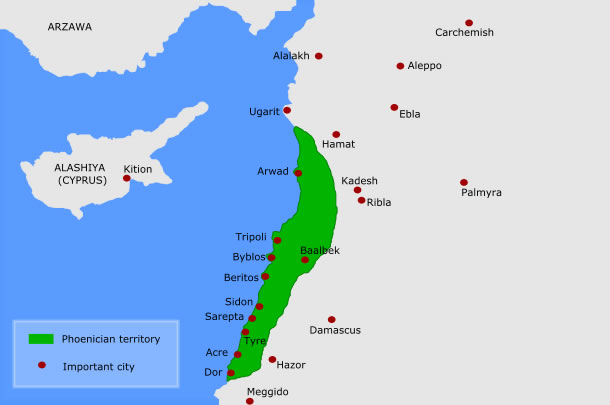
Map of the Phoenician settlements
According to an ancient Phoenician legend, handed down by Pliny the Elder (AD 23 –AD 79), some merchants, returning from Egypt with a large shipment of sodium carbonate, stopped one evening along the banks of a river to rest. They used few blocks of saltpeter to light a fire and cook some food. The fire kept on burning all night long, and in the morning they found with amazement a new bright and transparent material: glass!
The oldest archaeological finds of glass pastes date back to around the fourth millennium BC and were found in the area stretching from the Mesopotamian basin to Egypt: mostly rings, beads, seals, inlays and plates, and this goes to show that the most ancient techniques only allow the production of objects of small dimensions, intended to ritual uses or created for ornamental purposes.
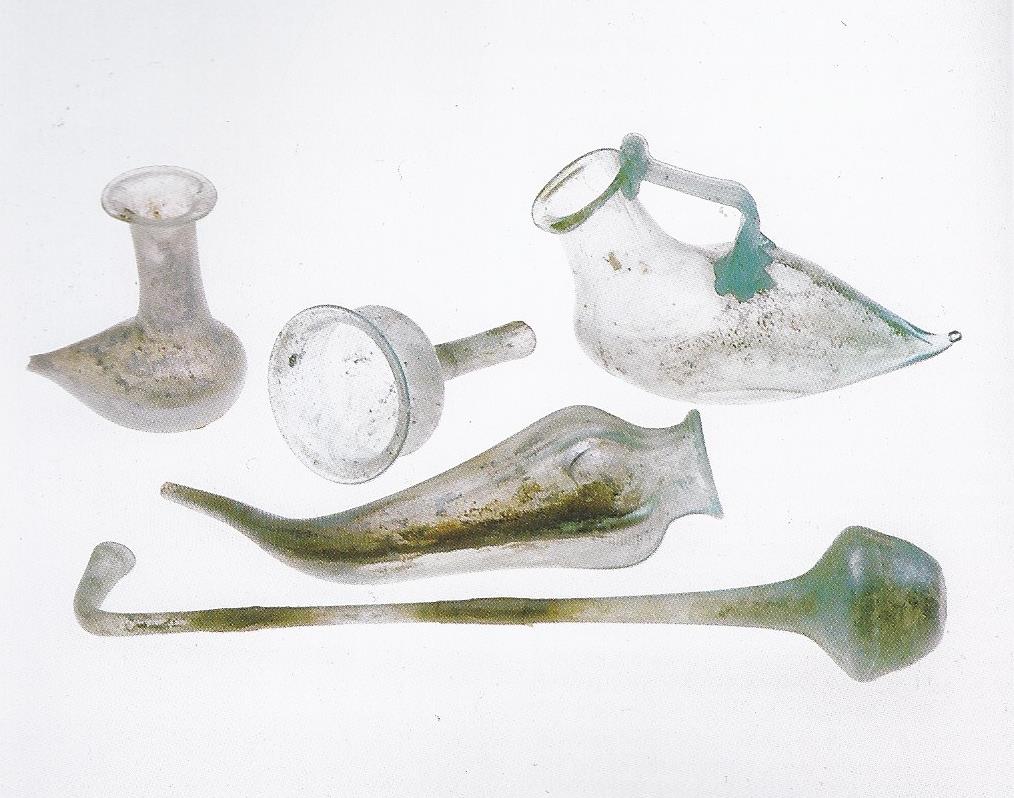
Old glass making products preserved in the Glass Museum of Murano
Apparently, in the early days of the process, the rarity due to the difficulty of production, was to consider the glass as a precious material like semiprecious gems and stones, with which were realized the jewelry.
From the Hellenistic period there was an increase in long-haul trades, and industries began to produce large-scale, and commonly used luxury items. This is when the glass manufacturing experienced a period of prosperity, spreading throughout the Mediterranean.
At the time of emperor Augustus the manufacture of glass, along with the other arts, experienced profound changes. Glass artifacts of that period have been found throughout Europe (France, Switzerland, Austria, Germany and Spain), and in those days the glass industry experienced a productivity growth.
Important production centers were created everywhere, thanks to itinerant craftsmen ready to bring their skills wherever there was demand for glass.
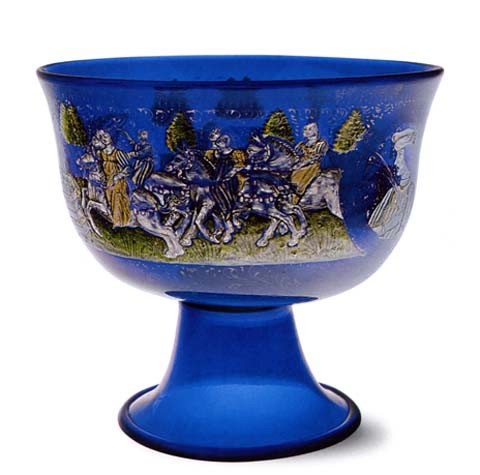
Barovier’s Nuptial Cup (1460) preserved in Murano Glass Museum
The art of glass spread throughout Europe especially during the Roman Empire, and certainly, the phenomenon that favored this expansion is to be found in the orientation to daily use of glass production.
The center of glassmaking in Italy was the island of Murano. Murano’s reputation as a center for glassmaking began when the Venetian government, in order to prevent fires in the city centre, ordered to move all glass furnaces to the island of Murano in 1291. From then on all the necessary measures to prevent possible industrial espionage were taken.
Murano glass production became such a thriving industry that, until the end of the 18th C, the island was Europe’s leading centre for glass making.
The art of glass blowing in Murano achieved soon great results, due to the technological innovations introduced by Angelo Barovier, the greatest glassmaker of the 15th C, who in 1460 created the most precious masterpiece of glass art: the famous “Barovier Cup”, made of enameled blown glass, now preserved in the Glass Museum in Murano.
A visit to Murano glass making factories today offers the opportunity to see how glass is still made, with the same techniques used in the past. You can also enrich the experience with the visit of the Glass Museum to admire the precious old glass works of art which are still today inspiring the glass masters of Murano.
VGB Blog
Venice Tourist Traps to Avoid: An Honest Guide to Scams, Overcharges, and How to Sidestep Every One
Roughly twenty million visitors pass through a historic centre that houses around fifty thousand residents — a ratio unlike almost anywhere else in Europe. That imbalance has produced, alongside the extraordinary art and architecture Venice is actually famous for, a small but persistent economy built entirely around the gap between what a first-time visitor knows […]
The Venice Spritz: History, Variants, and Where to Drink the Best One in the City
The spritz is now one of the most popular cocktails in the world. It appears on menus from Tokyo to Buenos Aires, it has its own emoji in several phone keyboards, and Aperol — its most internationally recognised version — has achieved a level of global ubiquity that would have astonished the Venetians who invented […]
The Venice Film Festival: A Complete Visitor’s Guide to the World’s Oldest Film Festival
Every year in late August and early September, Venice — which for the preceding weeks has been managing the logistical and human pressures of peak tourist season — undergoes a transformation. The focus of the city shifts southward to the Lido, the long barrier island that separates the lagoon from the Adriatic. The Palazzo del […]
Venice Ghost Stories and Legends: The Dark, Mysterious and Supernatural Side of the Serenissima
Every city of sufficient age accumulates its shadows — the stories that explain the things that cannot quite be explained, the legends that attach themselves to old buildings like moss to stone, the rumours that persist long after anyone can verify their origins. Venice, which has been accumulating history since the 5th century and which […]

