Venice Guide and Boat
Murano, Burano and Torcello: A Complete Guide to Venice’s Three Extraordinary Islands
Most visitors to Venice know that Murano, Burano and Torcello exist. They appear on every tourist map, they feature in every guidebook, and the boats that serve them depart throughout the day from the Fondamente Nove and from San Zaccaria. But there is a significant difference between knowing these islands exist and actually understanding what makes each of them extraordinary — and an even larger difference between visiting them on the public vaporetto, squeezed into a crowded boat with hundreds of other tourists, and experiencing them on a private boat with a guide who knows their history, their crafts and their stories intimately.
Murano, Burano and Torcello are three of the most distinctive and historically important places in the Venice Lagoon — each with a completely different character, a completely different aesthetic and a completely different relationship to the city that sits at the centre of the lagoon. Together, they constitute a day-long journey through more than a thousand years of Venetian history: from the ancient Byzantine settlement of Torcello, where Venice’s story effectively begins, to the living craft tradition of Murano’s glass furnaces, to the extraordinary chromatic world of Burano’s coloured houses.
This guide covers each island in depth — what it is, what it was, what to see and what to look for — and explains how to make the most of a visit to all three, with or without a guide.
The Three Islands at a Glance
| Murano | Burano | Torcello | |
| Distance from Venice | ~15 min by boat | ~40 min by boat | ~45 min by boat |
| Character | Industrial craft island, art glass | Fishing village, vivid colour, lace | Ancient, silent, archaeological |
| Main draw | Glass furnaces and Glass Museum | Coloured houses and Lace Museum | Cathedral of Santa Maria Assunta |
| Best for | Craft lovers, shoppers, design fans | Photographers, colourful architecture | History, solitude, authenticity |
| Crowds | High — especially glass factory tours | Very high in summer | Low — the quietest of the three |
| Time needed | 1.5–2 hours | 1.5–2 hours | 1–1.5 hours |
| Must not miss | Glass Museum (Museo del Vetro) | Lace Museum + Via Galuppi for colour | 7th-century cathedral + Byzantine mosaics |
Murano: The Island of Fire and Glass
What Murano is and why it matters
Murano is a cluster of seven small islands connected by bridges, located about 1.5 kilometres north of the historic centre of Venice. It has been the centre of Venetian glassblowing since 1291, when the Republic of Venice ordered all of the city’s glass furnaces to be relocated to the island — ostensibly for fire safety reasons, since the furnaces were creating a serious risk of conflagration in the densely built historic centre, but also as a means of concentrating and controlling the craft that was one of Venice’s most valuable commercial secrets.
The decision to isolate the glassblowers on Murano had profound consequences. Cut off from the mainland city, the maestri vetrai developed an insular, highly specialised culture in which the secrets of glassmaking were guarded jealously and passed from father to son across generations. The Republic rewarded this secrecy with extraordinary privileges: Murano’s glassblowers were permitted to wear swords, their daughters could marry into Venetian patrician families, and they were granted their own governing council and their own system of laws. In return, any glassblower who attempted to leave Venice and take his knowledge to a foreign country was subject to arrest — and, according to some accounts, assassination.
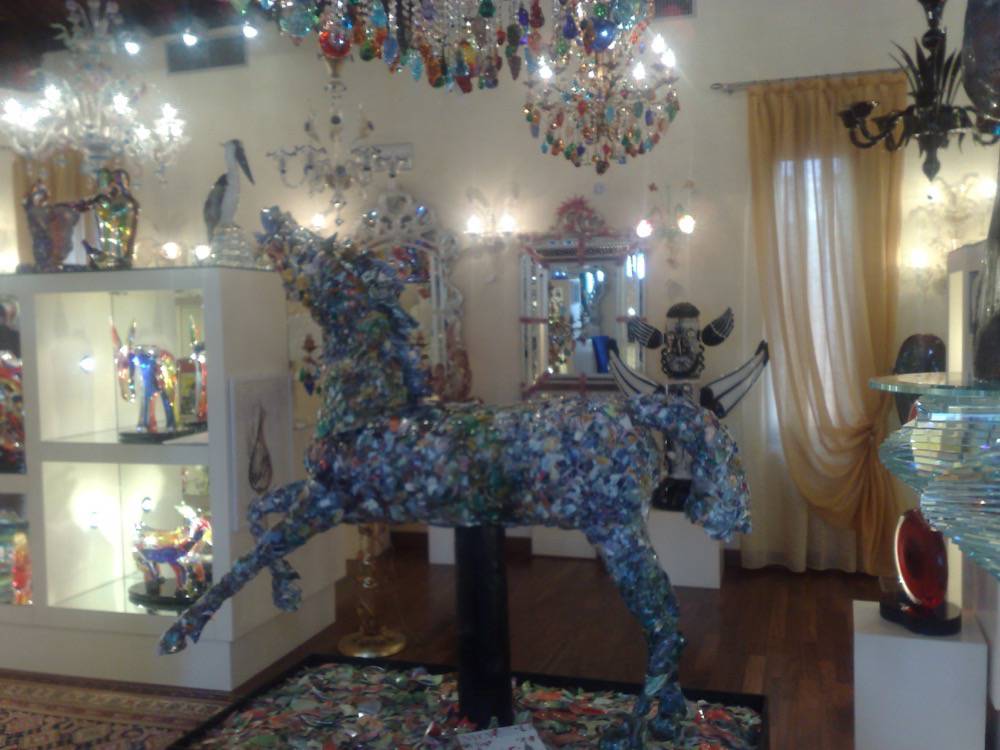
The result of this centuries-long system of isolation and privilege is the most sophisticated glass-making tradition in the world. Venetian glass is not simply transparent glass that has been coloured or shaped — it is a family of distinct techniques, each requiring years of mastery, that produce effects that no other glass-making tradition has replicated: the lattimo (milky white glass that imitates Chinese porcelain), the filigrana (glass thread work of extraordinary delicacy), the murrine (cross-section patterns formed by fusing coloured glass rods), and the sommerso (layers of coloured glass of different densities, shaped to create depth and luminosity). These techniques are still practised on Murano today, by the remaining handful of furnaces that continue to operate in the traditional manner.
What to see on Murano
The most important stop on Murano is the Museo del Vetro — the Glass Museum — housed in the 17th-century Palazzo Giustinian, one of the finest palaces on the island. The museum holds a comprehensive collection of Venetian glass from Roman times to the present day, tracing the development of the island’s craft traditions with exceptional clarity. The historical section, covering the great period of Venetian glass from the 15th to the 18th century, is particularly fine — the filigrana work of the 16th century, and the extraordinary colour experiments of the 17th and 18th centuries, represent achievements that remain technically unmatched.
Beyond the museum, Murano’s main canal — the Canale dei Vetrai — is lined on both sides with glass showrooms and workshops, many of which offer demonstrations of glassblowing. The quality and authenticity of these demonstrations varies considerably. The large tourist-oriented furnaces on the main quay produce competent work designed for rapid sale to visitors; the smaller workshops away from the main canal, where the maestri work more quietly and the glass is less obviously commercial, offer a more genuine encounter with the craft.
Murano also has one of the finest Romanesque churches in the Veneto: the Basilica di Santi Maria e Donato, whose 12th-century apse is one of the great examples of Venetian Byzantine architecture. The floor mosaic inside — laid in 1140 and still largely intact — is a masterpiece of medieval decorative art, and the church is sufficiently off the main tourist circuit to be visited in relative quiet.
| The most important thing to know about buying glass on Murano is that the island is full of shops selling mass-produced glass imported from eastern European factories, not made on the island at all. Authentic Murano glass carries the Vetro Artistico Murano trademark. Buying directly from a working workshop, where you have watched the glass being made, is the only guarantee of authenticity. |
Burano: The Island of Colour and Lace
What Burano is and why it matters
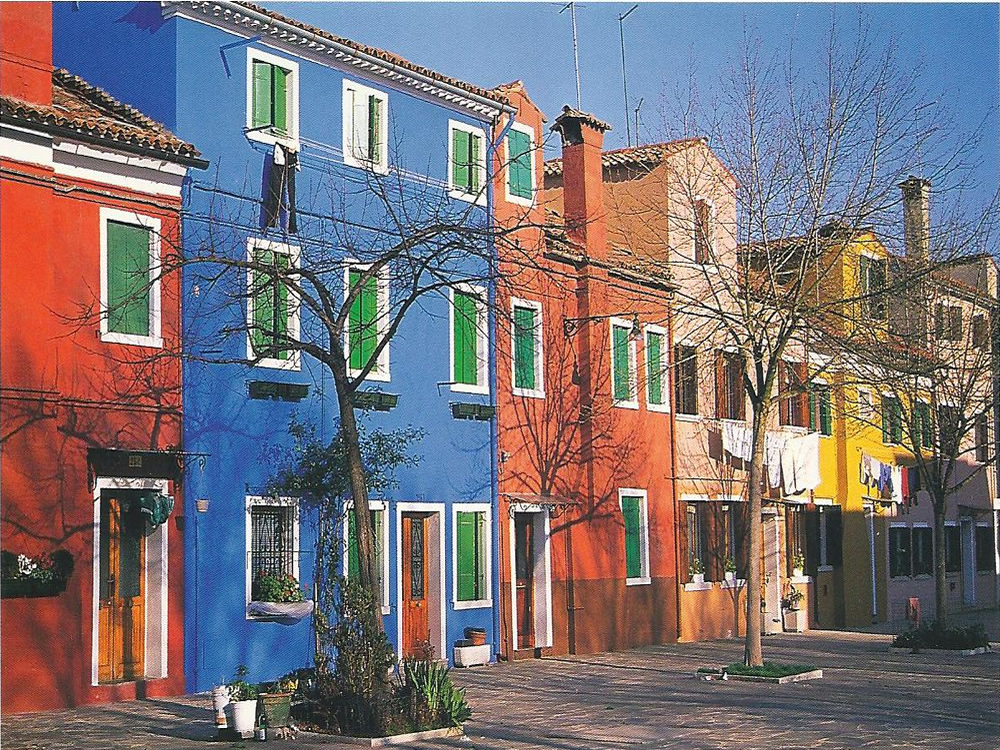
Burano is the most immediately striking of the three islands — a fishing village of extraordinary chromatic intensity, where every house is painted in a different, vivid colour and the effect of the whole, reflected in the canals that run between the streets, is unlike anything else in the lagoon or, arguably, in Italy. The colours are not arbitrary: they follow a tradition that stretches back centuries, by which each fishing family painted its house in a colour that could be recognised from the water, allowing fishermen to identify their homes as they returned from sea in low light or fog.
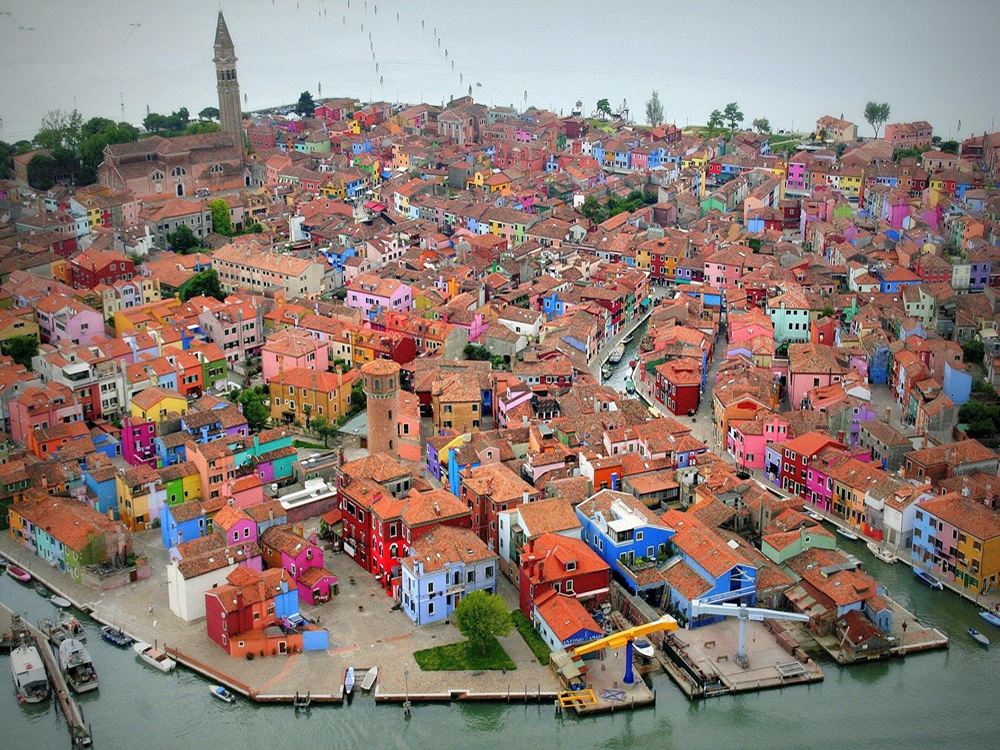
The tradition has been maintained with extraordinary consistency. Burano’s local council maintains a register of the permitted colours for each property, and any owner wishing to repaint must apply for approval of the chosen colour — a process that ensures the chromatic harmony of the island is preserved while allowing for evolution and variety. The result is a village that functions as a kind of living colour theory experiment: every combination of adjacent colours has been tried and refined over generations, and the cumulative effect is a place that is both intensely visual and strangely coherent.
Beyond its colour, Burano is — or was — famous for its lace. Punto in aria lace, developed on Burano in the 16th century, was for two centuries the most prized textile in Europe: worn at the courts of France, Spain and England, referenced in inventories and portraits and diplomatic correspondence as a marker of the highest social status. The craft requires extraordinary patience and precision — a single piece of Burano lace can take hundreds of hours to complete — and it has declined precipitously over the past century. Genuine punto in aria lace is now produced by only a small number of elderly craftswomen on the island, and the pieces they make are correspondingly rare and expensive.
What to see on Burano
The visual experience of Burano begins the moment you step off the boat. The main street, Via Baldassare Galuppi (named after the composer who was born on the island in 1706), runs the length of the village and is lined on both sides with shops, cafés and the most intensely coloured buildings of any street in the lagoon. Photography here is almost compulsive — every turning reveals a new combination of colours, a new reflection in a canal, a new perspective on the extraordinary visual world of the island.
The Museo del Merletto — the Lace Museum — is housed in the former Scuola dei Merletti, the lace-making school that was established in 1872 to revive the declining craft. The museum holds a collection of historic Burano lace that is both technically astonishing and historically rich — pieces that were made for royal courts, diplomatic gifts and the great ceremonial occasions of early modern Europe. The demonstrations occasionally offered in the museum, by the few remaining practitioners of the craft, provide a vivid sense of the patience and skill required.
Beyond the lace museum and the coloured streets, Burano rewards slower, more deliberate exploration. The island is small — you can walk from one end to the other in ten minutes — but its side streets and smaller canals offer views that the main route does not. The church of San Martino, with its distinctively tilting campanile (the result of the soft lagoon sediment beneath the foundations), contains an important late work by Tiepolo — a Crucifixion of remarkable power, painted when the artist was in his eighties.
| The best time to photograph Burano’s coloured houses is in the early morning, when the light is flat and even and the tourist crowds have not yet arrived. On a private boat tour, you can time your arrival at Burano for exactly this hour — one of the significant advantages of the private format over the public vaporetto. |
Torcello: The Island Where Venice Was Born
What Torcello is and why it matters
Torcello is the oldest continuously inhabited island in the Venice Lagoon, and in many ways the most important: it is the place where the story of Venice effectively begins. The island was settled in the 5th and 6th centuries by refugees from the Roman cities of the Veneto — Altino, Oderzo, Padua — fleeing the successive waves of Barbarian invasion that were dismantling the Western Roman Empire. On the low, marshy islands of the lagoon, these refugees found safety from the armies that were destroying the mainland, and they began to build the settlements that would eventually coalesce into the city of Venice.
At its peak, in the 10th and 11th centuries, Torcello was the most important settlement in the lagoon — a city of perhaps 20,000 people, with its own bishop, its own commercial life and its own architectural ambitions. Then the lagoon silted up around it, the trading routes shifted, and the population migrated northward to the more advantageous location of Rialto. By the 15th century, Torcello was virtually abandoned. Today, the island has fewer than ten permanent residents.
What remains of Torcello’s greatness is extraordinary: a cathedral, the Basilica di Santa Maria Assunta, whose foundation dates to 639 AD and whose interior contains some of the finest Byzantine mosaics in Italy; a small adjacent church, Santa Fosca, of great architectural refinement; a modest but evocative archaeological museum; and a silence so complete, so removed from the noise and crowds of the tourist city, that visitors consistently describe it as one of the most moving experiences in the lagoon.
What to see on Torcello
The Basilica di Santa Maria Assunta is not the largest or the most famous church in the Venice Lagoon, but it is arguably the most important. Its foundation stone was laid in 639 AD — more than four centuries before St Mark’s Basilica was built — and the current structure, substantially rebuilt in the 11th century, preserves an extraordinary series of Byzantine mosaics that rank among the finest examples of the form in Western Europe.
The apse mosaic — a golden Madonna and Child of heartbreaking simplicity and refinement, set against a plain gold ground — is one of the great images of medieval art. The west wall mosaic of the Last Judgement, by contrast, is an encyclopaedic and sometimes terrifying depiction of the fate of souls after death, covering the entire western end of the nave in a programme of images that unfolds from the top (the Crucifixion, the Harrowing of Hell) to the bottom (the weighing of souls, the torments of the damned). It was completed in the 12th century and remains in remarkable condition.
Outside the cathedral, the adjacent church of Santa Fosca — a beautiful 11th-century building in the Venetian Byzantine style, with an elegant external portico — deserves careful attention. The stone chair beside the cathedral, known as Attila’s Chair (though it almost certainly has nothing to do with Attila the Hun), is one of the most photographed objects on the island. The Museo Provinciale di Torcello holds a small but significant collection of archaeological finds from the island and the surrounding lagoon.
The journey to Torcello by private boat is itself part of the experience. The approach through the outer lagoon — through channels that wind through the salt marshes, with herons standing motionless on the banks and the campanile of Santa Maria Assunta visible from a great distance across the flat water — prepares the visitor for the particular quality of silence and remoteness that defines the island.
| Ernest Hemingway, who stayed on Torcello in 1948 while writing Across the River and into the Trees, described it as ‘the oldest church and the oldest feeling you have ever had’. The island has changed very little since then. That quality of ancientness — of contact with a world that predates Venice itself — is what makes it unlike anywhere else in the lagoon. |
How to Visit All Three Islands: The Practical Guide
The itinerary question
Visiting Murano, Burano and Torcello in a single day is the standard approach, and it is perfectly achievable — but it requires good organisation and an early start. The three islands are located in different parts of the lagoon (Murano to the north of the historic centre, Burano and Torcello to the north-east), and the logical order depends on your departure point and your priorities.
The most common sequence is Murano first (closest, most accessible, good for a morning start), then Torcello (quietest, most remote, best in the middle of the day when the light is good for the cathedral interior), then Burano (most visually dramatic, best in softer afternoon light for photography). Reversing Torcello and Burano also works well — particularly if you want to photograph Burano in the early morning light before the crowds arrive.
The recommended full-day itinerary
| 9:00 AM | Depart Venice by private boat. Morning light on the lagoon. Brief orientation from the guide as you cross the Bacino di San Marco and head north towards Murano. |
| 9:20 AM | Arrive Murano. Visit the Museo del Vetro — allow 45–60 minutes. Then a walk along the Canale dei Vetrai, with the option of visiting a working furnace for a glassblowing demonstration. |
| 11:00 AM | Depart Murano by private boat. Cross the northern lagoon towards Torcello — one of the finest boat journeys in the lagoon, through channels in the salt marshes with extensive birdlife. |
| 11:30 AM | Arrive Torcello. Visit the Basilica di Santa Maria Assunta and Santa Fosca — allow 60–75 minutes. Lunch at the Locanda Cipriani or a simpler option in the small piazza. The island is very quiet; take time to absorb it. |
| 1:30 PM | Depart Torcello by private boat towards Burano — a short journey of approximately 10 minutes. |
| 1:45 PM | Arrive Burano. Walk the coloured streets at leisure. Visit the Lace Museum. Gelato, coffee or an early aperitivo on Via Galuppi. Allow 90–120 minutes. |
| 3:30 PM | Depart Burano by private boat for the return to Venice — approximately 40 minutes. The afternoon light on the return across the lagoon is often beautiful. |
| 4:15 PM | Arrive Venice. The rest of the day is free. Dinner reservations recommended — your guide can suggest options. |
Vaporetto vs Private Boat: An Honest Comparison
Both the public vaporetto and a private boat can get you to all three islands. Here is what the two approaches actually involve.
| Vaporetto (Public) | Private Boat Tour | |
| Route flexibility | Fixed stops only; no detours | Any route, any stop, any channel |
| Journey experience | Crowded, standing room only in peak season | Private deck, open views, guide commentary |
| Timing | Fixed timetable; waits between services | Departs when you’re ready; no waiting |
| Crowd management | Arrives at same time as other vaporetti | Can time arrival before or after peak crowds |
| Access to channels | Main routes only | Narrow marsh channels and outer lagoon |
| Guide commentary | None | Expert interpretation throughout |
| Luggage/comfort | Limited space | Comfortable seating; drinks on board |
| Cost (2 people) | €15–25 total (day pass) | Higher; shared across the group |
| Best for | Budget travellers, experienced visitors | First-timers, families, special visits |
| The vaporetto is a perfectly viable way to reach the three islands independently — and for travellers who know Venice well, it is a reasonable choice. For a first visit, or for visitors who want to understand what they are seeing rather than simply seeing it, the private boat tour transforms the experience in ways that are difficult to overstate. |
What to Buy — and What to Avoid
On Murano
Authentic Murano glass is one of the finest craft objects available anywhere in Italy — and one of the most frequently counterfeited. The safest approach is to buy directly from a working workshop where you have seen the glass being made, or from the Museo del Vetro shop, which carries authenticated pieces. Look for the Vetro Artistico Murano trademark on the label. Price is not a reliable indicator of authenticity — some of the most convincing counterfeits are sold at prices that would be plausible for genuine Murano work.
What to avoid: the large showrooms immediately adjacent to the main vaporetto landing stage, which are almost uniformly stocked with imported glass; any shop that offers ‘free factory tours’ as a sales technique; and the souvenir-grade glass figures and knick-knacks sold across the island, which bear no relationship to the serious craft tradition that makes Murano worth visiting.
On Burano
Genuine Burano lace — made by hand using the punto in aria technique — is extraordinarily rare and correspondingly expensive. A small handmade piece will cost hundreds of euros; larger pieces are priced in the thousands. If you are buying lace on Burano, the Lace Museum shop is the most reliable source of authenticated work. Most of the lace sold in the tourist shops on Via Galuppi is machine-made or imported; it can be beautiful, but it is not the craft that made Burano famous.
Burano is also known for its biscuits — the bussolai buranei, ring-shaped butter biscuits, and the S-shaped esse biscuits — which are genuinely local and genuinely good. They make excellent, inexpensive and entirely authentic souvenirs.
On Torcello
Torcello has almost no shops. The Locanda Cipriani — a legendary hotel and restaurant in continuous operation since 1934, where Hemingway stayed and wrote — is the only significant commercial establishment on the island. A meal or even just a coffee at the Locanda is an experience in itself and a direct connection to the island’s literary history. Beyond that, Torcello is a place to look, to listen and to think, not to buy.
The Venice Guide and Boat Three Islands Tour
Venice Guide and Boat’s Three Islands Tour is a full-day private boat experience covering Murano, Burano and Torcello, led by a qualified local guide with specialist knowledge of the history, craft traditions and architectural heritage of all three islands.
The tour is designed to make the most of each island’s particular character — arriving at Burano early to photograph the coloured houses in the best light, spending the quietest part of the day on Torcello, and timing the glass demonstration at Murano to coincide with the most interesting part of the furnace’s working day. The private boat allows the itinerary to be adjusted on the day according to conditions, weather and the specific interests of the group.
- Full-day private boat tour of Murano, Burano and Torcello
- Qualified local guide with specialist knowledge of all three islands
- Entry to the Museo del Vetro on Murano and the Museo del Merletto on Burano
- Glassblowing demonstration at a working Murano furnace
- Flexibility on timing, itinerary focus and pace throughout the day
- Drinks and snacks on board; lunch options recommended and arranged on request
| The Three Islands Tour can be combined with a Venice sunset tour for an extraordinary full day on the lagoon — islands in the morning, open water at golden hour in the evening. Contact Venice Guide and Boat to discuss the combined itinerary. |
Frequently Asked Questions
Can I visit Murano, Burano and Torcello in one day?
Yes — it is the standard approach, and with an early start (departing Venice by 9am) and good organisation, it is entirely achievable without feeling rushed. A private boat tour covers the logistics and timing, making the day flow naturally. On the public vaporetto, the same itinerary requires more careful planning and more patience with waiting times between services.
Which island is the most worth visiting?
All three are worth visiting, and each is worth visiting for completely different reasons. If forced to choose one, Torcello is the most irreplaceable — the cathedral of Santa Maria Assunta is one of the great medieval buildings of Italy and is found nowhere else in the lagoon. Burano is the most visually dramatic and the most instantly rewarding for first-time visitors. Murano is the most directly connected to a living craft tradition that is historically unique.
How long does the Three Islands Tour take?
The full Three Islands Tour runs for approximately 6–7 hours including boat travel time, a full visit to each island and a break for lunch. A shorter version, covering Murano and Burano only, runs for approximately 4 hours. The itinerary is flexible and can be adjusted according to the specific interests and available time of the group.
Is the Three Islands Tour suitable for children?
Extremely so. Children are consistently fascinated by the glassblowing demonstration on Murano — the transformation of molten glass into a finished object is one of the most visually compelling craft demonstrations anywhere. Burano’s colours delight younger visitors. Torcello requires a slightly different approach with very young children — the cathedral demands some patience — but older children often find the archaeological and historical aspects genuinely engaging.
What is the best time of year to visit the three islands?
Spring (April–June) and autumn (September–October) offer the best combination of good weather, manageable crowds and pleasant temperatures for a full day on the water. July and August are the busiest months — Burano in particular can be extremely crowded in peak summer — but the long evenings and warm temperatures have their own appeal. Winter visits offer the most atmospheric experience, particularly on Torcello, where the fog and the silence combine to produce an impression of genuine remoteness.
Is it worth hiring a guide for the islands?
The straightforward answer is yes — for the same reasons that a guide is valuable in Venice itself. Murano’s glass tradition, Burano’s lace history and Torcello’s Byzantine mosaics all carry stories that are genuinely difficult to access without expert assistance. The cathedral of Santa Maria Assunta on Torcello, in particular, is one of those places where the difference between looking and understanding is almost entirely determined by whether you have a guide who can explain the iconographic programme of the mosaics and connect them to the historical context in which they were made.
Three Islands, Three Stories, One Lagoon
Murano, Burano and Torcello are not simply three tourist destinations that happen to be located in the same lagoon. They are three chapters in the same story — the story of how human beings built a civilisation on water, maintained it for a thousand years against every natural and political pressure, and left a legacy of craft, architecture and visual beauty that has no parallel in the Western world.
Murano preserves the industrial genius of the Republic — the craft tradition that was simultaneously Venice’s commercial secret and its artistic achievement. Burano preserves its social world — the fishing communities, the domestic traditions, the colour and noise of daily life in the lagoon. Torcello preserves its origin — the moment of foundation, the first settlements on the marsh islands, the extraordinary ambition of a community that built a cathedral in a place that had been underwater a few generations earlier.
Together, they constitute a day that most visitors to Venice describe as one of the most memorable of their lives — not for the sights, though the sights are extraordinary, but for the experience of moving through a landscape that is simultaneously ancient and alive, and in which the water, the light and the history combine to produce something that cannot be found anywhere else on earth.
| Book your private Three Islands Tour with Venice Guide and Boat — a full day on the lagoon covering Murano, Burano and Torcello, with a qualified local guide, entry to the island museums, glassblowing demonstration and complete flexibility on pace and itinerary. |

