Venice Guide and Boat
Venice Architecture Guide: A City Built on Water, Wood and Imagination
Venice architecture is a thousand-year conversation between East and West, shaped by one stubborn fact: everything had to be built on a lagoon. Byzantine domes, Gothic palaces, Renaissance churches, Baroque landmarks and daring modern interventions all stand within a few kilometres of each other, often within sight of the same canal.
This guide walks you through the main styles, the buildings that define them, the clever engineering underneath, and the best way to see it all. Whether you are an architecture lover or simply curious why Venice looks the way it does, you will leave knowing what to look for.
Key takeaways
- Venice is built on millions of wooden piles driven into lagoon clay and topped with waterproof Istrian stone.
- The city mixes Byzantine, Gothic, Renaissance, Baroque, Neoclassical and modern architecture — often side by side.
- The Grand Canal is the best “open-air gallery”: roughly 170 buildings line its 3.8 km, and their main entrances face the water.
- Must-see names: Longhena, Sansovino, Palladio, Codussi and, in the 20th century, Carlo Scarpa.
- Seeing facades from a boat, at water level, shows them the way their architects intended.
How Venice Was Built: Foundations on a Lagoon
Venice sits on a group of around 118 small islands, joined by roughly 400 bridges and crossed by more than 170 canals. The ground is soft clay and mud, so builders did something remarkable: they drove dense forests of timber piles (typically alder, oak and larch) deep into the clay until they reached a firmer layer.
Because the piles are permanently submerged, they are starved of oxygen and do not rot. A platform of wooden planks was laid on top, then a course of Istrian stone, which is practically waterproof and stops salt water creeping up into the brick walls above. Palaces and churches were then built in light brick, often covered in stucco or marble, to keep the weight down.
This explains many details you will notice while walking: thin walls, flat-looking facades, airy loggias with big windows, and the extensive use of stone only where water is likely to touch. Today, the city’s defence against high tides includes the MOSE barrier system, operational since 2020, which protects the lagoon while the historic buildings themselves remain the real protagonists.
Venice Architecture Styles at a Glance
Use this table as a quick map of the city before diving deeper.
| Style | Period | Key features | Where to see it |
| Veneto-Byzantine | 11th–13th c. | Domes, round arches, gold mosaics, Greek-cross plans | St Mark’s Basilica, Torcello Cathedral, Fondaco dei Turchi |
| Venetian Gothic | 14th–15th c. | Ogee (pointed) arches, quatrefoil tracery, lacy loggias, pink and white patterns | Doge’s Palace, Ca’ d’Oro, Frari, Santi Giovanni e Paolo |
| Renaissance | 15th–16th c. | Classical orders, symmetry, white Istrian stone, semicircular arches | Santa Maria dei Miracoli, Libreria Marciana, San Giorgio Maggiore, Il Redentore |
| Baroque | 17th–18th c. | Sculptural volumes, domes, scrolls, dramatic facades | Santa Maria della Salute, Ca’ Pesaro, Ca’ Rezzonico |
| Neoclassical & 19th c. | 1790s–1900s | Restrained classical lines, industrial neo-Gothic | La Fenice, Giardini della Biennale, Molino Stucky |
| Modern & contemporary | 20th–21st c. | Minimal materials, detailed interiors, bold bridges and conversions | Querini Stampalia (Scarpa), Punta della Dogana (Ando), Ponte della Costituzione |
Byzantine Venice: Domes, Gold and a Link to the East
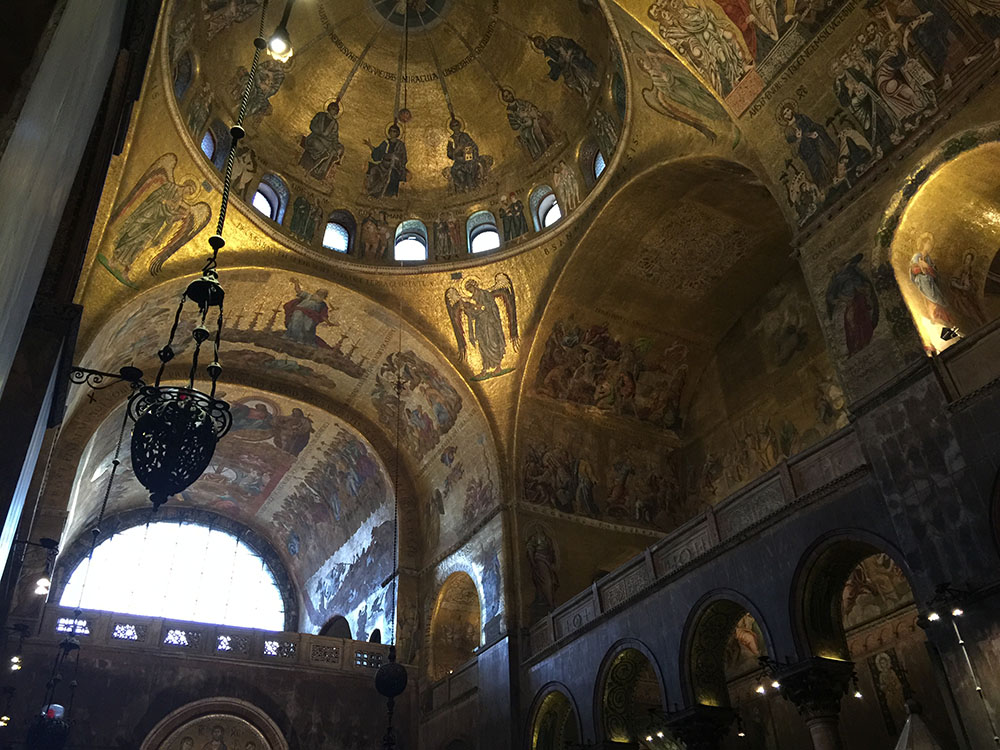
In its early centuries Venice looked east, to Constantinople, for trade and for style. The clearest result is St Mark’s Basilica, begun in 1063 and consecrated in 1094. Its Greek-cross plan, five domes and glittering mosaics echo Byzantine models, while later centuries added Gothic pinnacles and Renaissance details to the facade.
For an earlier and quieter example, visit Torcello, where the cathedral of Santa Maria Assunta was founded in 639 and rebuilt in the early 11th century. Its mosaics are among the oldest and most impressive in the lagoon. Back on the Grand Canal, the Fondaco dei Turchi preserves the look of a 13th-century Veneto-Byzantine palace, although it was heavily restored in the 19th century.
Venetian Gothic: The Style That Defines the Grand Canal
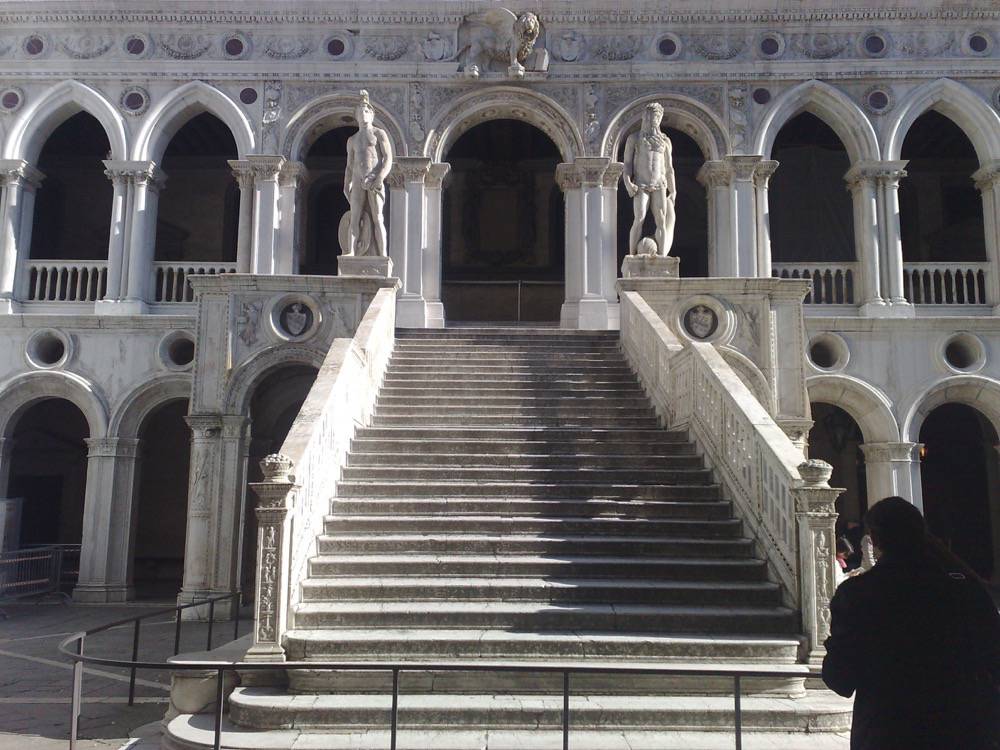
Venetian Gothic is a local invention. It takes the pointed arch from northern Europe, adds Islamic-inspired ogee curves and decorative stonework, and combines them with an open, light structure suited to the lagoon. Look for quatrefoil medallions, delicate balconies and long arcaded loggias, designed to let light flood in from the water.
Doge’s Palace (Palazzo Ducale)
The seat of Venetian power is a masterpiece of balance: a heavy upper storey in pink and white patterned marble resting on slender arcades. It is mainly a 14th- and 15th-century building. The Porta della Carta (1438–1442), by Giovanni and Bartolomeo Bon, is a showpiece of late Gothic sculpture.
Ca’ d’Oro
Built in the 1420s and 1430s, the “Golden House” was named for gilding that once highlighted its facade. Its asymmetrical, lace-like loggia is the finest example of Gothic palace design on the Grand Canal, and today it houses the Galleria Franchetti.
The great brick churches
Away from the water, the Frari (Santa Maria Gloriosa dei Frari) and Santi Giovanni e Paolo (“Zanipolo”) show Gothic in its monumental brick form, built over the 13th to 15th centuries. They hold tombs of doges and masterpieces by Titian, Bellini and others.
Renaissance Venice: Codussi, Sansovino and Palladio
Renaissance ideas arrived in Venice in the late 15th century, filtered through local taste. Instead of copying Rome, architects blended classical order with the city’s love for colour, marble and light.
- Mauro Codussi introduced the new style with works such as San Michele in Isola, the facade of the Scuola Grande di San Marco and Palazzo Vendramin Calergi.
- Pietro Lombardo created the jewel-box church of Santa Maria dei Miracoli (1481–1489), faced in coloured marble.
- Jacopo Sansovino reshaped St Mark’s Square with the Libreria Marciana (begun 1537), the Loggetta and the Zecca (Mint).
- Antonio da Ponte completed the single-arch Rialto Bridge in 1591, beating proposals from the big names of the day, Palladio among them.
Palladio in Venice
Andrea Palladio is famous for his villas on the mainland, but in Venice he left two serene landmarks: San Giorgio Maggiore (begun in 1566), whose white facade rises across the water from St Mark’s, and Il Redentore (1577–1592), built as a thank-offering after the plague of 1575–76. Each July, the Feast of the Redeemer is celebrated with a temporary bridge of boats across the Giudecca Canal leading to the church.
Baroque Venice: Longhena and the Drama of Stone
The Baroque in Venice belongs to Baldassare Longhena. His masterpiece is Santa Maria della Salute, begun in 1631 after the plague of 1630 and consecrated in 1687. Its octagonal plan, vast dome and giant scrolls make it one of the most recognisable silhouettes at the mouth of the Grand Canal. The Feast of the Madonna della Salute, on 21 November, still brings locals across the canal on a temporary pontoon bridge.
Longhena also designed the imposing Ca’ Pesaro (begun 1652, now home to the modern art gallery) and began Ca’ Rezzonico (completed by Giorgio Massari in the 18th century), a palace that now showcases 18th-century Venetian life. Their rusticated bases, deep shadows and rich sculptural detail are pure Baroque theatre.
Neoclassical and 19th-Century Venice
As the Republic fell and Napoleon arrived, architecture turned toward restraint. La Fenice, the city’s famous opera house, opened in 1792 in Neoclassical style, was destroyed by fire in 1996 and rebuilt, reopening in 2003. The Giardini area, which hosts the Biennale, took shape in the Napoleonic era. And on the Giudecca, the neo-Gothic Molino Stucky (1884–1895), a former flour mill, is an unexpected industrial landmark, now a hotel.
Modern and Contemporary Venice: Scarpa, Ando and Beyond
Venice is often called a museum city, but modern architects have left thoughtful marks here, usually working with, not against, the historic fabric.
- Carlo Scarpa (1906–1978), the Venetian master of detail, designed the ground floor and garden of the Fondazione Querini Stampalia (1961–63) and the Olivetti showroom on St Mark’s Square (1957–58). His work is a lesson in how water, light, concrete, stone and metal can be composed.
- Tadao Ando renovated Palazzo Grassi (2006) and the Punta della Dogana (2009) as contemporary art spaces, keeping the original structures visible.
- Santiago Calatrava’s Ponte della Costituzione (2008) is the fourth bridge over the Grand Canal and the most debated of them.
- OMA / Rem Koolhaas reimagined the Fondaco dei Tedeschi near Rialto (reopened 2016), a historic German merchants’ trading house, now with a rooftop terrace.
Every two years, the Venice Architecture Biennale turns the Giardini and the Arsenale into a worldwide forum for architecture, adding new temporary pavilions to the city’s long story.
Learn the Language: Venetian Architectural Terms
| Term | What it means |
| Ca’ | Short for “casa”: the name of a Venetian noble palace (Ca’ d’Oro, Ca’ Pesaro). |
| Portego | The long central hall of a palazzo, running from the canal entrance to the courtyard side. |
| Water gate | The main entrance of a palace, opening directly onto the canal. |
| Calle / Campo | A narrow street / a square (only St Mark’s is called a “piazza”). |
| Fondamenta | A paved walkway running alongside a canal. |
| Sottoportego | A covered passage running under a building. |
| Altana | A wooden rooftop terrace, traditionally used for drying laundry and enjoying the view. |
| Vera da pozzo | A decorative wellhead in a campo, a reminder of the days of rainwater cisterns. |
| Fumaiolo | A Venetian chimney with a flared top, designed to catch sparks and protect wooden roofs. |
The Best Way to See Venice Architecture
Most Venetian palaces were designed to be admired from the water. Their elegant facades and water gates, built for merchant families, were meant to impress visitors arriving by boat. On foot, you often see only the back door.
That is why a boat trip along the Grand Canal is the most revealing introduction to the city: from water level you can follow the story from Byzantine arcades to Gothic loggias and Baroque facades in a single journey, with someone explaining who built what, and why. A private boat tour lets you slow down at the details you care about and adjust the route to your interests. Our local guides at Venice Guide and Boat can shape an architecture-focused itinerary for your group.
Sample architecture route (full day)
| Time | Stop | What to look for |
| Morning | St Mark’s Basilica & Doge’s Palace | Byzantine domes and mosaics; Gothic loggias; the Porta della Carta |
| Late morning | St Mark’s Square | Libreria Marciana, Torre dell’Orologio, Procuratie, Scarpa’s Olivetti showroom |
| Midday | Grand Canal by boat | Fondaco dei Turchi, Ca’ d’Oro, Rialto Bridge, Ca’ Pesaro, Ca’ Rezzonico, Salute |
| Afternoon | Dorsoduro & Giudecca | Salute, Punta della Dogana, Il Redentore, Molino Stucky |
| Late afternoon | San Giorgio Maggiore | Palladio’s facade and the bell tower view over the lagoon |
| Evening | Sunset on the water | The skyline of domes, towers and palaces in golden light |
Practical tips: wear comfortable shoes, carry a small bottle of water, and dress for churches (covered shoulders and knees). Early morning and late afternoon give the softest light for photography.
Frequently Asked Questions About Venice Architecture
What architectural style is Venice known for?
Venice is best known for Venetian Gothic, a blend of pointed arches, ogee curves and ornate tracery seen in the Doge’s Palace and Ca’ d’Oro. The city also has important Byzantine, Renaissance and Baroque landmarks.
How are Venice’s buildings supported on water?
Builders drove wooden piles into the compact clay beneath the lagoon, laid timber platforms on top, and added Istrian stone as a waterproof barrier before building in brick and stone above.
What is the most famous building in Venice?
St Mark’s Basilica is the best-known landmark, followed closely by the Doge’s Palace, the Rialto Bridge and Santa Maria della Salute.
Who are the most important architects in Venice?
Mauro Codussi, Jacopo Sansovino, Andrea Palladio and Baldassare Longhena shaped historic Venice, while Carlo Scarpa is the key 20th-century figure.
Where can I see the best palaces in Venice?
Along the Grand Canal, which is lined with about 170 buildings from the 13th to 18th centuries. A boat trip is the easiest way to see them all.
Are there modern buildings in Venice?
Yes. Highlights include Carlo Scarpa’s Querini Stampalia, Tadao Ando’s Punta della Dogana, Calatrava’s Ponte della Costituzione and the Fondaco dei Tedeschi renovation.
Conclusion: Read the City Like a Book
Once you know how to read its styles, Venice stops being a pretty backdrop and becomes a story told in stone: Byzantine ambition, Gothic elegance, Renaissance order, Baroque drama and modern experimentation, all built on wood and water. The best way to understand it is to see it, ideally from the water.
Ready to explore? Book a private tour with Venice Guide and Boat and we will tailor the route to the buildings you most want to see.

