Venice Guide and Boat
The Grand Canal of Venice: A Palace-by-Palace Guide to Seeing It from the Water
Venice has plenty of canals, but only one that everyone calls grand. The Grand Canal is the city’s main thoroughfare, a great reverse-S of water that cuts through the heart of Venice, and it is lined with some of the most remarkable buildings in Europe.
This guide explains how the canal works, what to look for on its banks, and why it looks so different from the water than it does from the street. It sticks to history and architecture that stay true year after year, so check tickets, opening hours and timetables locally before you go.
| THE GRAND CANAL IN ONE PARAGRAPH The Grand Canal runs for about 3.8 km through the centre of Venice, from the area of Santa Lucia railway station to the basin in front of St Mark’s. More than 170 buildings line its banks, most of them dating from the 13th to the 18th century. Only four bridges cross it, and the best way to see the palace facades, which were built to face the water, is from a boat. |
| Quick facts | |
| Length | About 3.8 km (2.4 miles) |
| Width | Roughly 30 to 90 metres |
| Depth | About 5 metres on average |
| Shape | A large reverse-S through the central districts (sestieri) of Venice |
| Runs from | Near Santa Lucia railway station to the basin at San Marco |
| Buildings | More than 170, mostly 13th to 18th century |
| Bridges | Four: Scalzi, Rialto, Accademia and Costituzione |
| Main role | Venice’s principal thoroughfare, used by boats of every kind |
Why the Grand Canal Matters
In Venice, water is the street. Most of the city’s traffic still runs along the Grand Canal rather than across it, which is one reason the great merchant families built their palaces here. A palace on the Grand Canal was both a family home and a showcase, and its main facade faced the water, where visitors, goods and neighbours would see it.
That is why the canal looks so different depending on how you see it. On foot, you can only catch glimpses between bridges, and the banks are not continuous walkways. From a boat, you see the whole procession of facades at once, in the order their builders intended.
The Four Bridges
For centuries the Rialto Bridge was the only fixed crossing of the Grand Canal. Today there are four, and each one tells a different story.
| Bridge | The story in brief |
| Ponte degli Scalzi | The bridge nearest Santa Lucia station, the first one you reach when travelling towards the centre. |
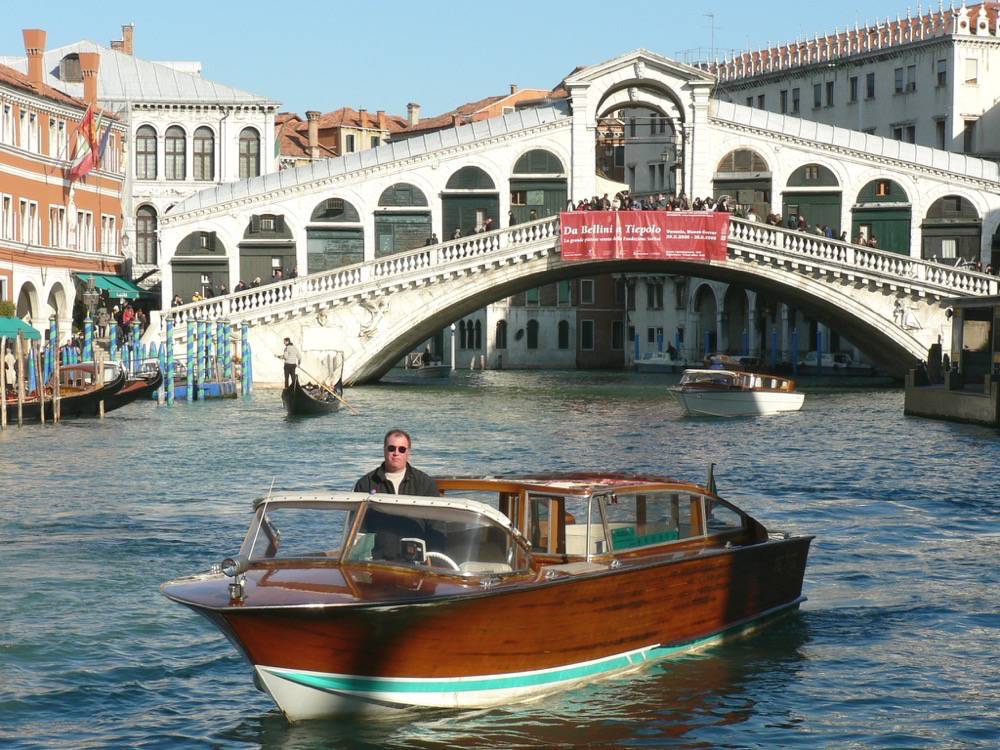
| Rialto Bridge | The oldest of the four. A single stone arch completed in 1591 after earlier wooden bridges collapsed. Lined with shops on two covered ramps. |
| Ponte dell’Accademia | Links the San Marco and Dorsoduro districts. The first bridge on this spot, a metal one, opened in 1854; the present wooden bridge by Eugenio Miozzi dates from 1933. |
| Ponte della Costituzione | Santiago Calatrava’s steel-and-glass bridge between the station and Piazzale Roma, opened in 2008. It has been controversial for its cost, its modern style and its accessibility. |
The long story of the Rialto Bridge
The first crossing at Rialto was a pontoon bridge, replaced in the 13th century by a wooden bridge with a movable central section that could be raised to let tall ships pass. The wooden bridge was damaged during a revolt in 1310 and collapsed twice, in 1444 and again in 1524.
The idea of rebuilding it in stone was discussed for decades. When the authorities asked for proposals, famous names including Jacopo Sansovino, Palladio and Vignola submitted designs, but their classical multi-arch schemes were judged unsuitable. The commission eventually went to Antonio da Ponte, who proposed a single bold span. Work ran from 1588 to 1591, and a rival architect, Vincenzo Scamozzi, predicted the bridge would not last. It has stood for more than four centuries.
The finished bridge is about 22.9 metres wide, with a main span of about 31.8 metres. Two ramps climb to a central portico, with rows of shops on either side.
The Calatrava bridge
The Ponte della Costituzione is the newest crossing, opened in September 2008. Its glass steps proved slippery, and the city began replacing them with stone in December 2024. Whatever you think of it, it is a reminder that the Grand Canal is not a museum: it is still a living piece of the city.
A Palace-by-Palace Route from the Station to St Mark’s
Here are the landmarks worth knowing, roughly in order as you travel from the station towards St Mark’s. Each building stands in a particular district of Venice, shown in the second column.
| Landmark | District | What to look for |
| Ca’ Vendramin Calergi | Cannaregio | A Renaissance palace by Mauro Codussi. It is now the winter seat of the city’s casino. |
| Fondaco dei Turchi | Santa Croce | A 13th-century warehouse and residence in the Veneto-Byzantine style, heavily restored in the 19th century. It houses the Natural History Museum. |
| Ca’ Pesaro | Santa Croce | A Baroque palace by Baldassare Longhena, begun in 1659 and completed in 1710 by Gian Antonio Gaspari. Today it holds the modern art gallery and the Oriental art museum. |
| Ca’ d’Oro | Cannaregio | The “House of Gold”, a Venetian Gothic gem of the early 15th century, named for the gilt and coloured decoration that once covered its facade. Baron Giorgio Franchetti gave it to the Italian state in 1916. |
| Rialto Bridge | — | The heart of the canal, with the old market district beside it. |
| Fondaco dei Tedeschi | San Marco | The former trading house and residence of the German merchants, near the foot of the Rialto Bridge. |
| Ca’ Foscari | Dorsoduro | A late Gothic palace built in 1453 for Doge Francesco Foscari, at the widest bend of the canal. In 1574 Henry III of France was received here. It has housed the university since the 19th century. |
| Ca’ Rezzonico | Dorsoduro | Begun by Baldassare Longhena and completed by Giorgio Massari. It is now the Museum of 18th-century Venice. |
| Palazzo Grassi | San Marco | An 18th-century palace by Giorgio Massari, one of the last great palaces built on the canal. |
| Ponte dell’Accademia | — | The wooden bridge beside the Gallerie dell’Accademia, in the former Scuola della Carità. |
| Palazzo Venier dei Leoni | Dorsoduro | A low, unfinished palace that now houses the Peggy Guggenheim Collection. |
| Santa Maria della Salute | Dorsoduro | Baldassare Longhena’s Baroque church, begun in 1631 after the plague of 1630. Its great dome is one of the symbols of Venice. |
| Spot the styleA short cheat sheet for the styles you will see along the water:Veneto-Byzantine: round arches and slender columns, as at the Fondaco dei Turchi.Venetian Gothic: pointed arches and lace-like stone tracery, as at Ca’ d’Oro and Ca’ Foscari.Renaissance: calmer, more classical proportions, as at Ca’ Vendramin Calergi.Baroque: heavy sculpted stonework and dramatic shapes, as at Ca’ Pesaro, Ca’ Rezzonico and the Salute.Classical and neoclassical: restrained 18th-century facades, as at Palazzo Grassi. |
When the Grand Canal Becomes a Stage
Two annual events turn the canal into a ceremonial route.
- The Regata Storica, on the first Sunday of September. It begins with a historical procession of decorated boats that recalls the welcome given to Caterina Cornaro, the former queen of Cyprus, after she gave up her crown in 1489. Then come the races between Venetian rowing boats, watched from the banks and from boats along the route.
- The Festa della Madonna della Salute, on 21 November. City officials cross the Grand Canal to the Salute church on a specially built pontoon bridge, in a tradition that dates back to the votive church’s founding after the plague.
Four Ways to See the Grand Canal
| Way | What it is like | Best for |
| Vaporetto (public waterbus) | The slow, all-stops service travels the length of the canal. It is a real piece of everyday Venice, and busy at peak times. | A first overview and local atmosphere |
| Traghetto | A short gondola crossing at set points on the canal. Passengers traditionally stand. It is a very short crossing, but for a moment you are in the middle of the canal, surrounded by facades. | A brief, authentic taste of the canal |
| Gondola | Slow, quiet and atmospheric. Routes vary, and some include a stretch of the Grand Canal. See our gondola guide before you book. | Romance and photographs |
| Private boat | Your own pace, with time to stop, turn around and look at what you want. The canal can be combined with the lagoon in a single outing. | Palaces, photography and flexible plans |
Vaporetto lines, timetables and stops change from season to season, so always check the current ACTV information before you travel.
Practical tips for seeing the canal
- Choose the light. Early morning and late afternoon give the soft, warm light that flatters the facades, and the water is generally calmer.
- Read the buildings, not just the view. Pick three or four from the list above and look for them as you pass; it turns a pretty sail-by into a story.
- Do not try to walk it. The banks are broken up by buildings and side canals, and only four bridges cross the water. A boat is the only way to see the whole length.
- Combine it with a visit. Ca’ Rezzonico, Ca’ d’Oro, Ca’ Pesaro and the Peggy Guggenheim Collection are all palaces you can enter after seeing them from the water. Check each museum’s opening days first.
- Mind the festivals. On the Regata Storica Sunday the canal is given over to the procession and the races, so plan your own boat trip around it.
The Grand Canal with Venice Guide and Boat
The Grand Canal rewards a slower look, and a private boat gives you time to take it. Venice Guide and Boat can arrange private itineraries on the water, and can arrange viewing from the water for events such as the Regata Storica. If you would like to see the Grand Canal as part of a broader Venice itinerary, get in touch and we will talk through what is possible.
To go deeper into the buildings you see from the water, read our guides to Venice Architecture, Ca’ Rezzonico, the Accademia and Venice Art and History.
Frequently Asked Questions
How long is the Grand Canal in Venice?
About 3.8 km (2.4 miles). It is between roughly 30 and 90 metres wide and, on average, about 5 metres deep.
How many bridges cross the Grand Canal?
Four: Ponte degli Scalzi, the Rialto Bridge, Ponte dell’Accademia and Ponte della Costituzione. For centuries the Rialto Bridge was the only one.
Which is the oldest bridge on the Grand Canal?
The Rialto Bridge. The current stone bridge was built between 1588 and 1591 and replaced earlier wooden bridges, which had collapsed in 1444 and 1524.
Who designed the Rialto Bridge?
Antonio da Ponte, who proposed a single stone arch. Better-known architects of the time, including Sansovino, Palladio and Vignola, had proposed multi-arch designs that were not adopted.
What is the Ca’ d’Oro?
A Venetian Gothic palace of the early 15th century on the Grand Canal, named the “House of Gold” for the gilt decoration that once covered its facade. It was given to the Italian state by Baron Giorgio Franchetti in 1916 and now houses a museum.
What is the best way to see the Grand Canal?
By boat, because the palace facades were built to face the water. The vaporetto gives you an affordable overview, a traghetto gives you a short crossing, and a private boat gives you the most time and flexibility.
When is the Regata Storica?
On the first Sunday of September. A procession of historical boats on the Grand Canal is followed by races between Venetian rowing boats.

