
Venice Guide and Boat
The Rialto Market: Venice’s Most Authentic Experience. History, Food and the City’s Living Soul
There are two ways to spend a morning in Venice. The first is to join the flow of visitors moving from the station towards St Mark’s Square — through the Lista di Spagna, across the Scalzi bridge, along the Strada Nova — in a procession that reaches the Piazza by mid-morning and disperses into queues for the Basilica and the Doge’s Palace. The second is to go to the Rialto Market.
The Rialto Market opens before dawn. By 7am, the pescheria — the fish market on the Grand Canal side of the Rialto Bridge — is in full operation: the boats have already made their deliveries, the tables are laden with the morning’s catch from the Adriatic and the lagoon, and the vendors are calling out their prices to the chefs and housewives and restaurant buyers who constitute their actual clientele. By 7:30am, the erberia — the fruit and vegetable market — is receiving its deliveries: crates of radicchio from Treviso, artichokes from Sant’Erasmo, asparagus from the mainland, and the seasonal produce that defines Venetian cooking at each time of year.
By the time the first tourist boats arrive from the hotels, the market has already been operating for several hours. And in those early hours — when the market belongs entirely to the people who use it rather than the people who photograph it — something becomes visible about Venice that the St Mark’s Square experience, for all its magnificence, cannot provide: the sense of the city as a living, working, self-sustaining place, connected to its lagoon and its hinterland in ways that have barely changed in a thousand years.
This guide is about the Rialto Market — its history, its geography, its food, its social world and its place in the larger story of Venice. It is also about how to experience it, what to eat there, and what the Venice Guide and Boat Business and Faith in Rialto tour adds to the experience for visitors who want to go beyond the surface.
A Thousand Years of Commerce: The History of the Rialto
The name Rialto comes from Rivus Altus — the high bank — which was the name given to the raised ground on the San Polo side of the Grand Canal that was among the first areas of the lagoon to be settled by the refugees from the Roman mainland. By the 9th century, the Rialto had become the commercial heart of the growing settlement that would eventually become Venice — the place where merchants met to trade, where goods were warehoused and exchanged, and where the financial transactions that fuelled the Republic’s extraordinary expansion were conducted.
The Rialto was not just a market — it was the engine of one of the most powerful commercial states in medieval and early modern Europe. The concentration of commercial activity here was so intense, and the financial instruments developed here so sophisticated, that the Rialto is sometimes credited with being the birthplace of modern banking. The Banco della Piazza, established at the Rialto in the early 16th century, was one of the first public banks in the world. The exchange rates posted daily at the Rialto were monitored by merchants from London to Alexandria. The commercial news that circulated here — carried by the network of Venetian merchants across the Mediterranean — is considered the origin of the modern newspaper.
| 9th–10th c. | The Rialto becomes the commercial centre of the growing Venetian settlement — the place where merchants congregate, goods are exchanged and the first financial instruments are developed. |
| 1097 | The first permanent market structures are documented at the Rialto. The area begins to take on the concentrated commercial character it will maintain for centuries. |
| 1311–1314 | The first Rialto Bridge — a wooden drawbridge — is constructed across the Grand Canal. It is rebuilt multiple times before the current stone bridge is completed in 1591. |
| 1514 | A catastrophic fire destroys most of the Rialto market buildings. The reconstruction, completed over the following decade, creates the market layout that still largely survives today. |
| 1591 | The current Rialto Bridge — designed by Antonio da Ponte — is completed in stone. It replaces a succession of wooden bridges and remains one of the finest single-arch bridges in Italy. |
| 17th–18th c. | The Rialto continues as Venice’s commercial centre even as the Republic’s power declines. The fish and vegetable markets operate essentially as they do today. |
| Present day | The pescheria and erberia continue to supply Venice’s restaurants and residents six days a week. The market is one of the last genuinely working traditional markets in a major Italian city. |
| The Rialto is not a museum piece or a tourist attraction that happens to look like a market. It is a functioning commercial market that has operated on this site, in essentially the same form, for more than a thousand years — and that continues to supply the restaurants and residents of Venice with the fish, vegetables and fruit that define Venetian cooking. |
The Geography of the Rialto: A Map in Words
The Rialto Bridge (Ponte di Rialto)
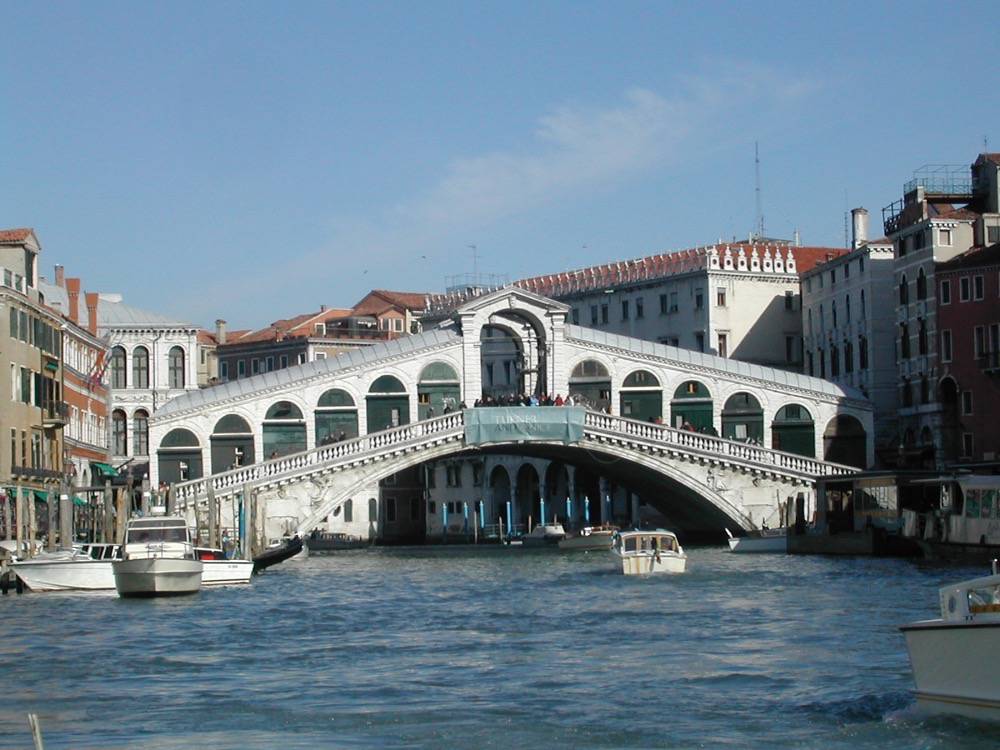
The current Rialto Bridge was designed by Antonio da Ponte — the name is almost too perfect for an architect who built a bridge — and completed in 1591, after a competition in which Michelangelo, Palladio and Sansovino all submitted designs. Da Ponte’s winning design was considered too bold at the time: a single arch spanning 28 metres, rising 7.5 metres above the water, with covered arcades along both sides housing small shops. It was widely predicted to collapse. It has not collapsed. Four centuries later, it remains one of the finest and most immediately recognisable structures in Venice.
The bridge’s covered arcades are lined on both sides with jewellery and souvenir shops — as they have been for centuries, since the Republic leased these spaces to generate revenue. The view from the top of the bridge, both up and down the Grand Canal, is one of the great urban views in Italy. The best time to see it is early morning, before the crowds arrive, when the Grand Canal below is alive with delivery boats and the light is still low and clear.
The Pescheria (Fish Market)
The pescheria occupies a neo-Gothic loggia built in 1907 on the Grand Canal, a few minutes’ walk north of the bridge on the San Polo side. It operates Tuesday through Saturday, from roughly 7am to 1pm. The market sells the catch from the Adriatic and the lagoon — the fish, shellfish and crustaceans that have been the foundation of Venetian cooking since the earliest days of the city. The variety is extraordinary: sole (sogliola), sea bass (branzino), red mullet (triglie), cuttlefish (seppie), clams (vongole), mussels (cozze), scampi, mantis shrimp (canocchie), spider crab (granceola), and the extraordinary soft-shell crab (moeche) — a lagoon speciality available only for a few weeks each spring and autumn, when the local crabs shed their shells.
The pescheria is simultaneously a practical market and a visual spectacle. The ice-covered tables, the iridescent scales of the fish in the morning light, the speed and expertise of the vendors, and the intense, sea-salt smell of the place are an experience that has no equivalent in the tourist Venice and that reveals, more clearly than almost anything else, the relationship between this city and the water that surrounds it.
The Erberia (Fruit and Vegetable Market)
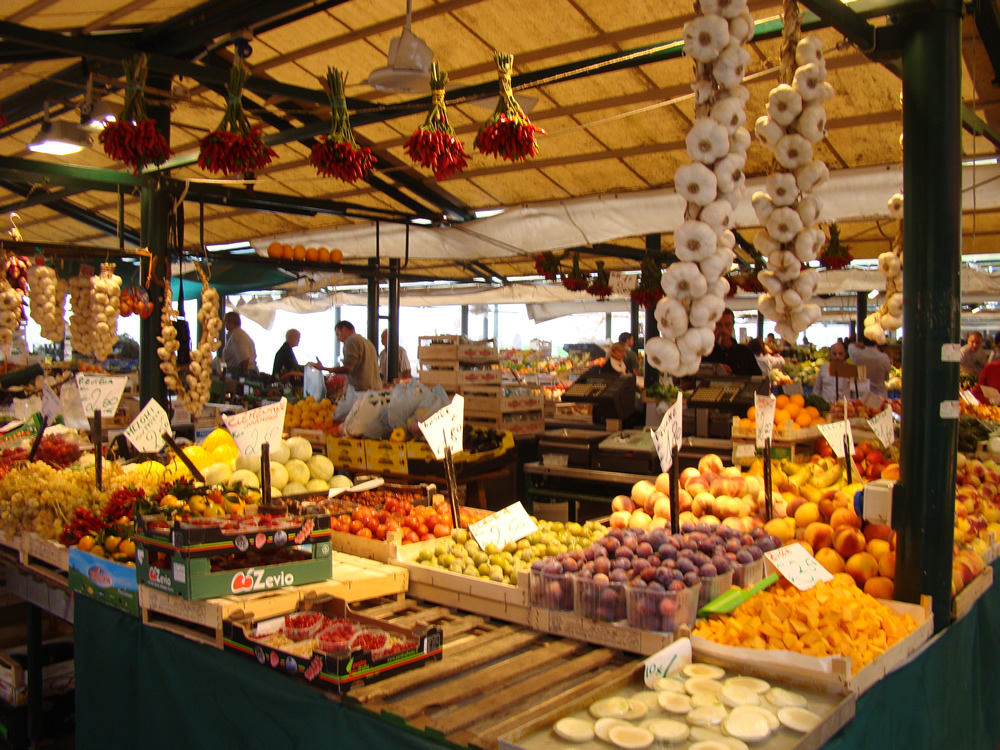
The erberia occupies the open-air space between the pescheria and the bridge, also on the San Polo side of the canal. It sells the fruit, vegetables and herbs that constitute the other half of the Venetian culinary tradition — and its seasonal variety is a direct index of what is appearing on the menus of Venice’s better restaurants at any given moment. The radicchio di Treviso — the long, bitter-sweet red radicchio grown in the clay soils of the Treviso hinterland — is one of the finest ingredients in the Veneto, available from autumn through winter. The artichokes of Sant’Erasmo — the large agricultural island in the northern lagoon — are a spring delicacy of the first order. The white asparagus of Bassano del Grappa arrives in April and dominates the vegetable stalls for six weeks.
The Surrounding Streets and Churches
The Rialto market is embedded in a dense urban fabric of streets, churches, palaces and campi that constitute some of the most historically interesting territory in Venice. The church of San Giacomo di Rialto — San Giacometto to Venetians — stands immediately beside the market and is traditionally considered the oldest church in Venice, with a foundation legend dating to 421 AD. Whether or not the legend is accurate, the current building dates substantially to the 11th century, making it one of the oldest standing structures in the city. The large clock on its facade — installed in the 15th century and still ticking — was, for centuries, the timekeeper of the Rialto market, consulted by merchants to time their transactions.
Further into the San Polo sestiere, the church of San Giovanni Elemosinario contains an important altarpiece by Titian — a relatively early work, painted around 1545, depicting the saint distributing alms — that is visited by very few tourists despite its considerable quality. The Scuola Grande di San Giovanni Evangelista, a few minutes’ walk away, is one of the great confraternity buildings of Venice and houses an extraordinary double-ramped staircase by Mauro Codussi.
The Food of the Rialto: What to Eat, Where and How
Cicchetti: Venice’s Answer to Tapas
Cicchetti (pronounced chi-KET-tee) are the small portions of food — a single bite or two — served at Venice’s bacari (traditional wine bars). They are the defining culinary experience of the Rialto area and, arguably, the most authentic food experience available anywhere in Venice. Eating cicchetti at the bar of a bacaro near the Rialto — standing, as Venetians do, with a glass of local wine in hand — is both the cheapest and the most genuine way to eat well in the city.
| Baccalà mantecato Salt cod — the quintessential cicchetto Dried salt cod whipped with olive oil into a smooth, spreadable cream — served on a round of polenta or on bread. Light, intensely flavoured and utterly unlike any other fish preparation. | Seppie in nero Cuttlefish in its own ink Cuttlefish braised in its own ink until the sauce is intensely dark and savoury — served on white polenta. One of the most characteristic flavours in Venetian cooking. |
| Polpette Venetian meatballs Small fried meatballs, typically made from beef or a combination of meats, seasoned with herbs and breadcrumbs. Every bacaro makes them slightly differently. They are always good. | Folpetti Baby octopus Small octopus, boiled and served with a drizzle of olive oil and lemon. A Rialto market staple — sometimes eaten warm from a street vendor’s pot outside the pescheria. |
| Crostini Toasted bread with various toppings Small rounds of toasted bread topped with anything from smoked fish and capers to liver pâté, anchovies, or the seasonal catch of the day. The bacaro’s equivalent of a blank canvas. | Moeche fritte Fried soft-shell crab (seasonal) Soft-shell crab, available only for a few weeks in spring and autumn, dipped in egg and fried whole. One of the great seasonal delicacies of the Venetian lagoon — crunchy, sweet and entirely unique. |
| Sopressa on polenta Cured sausage from the Veneto Slices of sopressa — a coarse, lightly spiced cured pork sausage from the Veneto mainland — on a round of grilled or fried polenta. Simple, substantial and very good. | Artichoke cicchetti Spring seasonal In spring, the artichokes of Sant’Erasmo appear on the erberia stalls and, shortly after, on the cicchetti menus of the bacari — sautéed in garlic and oil, or preserved in brine, or fried crisp. One of the finest seasonal treats in Venice. |
What to drink: the wines of the Veneto
The wines served at Rialto bacari are almost exclusively from the Veneto — the mainland region of which Venice is the capital — and the choice reflects the diversity of a wine region that produces some of the finest and most characterful wines in Italy.
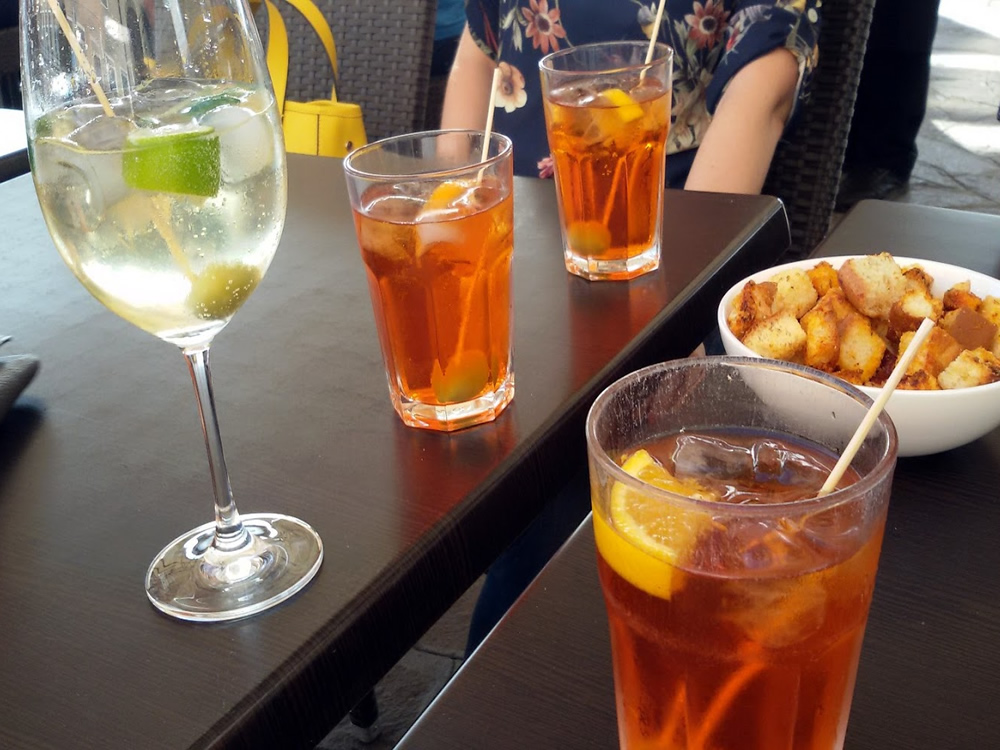
Prosecco from the Conegliano-Valdobbiadene zone, the delicately sparkling wine that has become Venice’s unofficial aperitivo, is served by the glass (a spritz — Prosecco with Aperol or Select and a splash of soda — is the definitive Venetian afternoon drink).
Soave from the Verona hills, is the great white wine of the Veneto — dry, mineral and slightly almond-scented, it is the classic pairing for the fish cicchetti of the Rialto.
Amarone della Valpolicella is the great red wine of the Veneto — made from dried grapes, rich and powerful, it appears on the bacaro counter as a small glass (un’ombra) alongside the heavier cicchetti.
Raboso from the Piave river valley is a tannic, food-friendly red that pairs well with the more robust cicchetti and is considered by many Venetians to be the most honest and characterful wine of the local tradition.
The correct order at a bacaro is un’ombra (a small glass of wine) or a spritz, accompanied by two or three cicchetti of your choice, eaten standing at the bar. The price is typically €1–2 per cicchetto and €1.50–3 per glass of wine. A full lunch at a good bacaro near the Rialto — five or six cicchetti, two glasses of wine — will cost €12–18 per person. This is the best value food available anywhere in Venice.
The Bacari of the Rialto: Where to Go
| Name | Location | Known for |
| All’Arco | Calle dell’Arco, San Polo | Considered by many the finest cicchetti bar in Venice; exceptional quality, serious wine list, standing room only |
| Do Mori | Calle dei Do Mori, San Polo | The oldest bacaro in Venice — records suggest it has been operating since 1462. Atmospheric, authentic, excellent francoboli (crustless sandwiches) |
| Cantina Do Spade | Calle delle Do Spade, San Polo | Traditional bacaro with a strong wine focus; one of the most complete selections of Veneto wines by the glass in the area |
| Bancogiro | Campo San Giacometto | Slightly more upscale than the traditional bacari; exceptional views over the Grand Canal from the outdoor tables; excellent baccalà |
| Osteria al Ponte | Near the Rialto Bridge | Neighbourhood institution; very good polpette and a loyal local clientele; arrive early for the best choice of cicchetti |
| Naranzaria | Campo San Giacometto | Contemporary interpretation of the bacaro tradition; good wine list and creative cicchetti; tables overlooking the Grand Canal |
| The cardinal rule of eating at a Rialto bacaro: arrive early. The best cicchetti are made fresh in the morning and are gone by noon. By 1pm, the choice is reduced and the quality can suffer. The ideal time for a Rialto cicchetti experience is between 10:30am and 12:30pm. |
The Seasonal Calendar: What the Rialto Market Reveals About Time
One of the most important things the Rialto Market communicates — to those who know how to read it — is the time of year. The market does not pretend that strawberries exist in February or that artichokes are available in August. It sells what is available, what is seasonal and what has come from the lagoon and the mainland hinterland within the past 24 hours. For this reason, the market is one of the finest available guides to what to eat in Venice at any given moment.
| Season | What’s at the Market |
| Spring (Mar–Jun) | Moeche (soft-shell crab, brief season in April); artichokes from Sant’Erasmo; white asparagus from Bassano; fresh peas; early-season clams and sea bass; wild herbs and spring greens from the lagoon islands |
| Summer (Jul–Aug) | Zucchini flowers; red prawns (gamberetti); seppie (cuttlefish); eggplant and peppers from the mainland; fresh figs; peaches and nectarines; the first grapes of the season |
| Autumn (Sep–Nov) | Second moeche season (October); radicchio di Treviso (from October); mushrooms from the Dolomites; spider crab (granceola); lagoon mullet (muggine); chestnuts; quince and late-season figs |
| Winter (Dec–Feb) | Scallops and oysters; salt cod (baccalà) season; cuttlefish ink at its richest; cavolo nero and winter greens; blood oranges from Sicily; Treviso radicchio at its finest; soups and braised dishes dominate the bacaro menus |
| The Rialto Market is a living calendar of the Veneto year — more reliable and more honest than any guidebook. If you want to know what Venice is eating this week, the answer is on the tables of the pescheria and the erberia. |
Business and Faith in Rialto: The Venice Guide and Boat Tour
The Business and Faith in Rialto tour is Venice Guide and Boat’s dedicated exploration of the Rialto area — covering not just the market itself but the full historical, commercial, architectural and culinary dimensions of this extraordinary district.
The tour is led by a qualified local guide with specialist knowledge of the history of the Venetian Republic’s commercial system and the role of the Rialto within it. It moves through the market in the early morning — when the pescheria and erberia are at their most active — explaining what is being sold, where it comes from and what it tells us about the relationship between Venice and its lagoon. It then explores the surrounding streets and churches — San Giacometto, San Giovanni Elemosinario, the Scuola Grande di San Giovanni Evangelista — connecting the commercial history of the Rialto to its religious and artistic dimensions.
The tour includes a cicchetti and wine tasting at one of the area’s most authentic bacari — an experience that is both convivial and genuinely informative about the Venetian food tradition. The guide explains the wine, identifies the cicchetti, explains their origins and places them in the context of the broader culinary culture of the Veneto.
What the tour covers
- Early morning visit to the pescheria (fish market) and erberia (vegetable market) with expert explanation of what is on sale and why
- The history of the Rialto as the commercial heart of the Venetian Republic — the first bank, the first newspaper, the financial instruments that funded the most powerful trading state in medieval Europe
- The Rialto Bridge — its history, its architecture and its place in the story of the Grand Canal
- The church of San Giacomo di Rialto — the oldest church in Venice, and the one most directly connected to the commercial life of the market
- San Giovanni Elemosinario and the Titian altarpiece — one of the great undervisited paintings in Venice
- A cicchetti and wine tasting at an authentic Rialto bacaro — with expert guidance on what to eat, what to drink and how to order
- The social world of the Rialto — how the market functions today, who uses it and how it connects the city to its lagoon and its mainland hinterland
| The Business and Faith in Rialto tour is one of Venice Guide and Boat’s most distinctive experiences — combining genuine historical depth with the most authentic food and wine experience available anywhere in the city. It is private, led by a qualified local guide, and timed for the early morning when the market is at its most alive. |
Practical Information for a Rialto Market Visit
When to go
The Rialto Market operates Tuesday through Saturday, from approximately 7am to 1pm. The pescheria closes first, typically by 12pm; the erberia stays open a little later. Sunday and Monday the market is closed. The best time to visit is between 7:30am and 10am — when the market is fully operational, the produce is at its freshest and the professional buyers are still working alongside the casual visitors. After 11am, the market thins and the remaining produce is of lower quality.
How to get there
The Rialto is accessible from almost every part of Venice. From St Mark’s Square, follow the signs towards Rialto along the Mercerie — approximately 10 minutes on foot. From the train station, follow the signs towards Rialto along the Strada Nova — approximately 20 minutes on foot, or take the vaporetto (Line 1 or 2) to the Rialto Mercato stop on the San Polo side of the canal (not the Rialto stop on the San Marco side, which deposits you on the wrong bank).
What to bring
A reusable bag if you plan to buy produce. Cash — many of the market vendors and bacari do not accept card payments, and the ATMs near the Rialto can have queues. A camera — the pescheria in the morning light is one of the most photographable places in Venice. An appetite.
What to buy
If you have access to a kitchen, the market is an extraordinary source of fresh ingredients — the fish in particular are of a quality rarely available outside Italy. For visitors without cooking facilities, the bacari adjacent to the market offer the best use of what the pescheria produces: the baccalà mantecato, the folpetti, the seppie in nero, the moeche in season. Edible souvenirs include the bussolai biscuits from Burano (sold in several shops near the Rialto), local honey from the lagoon islands, and Venetian polenta flour.
Frequently Asked Questions
Is the Rialto Market open every day?
No. The Rialto Market operates Tuesday through Saturday, from approximately 7am to 1pm. The fish market (pescheria) and the fruit and vegetable market (erberia) both follow this schedule. Sunday and Monday the market is closed entirely. If your visit to Venice falls on a Sunday or Monday and you want a market experience, the Sant’Erasmo island market (small, local, seasonal) or the Strada Nova food shops are the alternatives.
Is the Rialto Market a tourist attraction or a real market?
Both — but primarily the latter. The Rialto Market is a functioning commercial market that supplies Venice’s restaurants and residents. The fishmongers and vegetable vendors are selling to professional restaurant buyers and local households; the tourists who visit are a secondary audience. This dual character is part of what makes it so interesting — and it means that the market operates with a seriousness and quality that a purely tourist-oriented market would not maintain.
Can I eat at the Rialto Market?
Yes — and you should. The bacari immediately surrounding the market (All’Arco, Do Mori, Cantina Do Spade, Bancogiro) are among the finest eating experiences available in Venice. Cicchetti and a glass of Soave at the bar of one of these bacari, eaten standing in the company of the market workers and local residents who constitute the regular clientele, is the most authentic food experience the city offers.
What is the difference between the Rialto Market and a bacaro?
The Rialto Market (pescheria and erberia) is where the raw ingredients are sold — the fish, vegetables, fruit and herbs that go into Venetian cooking. A bacaro is a traditional Venetian wine bar that serves cicchetti — prepared small bites of food — alongside wine and other drinks. The two are intimately connected: the best bacari in the Rialto area use the morning’s market produce in their cicchetti, so there is a direct line from the pescheria table to the bacaro counter. Visiting both in the same morning — market first, then cicchetti and wine at a bacaro by 11am — is the standard local approach.
Is the Rialto Market worth visiting on a short trip to Venice?
Absolutely — and for many experienced Venice visitors, it is the single experience they recommend most strongly to first-timers. The combination of the market’s visual and sensory intensity, its extraordinary historical depth and the cicchetti experience at the adjacent bacari constitutes a morning that reveals Venice in a way that the major monuments, for all their magnificence, cannot. If you have only one day in Venice, the Rialto Market between 8am and 11am is the finest possible start.
The Market That Made Venice
The Rialto Market is not a museum exhibit, a tourist attraction or a heritage experience. It is the descendant of the market that built the most powerful commercial state in medieval Europe — the place where Venetian merchants developed the financial instruments, the trading networks and the commercial culture that made the Serenissima the dominant force in Mediterranean trade for four centuries.
That history is invisible if you approach the market purely as a picturesque backdrop for photographs of fish. It becomes vivid — and genuinely illuminating — if you approach it as what it actually is: the surviving heartbeat of a commercial tradition that transformed European history, still operating on the same ground, in essentially the same form, that it has maintained for a thousand years.
That is what the Business and Faith in Rialto tour is designed to communicate: not just the colour and smell and vitality of the market as a sensory experience, but the extraordinary depth of human history that underlies it. The bacaro, the bridge, the church, the cicchetti, the morning catch from the lagoon — all of it connected, all of it part of the same story that has been unfolding on this spot since Venice was barely more than a mudflat with ambitions.
| Ready to experience the most authentic morning in Venice? Join the Business and Faith in Rialto tour — a private, expert-led exploration of the market, the history, the churches and the cicchetti that define this extraordinary district. |

