Venice Guide and Boat
Madonna della Salute: Venice’s Festival of Thanks
Every year on 21 November, Venetians cross the Grand Canal on a bridge of boats, carry a candle to a Baroque basilica and, by tradition, sit down to a bowl of castradina. It is the Festa della Madonna della Salute — one of the city’s most heartfelt celebrations, and one with very little of the show about it.
The story begins in 1630, when plague struck Venice. According to the Comune di Venezia, Doge Nicolò Contarini and Patriarch Giovanni Tiepolo organised a procession of prayer lasting three days and three nights, gathering the surviving citizens, and made a solemn vow to the Virgin: if the city survived, they would build a church in her honour. The Comune places the doge’s vow in St Mark’s Basilica on 28 October 1630. Within weeks, the contagion declined until it stopped altogether.
The vow was kept. Work began in 1631 — the first stone was laid on 1 April — and the basilica was consecrated on 9 November 1687 by Patriarch Alvise Sagredo. The festival is a sister to the Festa del Redentore, which also grew out of a plague epidemic, and for more than three centuries the pilgrimage has been renewed each 21 November.
What happens in the city
- The votive bridge. A temporary floating bridge is built across the Grand Canal, linking the riva of Santa Maria del Giglio, in San Marco, with the riva of San Gregorio, beside the basilica in Dorsoduro. On this day it takes the place of the usual gondola ferry. Recent editions have had a wide central opening for public boats and emergency vessels, and tilting ramps that allow crossing at any tide.
- The pilgrimage and the candle. Many Venetians cross slowly on foot with family or close friends, carrying a candle to the Madonna to pray for protection for themselves and their loved ones. The Patriarchate reports that, on average, around 90,000 pilgrims reach the basilica in the days around 21 November; a solemn Mass presided over by the Patriarch is the heart of the day, and a pilgrimage of young people led by the Patriarch takes place on the eve.
- A votive water procession. In recent years a procession on the Grand Canal has carried a large candle to the steps of the basilica, renewing the meaning of the 1630 vow.
- Stalls and sweets. The line of pilgrims passes stalls selling sweets, coloured balloons and toys — the festival’s lighter side, and part of why the Comune describes it as a mix of the sacred and the profane.
- Castradina. On 21 November Venetians traditionally eat castradina, a rich soup of smoked mutton leg with cabbage and onions. The Comune’s tourism pages link the custom to the Dalmatians, who supplied mutton to a Venice isolated by the plague.
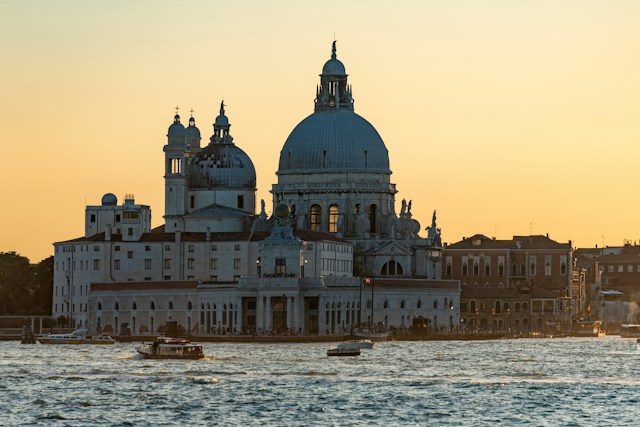
Santa Maria della Salute stands at the mouth of the Grand Canal, reached by a grand flight of steps, and its dome has shaped the view of the Bacino di San Marco for more than three centuries. The Serenissima entrusted the project to the young Baldassare Longhena, who also built Ca’ Pesaro; he did not live to see the basilica finished. His design answered the Republic’s demand for grandeur — a church that would exalt the Virgin and, at the same time, the Republic itself.
The result is a landmark of Venetian Baroque: a centrally planned temple beneath a monumental dome, whose great volutes act as buttresses. There are in fact two domes. The larger was conceived as the Crown of the Rosary and is topped by a statue of the Virgin holding the baton of a “Capitana da mar”; the smaller serves as the true sanctuary. Statues celebrating Mary decorate the façade and flanks.
Inside, the space is vast and bright: a central octagonal area surrounded by six chapels. The high altar is crowned by a marble group by Giusto Le Court, the Flemish sculptor who came to Venice from Amsterdam in 1655 — the Virgin and Child on a mass of clouds, an angel with a torch driving away the plague, and a woman representing Venice kneeling in supplication. At the altar’s centre is the Greek-Byzantine icon of the Madonna Mesopanditissa, brought from Candia and placed there in November 1670, venerated by pilgrims ever since. The main sacristy, run as a museum, holds works by Titian and Tintoretto’s *Wedding at Cana*, signed in 1561 and painted for the refectory of the Crociferi monastery.
A different Venice
The Salute is the festival Venetians keep for themselves: a procession across the water, a candle, a bowl of soup and a thank-you that has been repeated since 1630. If you would like to see the basilica from the water, or to talk through a visit around the festival, get in touch with Venice Guide and Boat.
Foto di Claudio Schwarz su Unsplash

