Venice Guide and Boat
Palladian Villas and Wine: The Perfect Day Trip from Venice into the Veneto
Venice is, by almost any measure, one of the great cities of the world. But it is also a city of 7.5 square kilometres, built on islands, surrounded entirely by water. Its hinterland — the broad, fertile plain of the Veneto stretching westward and northward from the lagoon to the Dolomites — is not part of Venice in any administrative sense. Yet it is, in a very real sense, part of the Venetian world: the source of the agricultural wealth that sustained the Republic, the location of the country retreats built by the Venetian nobility, and the home of the wine tradition that has been central to Venetian life and commerce for centuries.
The Palladian villas of the Veneto are the most visible expression of this relationship. Between approximately 1540 and 1580, the architect Andrea Palladio designed a series of country houses for the Venetian patrician families who were investing the profits of their Mediterranean trade in the mainland — consolidating land, establishing vineyards and grain farms, and building villas that functioned simultaneously as working farm centres and as expressions of extraordinary architectural ambition. The result is one of the greatest concentrations of Renaissance architecture in existence — a UNESCO World Heritage Site that stretches from the outskirts of Vicenza to the hills of the Euganean and Berici ranges, and that constitutes the single most direct link between Renaissance Italy and the architecture of the English-speaking world.
The Veneto wine country that surrounds these villas is no less remarkable. The Prosecco hills of Conegliano and Valdobbiadene — also a UNESCO World Heritage Site — produce the sparkling wine that has become the aperitivo of choice across the world. The Soave zone east of Verona makes one of Italy’s great white wines. The Valpolicella hills north of Verona are the home of Amarone, one of the most powerful and distinctive red wines in Italy. The rolling hills of the Berici — where several of Palladio’s finest villas are located — produce wines of remarkable character from indigenous Veneto varieties.
The Palladian Villas and Wine tour, offered by Venice Guide and Boat as a private day trip from Venice, combines these two extraordinary dimensions of the Veneto in a single, carefully designed itinerary. This guide explains what you will see, why it matters and what makes this day trip one of the most rewarding available from Venice.
Andrea Palladio: The Architect Who Changed the World
Andrea Palladio was born in Padua in 1508 and died in Vicenza in 1580. In the forty years of his productive career, he designed a sequence of buildings — villas, palaces, churches and civic structures — that constitute one of the most coherent and influential bodies of architectural work in Western history. He was not the most prolific architect of the Italian Renaissance, nor the most technically innovative. But he was, arguably, the most consequential: the architect whose ideas, transmitted through his illustrated treatise I Quattro Libri dell’Architettura (The Four Books of Architecture, 1570), shaped the course of Western building for the next three centuries.
Palladio’s work was grounded in a deep study of Roman antiquity — he was one of the first architects to make systematic measurements of surviving Roman buildings, and his reconstruction drawings of the ancient structures he studied formed the basis of his own design vocabulary. What he took from antiquity was not a set of forms to be imitated literally, but a set of principles — proportion, symmetry, the relationship between parts and whole, the integration of building with landscape — that he applied with extraordinary intelligence and sensitivity to the problems of 16th-century Venetian clients.
The villas he designed for the Venetian nobility were unlike anything that had been built before. They combined the classical temple front — the portico with its pediment and columns — with a practical country house plan that integrated living quarters, farm buildings and landscape into a single, coherent composition. The effect, seen for the first time by a 16th-century visitor riding through the Veneto countryside, must have been extraordinary: a classical temple, apparently transplanted from ancient Rome, standing in the middle of a working farm among fields of wheat and vines.
| Palladio’s influence extends far beyond Italy. The White House in Washington D.C., Monticello (Thomas Jefferson’s home in Virginia), Chiswick House in London, and hundreds of country houses across Britain and North America are all direct descendants of the Palladian villa tradition. When you visit a Palladian villa in the Veneto, you are visiting the source of an architectural tradition that has shaped the built environment of the English-speaking world for three centuries. |
Palladio’s influence: a global legacy
| Building / Country | Palladian Influence |
| Monticello, Virginia (USA) | Thomas Jefferson designed his home explicitly following Palladio’s Villa Rotonda; Jefferson owned a copy of I Quattro Libri and called Palladio ‘the Bible of architecture’ |
| The White House, Washington D.C. | The south portico of the White House is directly modelled on Palladian villa porticos; Palladianism was the dominant architectural style of American federal buildings |
| Chiswick House, London (UK) | Lord Burlington’s 1729 villa is a near-direct copy of the Villa Rotonda, bringing Palladianism to England and launching the English Palladian movement |
| Stourhead, Wiltshire (UK) | One of hundreds of English country houses in the Palladian tradition, inspired by the villas Burlington and other Grand Tour travellers had seen in the Veneto |
| Kedleston Hall, Derbyshire (UK) | Robert Adam’s masterpiece draws directly on Palladian principles of proportion, symmetry and the integration of building with landscape |
| Villa Capra (La Rotonda), Vicenza | Palladio’s own masterwork — the source from which Jefferson, Burlington and virtually the entire Anglo-American Palladian tradition drew their inspiration |
The Essential Palladian Villas of the Veneto
Palladio designed more than two dozen villas in the Veneto, of which approximately twenty survive in some form. The following are the most architecturally significant and most accessible for visitors on a day trip from Venice.
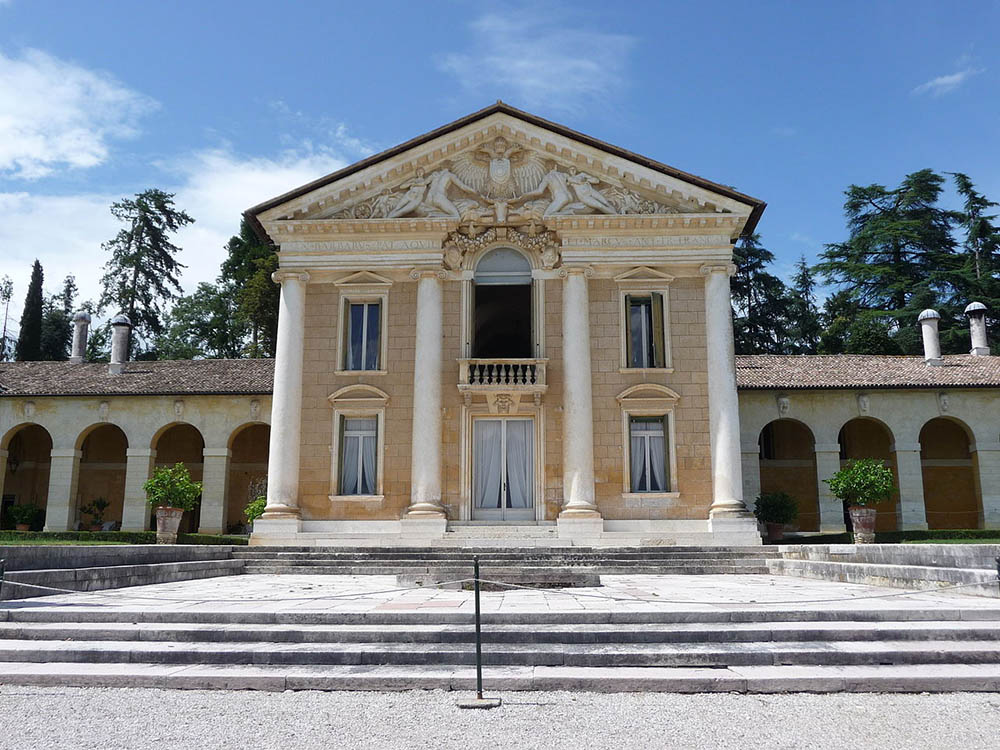
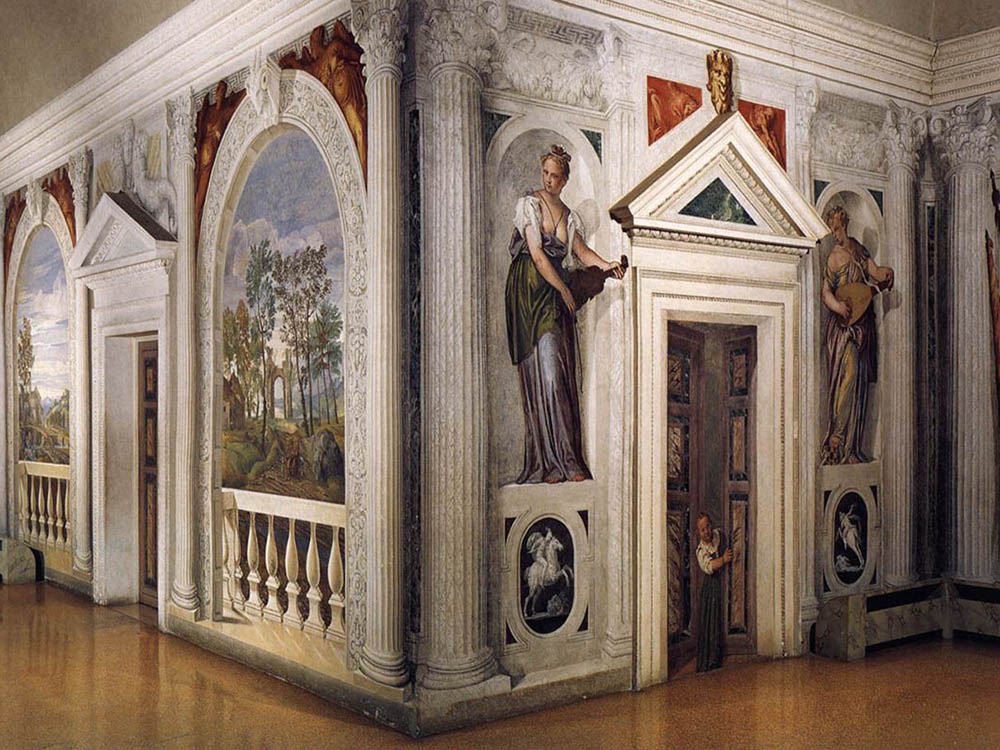
| Villa Capra — La Rotonda Near Vicenzac. 1566–1571 Palladio’s most famous villa and the most influential house in the history of Western architecture. A perfectly symmetrical cube surmounted by a dome, with four identical temple-front porticos facing the four compass points. The source from which Jefferson, Burlington and the entire Anglo-American Palladian tradition derived their inspiration. | Villa Barbaro Maser, Treviso hillsc. 1554–1560 The finest surviving interior of any Palladian villa, decorated by Paolo Veronese with trompe-l’oeil frescoes of extraordinary quality — painted landscapes, figures at balconies, dogs and children peering around painted doors. The combination of Palladio’s architecture and Veronese’s painting represents the highest point of 16th-century Venetian culture. |
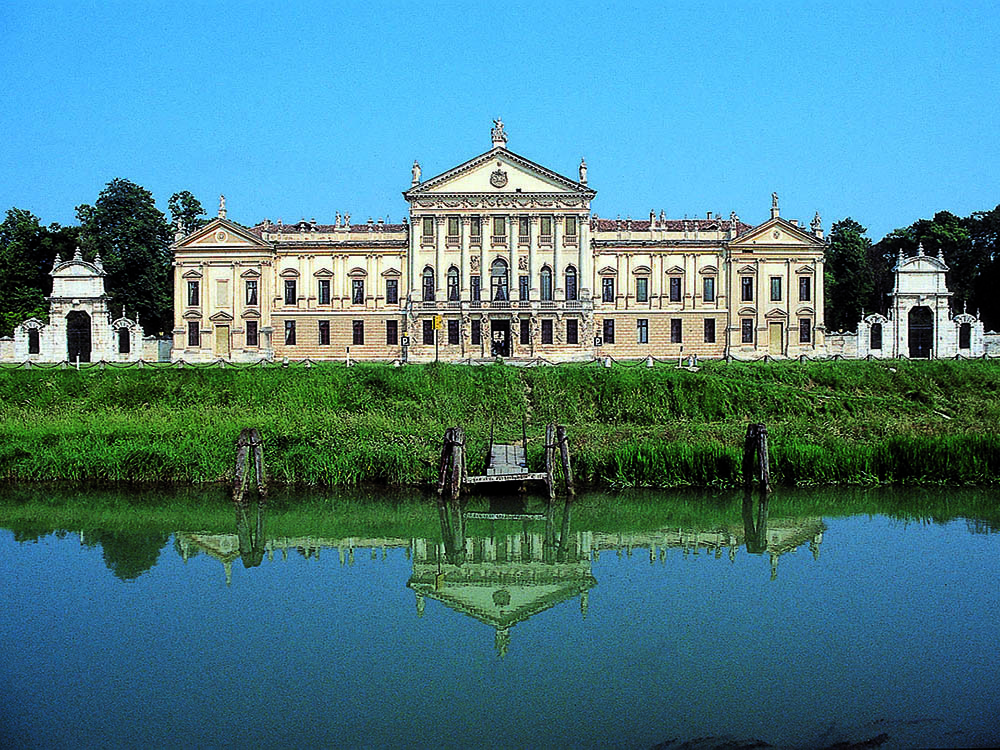
| Villa Emo Fanzolo di Vedelago, Trevisoc. 1559 One of the finest examples of Palladio’s working villa concept — a long, low composition of central block and flanking barchesse (farm wings) that demonstrates how Palladio integrated the aristocratic residence with the agricultural enterprise. Frescoes by Giambattista Zelotti in the central block. Still owned by the Emo family. | Villa Foscari — La Malcontenta Mira, Brenta Rivierac. 1559 The most dramatically sited of all Palladian villas — positioned directly on the Brenta canal, with a great Ionic portico rising above the water that confronted Venetian patricians arriving by boat from the city. Frescoes by Battista Franco and Giambattista Zelotti. The name La Malcontenta (the discontented woman) derives from a legend about a noblewomen confined here by her husband. |
| Villa Pisani Stra, Brenta Riviera18th century (post-Palladio) The largest villa on the Brenta Riviera — 114 rooms, a celebrated hedge maze, extensive grounds. Not a Palladio design, but a magnificent example of the Baroque expansion of the Palladian villa tradition, owned successively by the Pisani family, Napoleon, Beauharnais, and the Italian royal family. | Villa Pojana Pojana Maggiore, Vicenza hillsc. 1549 One of Palladio’s most unusual designs — a stripped, almost archaic-looking facade that dispenses with the conventional column order and creates a powerful sense of geometric abstraction that anticipates later architectural developments. Often cited as Palladio’s most experimental villa. |
The Brenta Riviera: Venice’s Country Road
One of the most distinctive features of the Venetian mainland relationship is the Brenta Riviera — the stretch of the Brenta canal that runs from Padua to the lagoon, lined on both sides with the villas built by the Venetian nobility as summer retreats from the heat and intensity of the city. By the 17th and 18th centuries, the Brenta Riviera had become the social circuit of the Venetian aristocracy: the summer months were spent moving between villas, attending receptions and concerts and theatrical performances, and conducting the complex social business of the Venetian patriciate in an atmosphere of relative informality and rural pleasure.
Goldoni wrote plays about it. Casanova visited repeatedly. The Doge himself maintained a villa on the Riviera. Byron rented one during his years in Italy. The procession of boats and carriages that moved up and down the Brenta during the summer season was one of the great spectacles of 18th-century Italy.
Several of the finest Palladian and post-Palladian villas are located on or near the Brenta — the Villa Foscari (La Malcontenta), the Villa Pisani at Stra, the Villa Widmann and others — and the approach to them by water, as the Venetian nobility made it, remains one of the most evocative ways to experience them. The Venice Guide and Boat tour can incorporate a section of the Brenta approach, connecting the lagoon world of Venice directly to its mainland counterpart.
| The Brenta Riviera is the physical expression of the relationship between Venice and its mainland empire. The Venetians who built their villas here were not escaping the city — they were extending it, bringing the values and aesthetics of the Serenissima into the countryside and making the Veneto plain an expression of Venetian civilisation as much as the Grand Canal itself. |
The Wines of the Veneto: A Guide for the Serious Visitor
The Veneto is Italy’s most prolific wine region by volume — and one of its most diverse in terms of style and quality. Understanding the landscape of Veneto wine is essential for making the most of any visit to the region, and for appreciating why the Palladian Villas and Wine tour pairs these two subjects so naturally.
The connection between the villas and the wine is not merely geographical. The Venetian patricians who built the Palladian villas were, in many cases, establishing agricultural estates that included substantial vineyard operations. Wine was part of the economic rationale for the mainland investment — a commodity that could be produced on the fertile Veneto plain and sold in Venice and beyond. The cellars beneath many of the surviving villas still hold wines from their own estates, and some of the finest wine producers in the Veneto are located on or near the grounds of Palladian villas.
| Wine | Zone | Style | Best With |
| Prosecco DOCG | Conegliano-Valdobbiadene (Treviso hills) | Sparkling, delicate, apple and peach notes | Aperitivo, cicchetti, light starters |
| Soave Classico DOC | Classico zone, Verona hills | Dry white, mineral, almonds, volcanic soil character | Fish, seafood, risotto al radicchio |
| Amarone della Valpolicella DOCG | Valpolicella hills, Verona | Powerful dry red from dried grapes; rich, long | Game, aged cheeses, braised meats |
| Valpolicella Ripasso DOC | Valpolicella hills, Verona | Medium-bodied red, cherry and spice; elegant | Pasta al ragù, grilled meats |
| Bardolino DOC | Lake Garda eastern shore | Light, fresh red; easy drinking; fruit-forward | Charcuterie, lake fish, pizza |
| Gambellara DOC | Vicenza hills (near Palladian villas) | Dry white from Garganega; mineral, floral | Appetisers, white fish, fresh cheeses |
| Breganze DOC | Vicenza hills, near Marostica | Various styles; excellent Torcolato dessert wine | Versatile; Torcolato with pastries |
| Colli Euganei DOC | Euganean Hills, Padua province | Red and white; volcanic soils; underrated quality | Grilled meats, local cheeses, mushrooms |
The Prosecco Hills: A UNESCO World Heritage Landscape
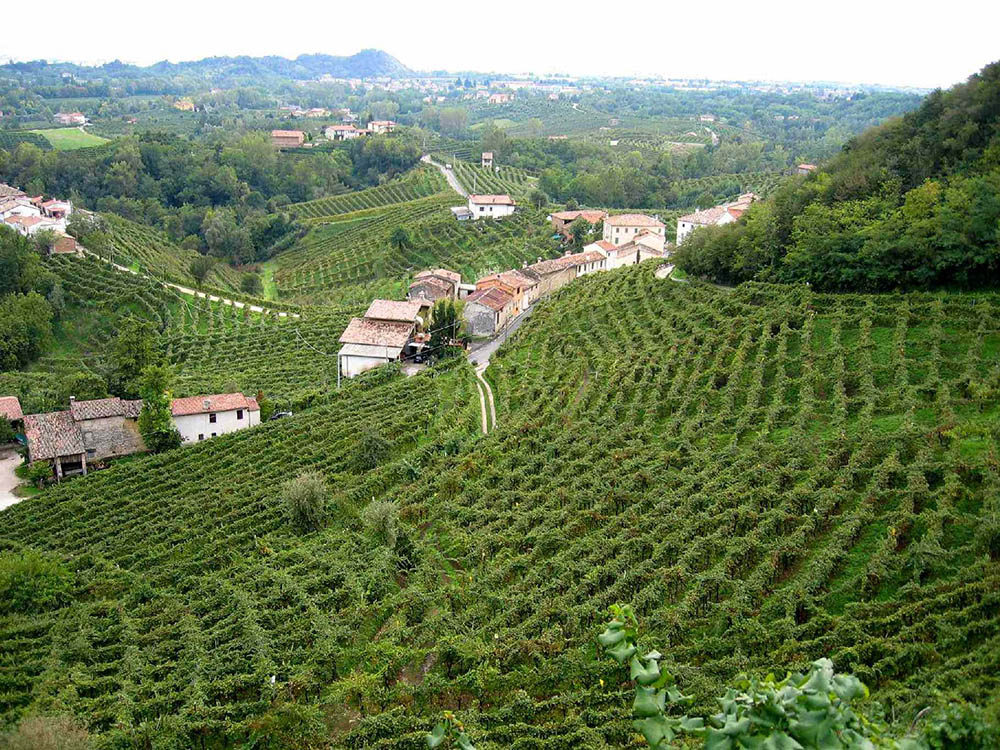
The Prosecco DOCG zone of Conegliano Valdobbiadene — the area of steep, south-facing hillsides in the Treviso province, north of Venice — was inscribed as a UNESCO World Heritage cultural landscape in 2019, recognising the extraordinary relationship between the landscape, the viticulture and the human culture that has shaped this corner of the Veneto over centuries. The Glera grape variety that produces Prosecco is grown on terraced hillsides of remarkable steepness — some approaching 35–40 degrees — using a system of viticulture that is classified as a heroic form of farming, requiring almost entirely manual labour.
The wines produced here are not merely the commercial Prosecco familiar from supermarket shelves. The Prosecco Superiore di Cartizze — grown on a specific 107-hectare subzone of extraordinary terroir, considered the grand cru of the DOCG — is one of Italy’s finest sparkling wines: delicate, complex and distinctively mineral, with none of the generic sweetness of mass-market Prosecco. A visit to a producer in the Conegliano-Valdobbiadene zone, with a tasting of Superiore and Cartizze alongside the standard DOCG, is one of the most illuminating wine experiences available in northern Italy.
Soave: Italy’s Most Misunderstood Great White Wine
Soave has suffered for decades from the damage done to its reputation by the industrial production of the 1970s and 1980s, when large cooperative wineries flooded the market with dilute, characterless wine that bore little resemblance to the traditional Soave of the hillside Classico zone. The recovery, led by a group of quality-conscious producers working the volcanic basalt soils of the Classico zone, has been remarkable — and the finest Soave Classico made today is one of the great white wines of Italy: dry, mineral, with a characteristic bitteralmond finish and an ageing potential that surprises even experienced tasters.
The Garganega grape variety — which constitutes the majority of any Soave blend — is one of Italy’s great indigenous white varieties, capable of producing wines of real complexity and character when grown on the right soils and vinified with care. A tasting of serious Soave Classico, in a cellar in the hills east of Verona, is an experience that challenges the assumptions of anyone who has only encountered the commodity version.
Amarone: The Great Red Wine of the Veneto
Amarone della Valpolicella is made by a unique process — the appassimento — in which harvested grapes are dried on bamboo racks for approximately three months before pressing, concentrating their sugars, flavours and aromas to a degree impossible to achieve with fresh grapes. The resulting wine is extraordinarily rich and powerful (typically 15–17% alcohol), with a flavour profile of dried fruits, dark chocolate, tobacco and spice, and an ageing potential of decades. It is one of the most distinctive red wines in the world and one of the most direct expressions of the Veneto’s relationship with its indigenous grape varieties.
The Valpolicella hills north of Verona, where Amarone is produced, are among the most beautiful wine landscapes in Italy — steep, terraced hillsides covered in the ancient pergola Veronese vine training that gives the landscape its distinctive character. A visit to a Valpolicella producer, with a tasting of Amarone alongside the lighter Valpolicella and the Ripasso, is an essential part of any serious engagement with Veneto wine.
The Palladian Villas and Wine Tour: What to Expect
The Venice Guide and Boat Palladian Villas and Wine tour is a private full-day excursion from Venice into the Veneto countryside, combining visits to one or more Palladian villas with a wine tasting at one or more carefully selected producers. The itinerary is designed to make the most of a single day away from Venice — covering the architectural and historical dimension of the Palladian villas in the morning, and the wine dimension in the afternoon, with a lunch in between that reflects the local gastronomic tradition.
All tours are private — your group, your guide, your vehicle — and the itinerary is adjusted according to the specific interests of the group. Visitors with a primary interest in architecture can spend more time at the villas; those whose priority is wine can extend the cellar visit and tasting. The guide has specialist knowledge of both subjects and can provide the depth of commentary appropriate to the group’s interests.
Sample full-day itinerary
| 9:00 AM | Departure from Venice by private vehicle. The guide introduces the history of the Venetian mainland empire and the context of the Palladian villas during the drive. |
| 10:00 AM | Arrival at the first villa — typically Villa Barbaro at Maser or Villa Emo, depending on the chosen itinerary. Expert-guided visit including the Veronese frescoes (Maser) or the Zelotti cycle (Emo). Allow 75–90 minutes. |
| 11:45 AM | Drive through the Veneto countryside towards the wine zone — Prosecco hills, Soave, or Valpolicella depending on the route. The guide explains the agricultural landscape and its relationship to the villa economy. |
| 12:30 PM | Lunch at a local osteria or agriturismo — a working farm that produces and serves its own food and wine. Veneto cuisine: risotto, bigoli in salsa, grilled meats, local cheeses. Wines from the estate. |
| 2:00 PM | Visit to a selected wine producer — cellar tour with explanation of the winemaking process and the local terroir, followed by a structured tasting of three to five wines. Allow 90 minutes. |
| 3:45 PM | Optional: visit to a second villa or a brief stop in a historic Veneto town — Vicenza (for the Basilica Palladiana and the Teatro Olimpico), Asolo or Marostica. |
| 5:30 PM | Departure for Venice. The drive back across the plain offers a final perspective on the relationship between the lagoon city and its mainland hinterland. |
| 6:30 PM | Arrival back in Venice. Evening free for dinner — your guide can recommend restaurants that continue the Veneto wine theme. |
| The Palladian Villas and Wine tour is available in several configurations depending on the group’s priorities — a villa-focused morning with a single winery visit in the afternoon, a wine-focused route through the Prosecco hills or Valpolicella with a villa visit en route, or a comprehensive full day combining two villas and two producers. Contact Venice Guide and Boat to discuss the itinerary that best fits your interests and available time. |
Vicenza: Palladio’s City
Any complete engagement with Palladio’s legacy must include Vicenza — the city in which he spent most of his career and which contains the greatest concentration of his buildings. Vicenza was inscribed as a UNESCO World Heritage Site in 1994 specifically for its Palladian buildings, and the historic centre is effectively a Palladian architectural museum that you can walk through.
The Basilica Palladiana — Palladio’s reconstruction of the city’s medieval law courts, begun in 1549 — is the building that established his reputation and won him the patronage of the Venetian and mainland nobility. The great loggia of white Vicenza stone, with its extraordinary two-storey arcade, is one of the most accomplished pieces of civic architecture in Italy. The Palazzo Chiericati, directly opposite, houses the city’s art gallery and is one of Palladio’s finest surviving secular buildings. The Palazzo della Ragione, the Palazzo Barbarano, the Palazzo Valmarana — the sequence of palaces along the Corso Palladio is a masterclass in the application of classical principles to urban residential architecture.
But the greatest of all Palladio’s Vicenza buildings is the Teatro Olimpico — the last work he designed before his death in 1580, completed by Vincenzo Scamozzi in 1585, and the oldest surviving enclosed Renaissance theatre in the world. The theatre’s extraordinary stage set — a permanent, elaborately painted perspective scene representing the city of Thebes, designed by Scamozzi in 1585 and never altered — creates an illusion of deep urban space that is one of the most theatrical and intellectually dazzling spaces in Italian architecture. It is also remarkably intimate, seating only five hundred people, and the experience of sitting in it — in the steeply raked wooden seats, looking at the perspective stage — is genuinely unlike any other architectural experience in Italy.
| Palladio died in 1580 having seen his Teatro Olimpico framed but not completed. He had spent forty years building for the Venetian nobility and the citizens of Vicenza — transforming both the landscape and the architectural culture of the Veneto, and leaving a legacy that would reshape the built environment of Europe and North America for the next three centuries. A visit to Vicenza is a visit to the point at which all of that began. |
Food of the Veneto: What to Eat on a Day Trip from Venice
The Veneto is one of Italy’s finest gastronomic regions — and its food culture is significantly different from the seafood-dominated cuisine of Venice itself. The mainland Veneto produces extraordinary raw ingredients: the white asparagus of Bassano del Grappa, the radicchio of Treviso and Castelfranco, the Monte Veronese cheese of the Lessinia plateau, the Sopressa salami of Vicenza, the mushrooms of the Dolomitic foothills and the game of the Berici hills.
What to eat in the Veneto countryside
- Bigoli in salsa — thick, wholegrain spaghetti in a sauce of anchovies and onions, slowly cooked until the anchovies dissolve into a deep, savoury paste. One of the great pasta dishes of the Veneto tradition.
- Risotto all’Amarone — risotto made with Amarone wine, beef marrow and aged Grana Padano. Rich, deeply flavoured, and a direct expression of the wine tradition of the Valpolicella hills.
- Baccalà alla vicentina — the Vicenza interpretation of salt cod, braised very slowly in milk with onions, anchovies and Grana Padano cheese until it reaches a creamy, intensely flavoured consistency. Served on polenta. The quintessential dish of the Vicenza territory.
- Pearà — a sauce of stale bread, bone marrow and Grana Padano, slowly cooked with meat stock, traditionally served with bollito misto (mixed boiled meats). A medieval recipe that has survived unchanged in the Veronese tradition.
- Soppressa Vicentina — a coarse, lightly spiced cured pork sausage from the Vicenza hills, aged for several months and served sliced on bread or with polenta. One of the finest salumi of northern Italy.
- Monte Veronese — a semi-hard cow’s milk cheese from the Lessinia plateau above Verona, aged to produce a pleasantly bitter, nutty flavour that pairs superbly with Amarone and Valpolicella.
- Torta Sabbiosa — ‘sandy cake’, a simple, crumbly Venetian shortcake made with potato starch that gives it its characteristic texture. Served with a glass of Torcolato dessert wine from Breganze.
| The food of the Veneto countryside and the wines of the Veneto are not merely compatible — they are interdependent. The baccalà alla vicentina exists to be eaten with Soave Classico. The risotto all’Amarone exists to be drunk with the wine from which it is made. The bigoli in salsa exists to be followed by a glass of Valpolicella. Understanding this relationship — tasting it, rather than reading about it — is one of the defining experiences of a day trip into the Veneto. |
Frequently Asked Questions
How far is the Veneto countryside from Venice?
The Veneto mainland begins immediately west of Venice — the first Palladian villas on the Brenta Riviera are less than 30 minutes’ drive from the city centre. The Vicenza area, where the greatest concentration of Palladian villas is located, is approximately one hour from Venice. The Prosecco hills of Conegliano-Valdobbiadene are approximately one hour to the north. The Valpolicella and Soave zones are approximately 90 minutes to the west (towards Verona). All are accessible as full-day trips from Venice.
Can I visit Palladian villas independently?
Yes — most of the major Palladian villas are open to the public on scheduled days and times. However, visiting them independently, without expert guidance, means engaging with extraordinary buildings without the historical, architectural and cultural context that makes them comprehensible. Palladio’s genius is not always immediately legible to the uninitiated: the proportional system, the relationship between the central block and the barchesse, the integration with the landscape, the iconographic programme of the interior frescoes — all of these require explanation to be fully appreciated. A private guided tour transforms the experience from an aesthetic encounter into a genuine understanding.
Which villa is the most important to visit?
For architecture alone, the Villa Capra (La Rotonda) near Vicenza is the most important — it is the source from which the entire Anglo-American Palladian tradition derived its inspiration, and it is one of the most complete expressions of Palladian design principles in existence. For the combination of architecture and painting, Villa Barbaro at Maser is unparalleled — the Veronese frescoes make it one of the greatest combined artistic achievements of 16th-century Italy. For the working villa concept, Villa Emo at Fanzolo represents the most complete surviving example of Palladio’s integration of residence and farm.
Which wine region is best to visit from Venice?
The answer depends on what you want to taste. For Prosecco and the UNESCO wine landscape, the Conegliano-Valdobbiadene hills (north of Treviso) are the most scenic and accessible. For Italy’s greatest dry white wine, the Soave Classico zone east of Verona is the destination. For Amarone and the power of Valpolicella, the hills north of Verona are the choice. The Palladian Villas and Wine tour can be designed around any of these zones, or can combine elements of two for a broader tasting experience.
Is the Palladian Villas and Wine tour suitable for non-wine-drinkers?
Absolutely. The tour has two fully independent dimensions — the Palladian architecture and history component, and the wine component — and the balance between them can be adjusted according to the interests of the group. Visitors who prefer to focus on the villas can do so, with a cellar visit that emphasises the historical and cultural dimensions of Veneto wine rather than the tasting. Non-drinkers are always welcome; soft drinks and local juices are invariably available at cellars.
What is the best season for the Palladian Villas and Wine tour?
The tour is available year-round and rewarding in every season. Spring and autumn offer the finest conditions for vineyard visits — the vines are most photogenic in the bright green of May-June and the gold and russet of October harvest. Summer is excellent for the villa gardens and the long evenings. Winter offers the most intimate cellar visits, with many producers having more time to dedicate to small private groups, and the bare vines against a winter sky have their own austere beauty.
Beyond Venice: Why the Veneto Matters
The Venice that most visitors experience is a city of extraordinary density and compression — 118 islands, 400 bridges, centuries of art and history in 7.5 square kilometres. It is a world unto itself, and it is easy to leave Venice having never looked beyond the lagoon at the mainland world that created and sustained it.
But the Veneto is not Venice’s backdrop. It is Venice’s foundation — the agricultural and commercial hinterland whose wheat, wine, wool and timber sustained the city through the centuries of its maritime power, and whose landscape was transformed by the investment of Venetian wealth into one of the finest concentrations of Renaissance architecture in existence. The Palladian villas are not country retreats from the city’s intensity. They are the city’s ambition expressed in stone and fresco on a different scale, in a different landscape, by the same civilization that built the Doge’s Palace and the Basilica di San Marco.
Understanding that relationship — the relationship between the lagoon city and its mainland territory, between the marble and water of Venice and the stone and vine of the Veneto hills — is one of the richest intellectual and aesthetic experiences that the greater Venetian world offers. The Palladian Villas and Wine tour exists to make that experience accessible, in the most direct and pleasurable way possible: by taking you there.
| Book your private Palladian Villas and Wine day trip from Venice — itinerary tailored to your interests, expert local guide, flexible balance between architecture and wine. Contact Venice Guide and Boat to design the perfect day in the Veneto. |

